
Quick answer: For most non-friable asbestos jobs in Melbourne, the on-site removal itself takes between half a day and three working days — a fence is typically a single day, a standard pre-1990 house with eaves, garage and fences is one to three days, and a corrugated asbestos roof is one to two days. The full end-to-end project, however, runs longer because licensed work must be notified to WorkSafe Victoria at least five days in advance under the Occupational Health and Safety Regulations 2017 (Vic). Once you factor in the site inspection, NATA-accredited sampling, the Asbestos Removal Control Plan (ARCP), the mandatory five-day notification window, the removal itself, EPA-tracked disposal and an independent clearance certificate under Regulation 297, expect roughly 2 to 3 weeks from first enquiry to final documentation for a typical residential job. Commercial, industrial and pre-demolition projects run longer — typically 4 to 8 weeks.
If you are a Melbourne homeowner planning a renovation, a builder programming a strip-out, or a developer trying to lock in a demolition start date, this guide gives you a realistic day-by-day timeline so you can plan around the work — not be surprised by it.
Why “How Long Will It Take?” Is the Wrong First Question
Almost every enquiry we receive starts with a variation of “How long will the removal take?” It is a fair question, but it is the wrong question to ask first, because the answer almost always misleads the person asking it.
The on-site removal for a typical Melbourne residential job — a fence, a garage, eaves, a bathroom — is genuinely short. Often less than a day on tools. That is the number a homeowner hears, and that is the number that produces the assumption: “Great, I can book the renderer for next Wednesday.”
The total project timeline — from first phone call to the clearance certificate that lets you legally re-occupy the space or commence demolition — is materially longer. It is longer not because the work is slow, but because Victorian asbestos law is built around a sequence of mandatory pre-work steps, the longest of which is the five-day WorkSafe Victoria notification required for all licensed removal jobs.
The right first question is therefore: “What’s the realistic total timeline from today, including notifications, sampling, removal, disposal and clearance?” That is the question this guide answers.
The Two Clocks: On-Site Work vs Total Project Timeline
It helps to think of every asbestos removal job in Melbourne as running on two clocks.
Clock 1 — On-site work. The hours and days the removal crew is physically on your site, in PPE, removing material. This is genuinely fast for most non-friable jobs.
Clock 2 — Total project. Everything from first site inspection through quote acceptance, sampling, ARCP and SWMS preparation, WorkSafe Victoria notification, the removal itself, EPA-tracked transport and disposal, and the independent clearance certificate. This is the timeline that actually governs when you can hand the site to the next trade.
Across every project type, Clock 2 is almost always 5 to 10 times longer than Clock 1. Understanding why is the difference between a smooth program and a frustrated builder calling the office on the morning of day one.
| Project type | On-site work (Clock 1) | Total project (Clock 2) |
|---|---|---|
| Small residential (fence, single garage, eaves only) | 0.5 – 1 day | 1.5 – 2.5 weeks |
| Standard pre-1990 home (eaves, garage, fences combined) | 1 – 3 days | 2 – 3 weeks |
| Asbestos cement roof (single residential) | 1 – 2 days | 2 – 3 weeks |
| Full residential strip-out (interior & exterior ACM) | 3 – 7 days | 3 – 4 weeks |
| Small commercial fit-out strip | 2 – 5 days | 3 – 4 weeks |
| Light industrial roof and cladding | 1 – 3 weeks | 5 – 8 weeks |
| Pre-demolition (residential) | 1 – 3 days | 3 – 4 weeks (plus demo) |
| Pre-demolition (commercial / industrial) | 1 – 4 weeks | 6 – 12 weeks (plus demo) |
These ranges assume non-friable asbestos in reasonable condition. Friable material — sprayed limpet, pipe lagging, fire-damaged sheets — requires Class A licensing, enclosures, air monitoring and longer programs, and typically adds one to three weeks to total project timelines.
The Phases of a Compliant Asbestos Removal Project
Every Victorian asbestos removal job — whether it’s a single backyard fence in Northcote or a 5,000m² industrial roof in Dandenong South — runs through the same phase sequence. The duration of each phase scales with the job, but the sequence does not change.
Phase 1 — Initial enquiry and site inspection (Day 0 to Day 3)
The first phase is the one homeowners most often underestimate, and the one builders most often forget to put on the program.
What happens:
- You call or submit an online enquiry.
- We schedule a free site inspection — typically within 24 to 72 hours for Greater Melbourne, slightly longer for regional Victoria.
- The site is walked, suspect materials are identified, measurements are taken, access is assessed, and an indicative scope is discussed on site.
- Where required, NATA-accredited bulk sampling is taken in line with AS 5370:2024. Lab turnaround is typically 2 to 5 working days for standard analysis.
Typical duration: 1 to 5 working days, depending on how quickly we can attend and whether sampling is needed.
What can extend it: Multiple buildings on one site, restricted access (tenant occupied, locked sheds, ladder access to roofs), or borderline materials that need lab confirmation before a quote can be issued.
Phase 2 — Quote, acceptance and paperwork (Day 3 to Day 7)
Once the scope is confirmed, the quote is prepared and the project paperwork begins.
What happens:
- A fixed-price written quote is issued covering survey, ARCP, SWMS, WorkSafe notification, removal, decontamination, transport, EPA-licensed landfill disposal, manifest, and the independent clearance certificate.
- Once accepted, we draft the site-specific Asbestos Removal Control Plan (ARCP) and Safe Work Method Statement (SWMS).
- For builders and developers, we coordinate with the principal contractor’s program and any council or VBA requirements.
Typical duration: 2 to 4 working days.
What can extend it: Multi-stakeholder approval (body corporate, owners corporation, insurer, lender), complex commercial scopes requiring additional engineering controls, or projects with heritage overlays.
Phase 3 — WorkSafe Victoria notification window (Day 5 to Day 12)
This is the phase nobody can shortcut. Under the Occupational Health and Safety Regulations 2017 (Vic), licensed asbestos removalists must notify WorkSafe Victoria at least five days before most removal work begins. The notification details the site address, the type and quantity of asbestos, the control measures, and the nominated site supervisor.
What happens:
- We lodge the notification with WorkSafe Victoria.
- The mandatory five-day clock begins.
- During this window, we finalise equipment hire (skips, scaffolding, edge protection where required), confirm landfill booking, brief the on-site team, and prepare the safety briefings.
Typical duration: 5 calendar days minimum (working or non-working days).
What can extend it: Nothing legitimate — the five-day window is a legal minimum, not a negotiable target. It is occasionally possible to obtain an exemption for genuine emergency works (storm damage, fire damage, immediate public safety risk), but these are tightly scrutinised and not granted for ordinary program convenience.
Key insight for builders and developers: If your demolition contractor tells you they can start removing asbestos tomorrow, they are either not licensed, not notifying, or both. Both are red flags. The five-day window is a feature, not a bug — it is what allows WorkSafe inspectors to attend if they choose, and it is the regulatory backbone that protects the principal from liability.
Phase 4 — On-site removal (the short part)
This is the phase everyone pictures when they think of “asbestos removal.” It is also typically the shortest phase of the project.
What happens, day by day on a typical residential job:
- Site set-up: Signage, barriers, drop sheets, decontamination zone, equipment unloading. Usually 1 to 2 hours.
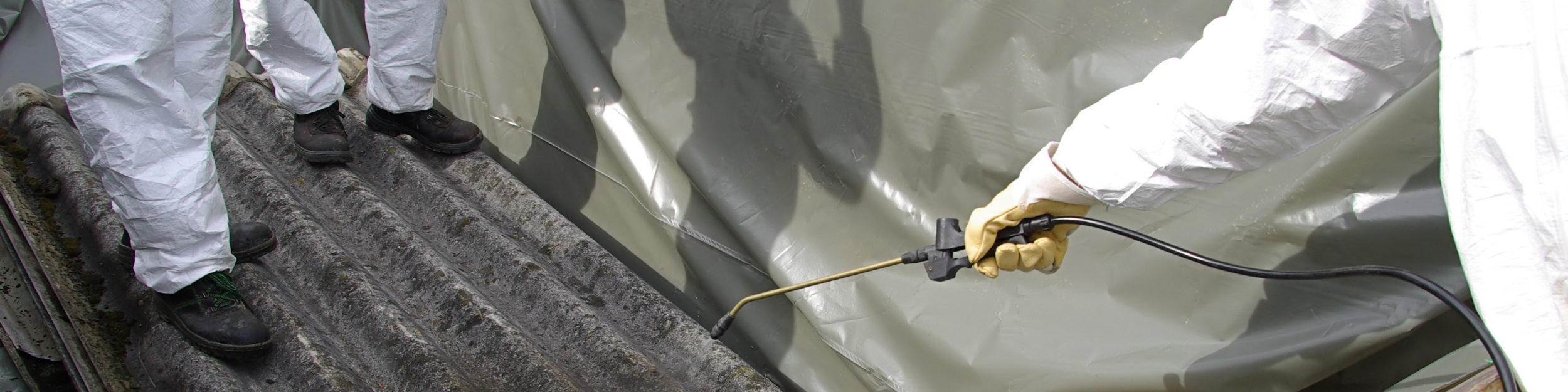
- Wet-method removal: Materials are sprayed with water and PVA wetting agent to suppress fibres, removed whole using hand tools, and immediately double-wrapped in 200-micron polyethylene. Power tools are never used on ACM.
- Continuous bagging and labelling: Every wrapped bundle is sealed with duct tape and labelled “CAUTION ASBESTOS.”
- Decontamination: Personnel decontaminate before leaving the work zone. PPE is bagged as asbestos waste.
- H-class vacuum and visual inspection: The work area is vacuumed with an H-class hazardous-dust vacuum cleaner and visually inspected before the team leaves.
Typical durations:
| Job | On-site time |
|---|---|
| Standard backyard asbestos fence (20–40m) | Half a day to one day |
| Single asbestos garage | One day |
| House eaves and soffits only | Half a day to one day |
| Combined residential job (fence + garage + eaves) | One to three days |
| Asbestos cement roof — single residential | One to two days |
| Bathroom / laundry wall sheeting strip | One to two days |
| Vinyl floor tiles with bituminous adhesive | One to three days |
| Full residential strip-out (interior + exterior ACM) | Three to seven days |
| Commercial fit-out strip (small to medium) | Two to five days |
| Light industrial roof and cladding | One to three weeks |
Phase 5 — Transport and EPA-tracked disposal (same day to next day)
Asbestos waste is classified as Reportable Priority Waste (RPW) under the Environment Protection Regulations 2021 (Vic) and must be tracked through EPA Victoria’s Waste Tracker system from cradle to grave.
What happens:
- Wrapped waste is loaded into a covered, secure vehicle.
- The load is transported by a permissioned operator to an EPA-licensed landfill authorised to receive asbestos. There are a limited number of these around Greater Melbourne.
- The manifest is lodged, the tip receipt is retained, and the load is recorded against the project.
Typical duration: Same day as removal, or the following morning for jobs finishing late in the day.
What can extend it: Landfill booking constraints (most authorised sites require pre-booked slots and have restricted opening hours), distance from regional sites to the nearest EPA-licensed landfill, or large-volume loads requiring multiple vehicle runs.
Phase 6 — Independent clearance certificate (Day of completion or next working day)
Under Regulation 297 of the OHS Regulations 2017, the person who commissioned the asbestos removal must obtain a clearance certificate from an independent competent person before the area is re-occupied — and, on demolition projects, before mechanical demolition begins. The clearance assessor must be independent of the removal contractor.
What happens:
- The independent assessor attends site, typically on the same day as completion or the following morning.
- A visual inspection is conducted to confirm no visible debris or residue remains.
- Where required (particularly for Class A jobs or larger commercial works), air monitoring is conducted to confirm fibre concentrations are below the workplace exposure standard.
- A written clearance certificate is issued to the person who commissioned the removal.
Typical duration: Half a day on site, with the certificate issued within 1 to 2 working days. For air-monitored jobs, allow an additional day for laboratory analysis of air samples.
Phase 7 — Documentation pack and project close-out (1 to 3 days after clearance)
The final phase is paperwork, and it is the phase that most cheap contractors quietly skip.
What happens:
- We compile the complete compliance pack: licence copy, ARCP, SWMS, WorkSafe Victoria notification, EPA Waste Tracker manifests, disposal receipts, and the independent clearance certificate.
- The pack is delivered to you (digital and hard copy) for your records, your insurer, your council, and any future buyer due diligence.
Typical duration: 1 to 3 working days after clearance.
This pack is the asset that protects you long after the removal is forgotten. It is the document your future buyer’s solicitor will ask for, the document your insurer will want sight of, and the document that demonstrates compliance if WorkSafe Victoria or EPA Victoria ever audits the site.
Realistic Timeline by Project Type
Here is what a typical end-to-end project looks like for the most common job types we run across Melbourne and Victoria.
Small residential job — asbestos fence replacement
Example: A 30-metre Super Six asbestos fence between two suburban backyards in Reservoir, Coburg, Sunshine or Frankston.
| Day | Activity |
|---|---|
| Day 0 | Initial enquiry, free site inspection booked |
| Day 1 | Site inspection, measurements, indicative scope |
| Day 2 | Fixed-price quote issued |
| Day 3 | Quote accepted; ARCP and SWMS drafted; WorkSafe notification lodged |
| Days 4–8 | WorkSafe five-day notification window |
| Day 9 | On-site removal (one day) |
| Day 9 or 10 | EPA-tracked transport and disposal |
| Day 10 | Independent clearance inspection |
| Days 11–13 | Clearance certificate issued; documentation pack delivered |
Total: approximately 1.5 to 2.5 weeks from enquiry to documentation.
Standard pre-1990 Melbourne home — combined residential job
Example: A 1970s weatherboard cottage in Northcote, Footscray, Box Hill or Glen Iris with asbestos eaves, an asbestos garage, and an asbestos fence — all bundled into one removal.
| Day | Activity |
|---|---|
| Day 0 | Enquiry, site inspection booked |
| Day 1–2 | Site inspection; NATA samples taken if borderline materials present |
| Days 3–5 | Lab results returned; fixed-price quote issued |
| Day 6 | Quote accepted; ARCP and SWMS drafted; WorkSafe notification lodged |
| Days 7–11 | WorkSafe five-day notification window |
| Days 12–14 | On-site removal (two to three days) |
| Day 14 or 15 | EPA-tracked transport and disposal |
| Day 15 | Independent clearance inspection |
| Days 16–18 | Clearance certificate issued; documentation pack delivered |
Total: approximately 2.5 to 3 weeks from enquiry to documentation.
Asbestos cement roof — single residential
Example: A corrugated asbestos cement roof on a 1960s home in Bentleigh, Oakleigh or Caulfield, replaced with new Colorbond.
The roof itself comes off in one to two working days for a standard suburban home, but the program needs to account for the new roof crew immediately following the asbestos removal. Coordination is critical: the new roof should be programmed to start the morning after the clearance certificate is issued, with temporary weatherproofing in between if rain is forecast.
Total project (asbestos removal only): approximately 2 to 3 weeks from enquiry to clearance certificate. Add the new roof program separately — typically a further 2 to 5 days depending on the roof type.
Full residential strip-out
Example: A complete interior strip of a 1970s home before a major renovation — eaves, internal asbestos cement wall sheets, vinyl tiles, bathroom and laundry sheeting, garage and fences.
On-site removal typically runs three to seven working days depending on internal access, ceiling space, and the presence of vinyl floor tiles (which add slow, methodical work to lift compliantly). Total project timeline runs 3 to 4 weeks.
Small to medium commercial fit-out strip
Example: A 200–500m² pre-1990 retail or office tenancy in Richmond, Carlton, South Yarra or the CBD, being stripped back to shell for a new fit-out.
The commercial environment introduces several complicating factors: access through building management, after-hours work requirements, additional engineering controls in adjoining tenancies, dust containment for shared HVAC, and (in many cases) air monitoring. On-site removal typically runs two to five working days, but coordination with the principal contractor extends the total project timeline to 3 to 4 weeks.
Light industrial — asbestos roof and cladding replacement
Example: A 1980s warehouse or factory in Sunshine, Tottenham, Brooklyn, Campbellfield, Broadmeadows or Dandenong South with an asbestos cement roof and wall cladding requiring replacement.
These projects routinely run one to three weeks on-site for removal alone, depending on roof area, height, edge protection requirements, and access for crane or hoist equipment. Total project timelines, including engineering, scaffold, edge protection, and the new building envelope program, typically span 5 to 8 weeks.
Pre-demolition asbestos removal
Example: A pre-1990 house, factory or warehouse being demolished for redevelopment anywhere in Melbourne or regional Victoria.
This is the project type where timeline planning matters most, because the demolition contractor cannot legally bring an excavator on site until the independent clearance certificate is issued under Regulation 297.
| Phase | Duration |
|---|---|
| Pre-demolition asbestos survey (destructive / Type 3) | 1 – 5 days on site, plus lab turnaround |
| Survey report and removal scope | 3 – 7 days |
| Council demolition permit (where required) | 2 – 6 weeks (variable by council) |
| Quote, ARCP, SWMS, WorkSafe notification | 5 – 10 days (including five-day window) |
| Utility disconnections and soft strip | 3 – 5 days |
| Licensed asbestos removal | 1 – 3 days (residential) / 1 – 4 weeks (commercial / industrial) |
| EPA-tracked transport and disposal | Concurrent with removal |
| Independent clearance certificate | 1 – 2 days |
| Mechanical demolition (separate program) | 3 – 10 days (residential) / 2 – 8 weeks (commercial) |
Total pre-demolition asbestos timeline: 3 to 4 weeks (residential) or 6 to 12 weeks (commercial / industrial), with the mechanical demolition program added on top.
For a deeper look at how asbestos fits into the demolition sequence, see our companion guide on Asbestos Removal During Demolition.
What Actually Drives the Timeline
The single biggest determinant of project duration is not the size of the job. It is the combination of regulatory steps and discovery risk. The factors that genuinely move the timeline are:
The five-day WorkSafe notification window
Non-negotiable for licensed work. Five calendar days minimum. The earlier in the process the quote is accepted, the earlier this clock starts.
Material type — non-friable vs friable
Non-friable asbestos (bonded cement sheeting, corrugated roofing, vinyl tiles, fences) is Class B work and runs on the timelines above. Friable material (sprayed limpet, pipe lagging, millboard, fire- or water-damaged cement sheets) requires Class A licensing, enclosures, negative air units, decontamination units and air monitoring. Friable work typically adds one to three weeks to total project timelines. A material that looks non-friable but has been weather-, fire- or flood-damaged often gets reclassified as friable on inspection — which is one of the most common causes of program slippage on older buildings.
Access and site complexity
A single-storey suburban home with vehicle access to the rear is fast. A three-storey walk-up in Carlton with no skip access and a shared driveway is slow. Commercial sites with after-hours work requirements, body-corporate approvals, or live tenancies in adjoining suites take materially longer than vacant sites.
Quantity of material
Quantity scales the on-site work but does not scale the regulatory steps. A 50m² job and a 500m² job both require the same five-day notification window, the same ARCP, and the same clearance process — just more days on tools in between.
Weather
Wet methods are central to compliant non-friable removal, so light rain is rarely a problem. Heavy rain, electrical storms, or extreme heat (above ~37°C in full PPE) can force a day’s stop-work for safety. Melbourne’s notoriously variable weather adds a small but real buffer to most outdoor jobs — particularly roofs.
Discovery risk
The biggest timeline killer on older buildings is hidden ACM that wasn’t identified at the initial inspection. Vinyl tiles under carpet. Asbestos cement behind a tiled splashback. A switchboard with a Zelemite backing panel that nobody opened until day one. A pre-demolition (destructive) survey is the single best defence against discovery risk, which is why we strongly recommend one on every pre-1990 demolition project.
Council permits and approvals
For straightforward removal work, council involvement is usually minimal. For demolitions, fence replacements over a certain height, heritage-overlay properties, or works affecting shared boundaries, council and VBA approvals can add 2 to 6 weeks depending on the council and the application complexity. Melbourne councils with heavier heritage portfolios — City of Melbourne, Yarra, Boroondara, Stonnington, Glen Eira and Moonee Valley — tend to be slower; outer growth-corridor councils such as Casey, Wyndham, Hume and Melton are generally faster on standard residential applications.
Disposal logistics
Around Greater Melbourne, there are a limited number of EPA-licensed landfills authorised to receive asbestos waste. Most require pre-booked drop-off slots, have restricted opening hours, and charge per cubic metre or per tonne. A licensed removalist will have these bookings managed in the background. DIY disposal — for the rare jobs that qualify — frequently bottlenecks at landfill booking.
Can Asbestos Removal Be Done Faster Than This?
Yes — but only by skipping legally required steps, which is exactly how contractors and owners end up on the WorkSafe Victoria prosecution list.
The five-day notification window cannot be compressed except in genuine emergencies. The clearance certificate cannot be issued by the removal contractor (it must be independent). The disposal cannot bypass an EPA-licensed landfill. The ARCP and SWMS cannot be photocopied from the previous job.
A contractor offering to “start tomorrow” on a 30m² job is almost certainly:
- Operating outside the licensed framework, or
- Not notifying WorkSafe Victoria, or
- Skipping the clearance certificate, or
- Disposing of waste somewhere other than an EPA-licensed landfill.
All four of those shortcuts sit at the owner’s legal door under Victorian law, not just the contractor’s. The penalties under the OHS Regulations 2017 and the Environment Protection Act 2017 routinely exceed $30,000 for individuals and $50,000 for body corporates, plus remediation costs and reputational consequences that long outlast the original project.
The honest answer to “Can we go faster?” is: yes, by two to three working days, if the quote is accepted within 24 hours of the site inspection, the sampling is straightforward, the WorkSafe notification is lodged immediately, and the clearance assessor is booked before the removal starts. That is exactly how we run our jobs. Beyond that, the timeline is structural — and trying to compress it further is where things go wrong.
What Genuine Emergencies Look Like (and How They’re Handled)
Victorian regulators do recognise genuine emergencies that allow for expedited timelines. These are not routine.
- Storm-damaged asbestos cement roofs that have been torn open and are now releasing fibres into a residential street.
- Fire-damaged buildings where ACM has become friable and is contaminating adjoining properties.
- Flood-damaged sites where rapid contamination control is needed.
- Public-safety risks such as a partially collapsed asbestos cement fence in a school yard or shared pedestrian area.
In these situations we can:
- Mobilise a site inspection within hours, not days.
- Lodge urgent notification with WorkSafe Victoria with a request for expedited acknowledgement.
- Begin secure containment (covering, sealing, fencing off) the same day to prevent further fibre release.
- Coordinate Class A subcontractors immediately if the material has been reclassified as friable by the damage event.
Most emergency jobs in Melbourne still run 5 to 10 working days end-to-end because the underlying regulatory framework still applies — but the work begins within a day rather than within two weeks.
How Asbestos Gone and Clean Programs a Typical Melbourne Job
We are a WorkSafe Victoria licensed Class B (non-friable) asbestos removalist and demolition contractor based in Melbourne, servicing all of Greater Melbourne and regional Victoria — from the inner suburbs out to Geelong, Ballarat, Bendigo, the Mornington Peninsula, the Yarra Valley, the Latrobe Valley and beyond.
Our scheduling approach is intentionally built around the two-clock reality so you can plan honestly:
- Free site inspection within 24 to 72 hours of enquiry across Greater Melbourne.
- Fixed-price written quote within 2 to 4 working days of the inspection, including any required NATA-accredited sampling.
- Same-day WorkSafe Victoria notification on quote acceptance, starting the mandatory five-day clock immediately.
- Booked removal date on the first available working day after the notification window closes.
- EPA-tracked transport and disposal to a licensed landfill, with manifests handled in the background.
- Independent clearance certificate booked to attend on the day of completion or the next working day.
- Complete documentation pack delivered within 1 to 3 working days of clearance.
For builders, developers and owner-builders, we also run integrated soft strip and demolition services under one ABN — which removes the single biggest cause of program slippage on pre-2004 demolition sites: the gap between when the asbestos contractor finishes and when the demolition contractor arrives. With both scopes under one project manager, the clearance certificate is issued and the excavator arrives on the same day.
Frequently Asked Questions
How long does asbestos removal take in Melbourne for a typical house?
For a standard pre-1990 Melbourne home with combined eaves, garage and fence removal, the on-site work typically takes one to three working days. The full end-to-end project, including the mandatory five-day WorkSafe Victoria notification window, NATA sampling, disposal and the independent clearance certificate, typically runs 2 to 3 weeks from first enquiry.
Why does asbestos removal take so long if the actual work is only a day or two?
Because Victorian asbestos law is built around mandatory pre-work steps. Licensed removalists must notify WorkSafe Victoria at least five days before the removal begins, prepare a site-specific Asbestos Removal Control Plan and Safe Work Method Statement, and arrange an independent clearance certificate after the work is complete. The removal day is short; the regulatory wrap-around is what sets the total project length.
Can you start asbestos removal sooner than five days?
Generally, no. The five-day WorkSafe Victoria notification window is a legal minimum for licensed work and cannot be compressed for ordinary program convenience. Genuine emergencies — storm damage, fire damage, immediate public safety risk — can sometimes be expedited, but these are tightly scrutinised and not granted for standard projects.
How long does it take to remove an asbestos fence in a Melbourne backyard?
The on-site removal for a typical 20–40m asbestos cement fence takes half a day to one day. The full project from enquiry to clearance certificate, including the five-day WorkSafe notification window and EPA-tracked disposal, typically runs 1.5 to 2.5 weeks.
How long does it take to remove an asbestos cement roof?
For a single residential asbestos cement roof in Melbourne, on-site removal is typically one to two working days depending on roof area and access. The full project timeline including notification and clearance runs 2 to 3 weeks. If a new roof is being installed immediately afterwards, that program is added separately — typically 2 to 5 days.
How long does pre-demolition asbestos removal take?
For a standard pre-1990 residential demolition, the asbestos removal phase — from pre-demolition survey through to clearance certificate — typically runs 3 to 4 weeks, after which the mechanical demolition can commence. Commercial and industrial pre-demolition asbestos work runs 6 to 12 weeks end-to-end. The clearance certificate under Regulation 297 must be issued before the excavator can legally start.
Can I book the new tradespeople for the day after asbestos removal finishes?
It is safer to book them for the day after the clearance certificate is issued, not the day after removal finishes. The independent clearance inspection typically happens on the day of completion or the next working day, and the written certificate is generally issued within 1 to 2 working days. Building your program around the certificate date — not the removal end date — avoids any awkward waiting on site.
How long does the clearance certificate take?
The independent clearance inspection itself takes a few hours on site, with the written certificate typically issued within 1 to 2 working days. For larger commercial jobs that include air monitoring, allow an additional day for laboratory analysis of air samples.
How long do NATA-accredited asbestos sample results take?
Standard turnaround for NATA-accredited bulk sample analysis is typically 2 to 5 working days. Express services are sometimes available for genuine emergencies at additional cost. Sampling is only required where the material identity cannot be confirmed visually or where regulatory documentation requires laboratory confirmation.
Does weather affect asbestos removal timing in Melbourne?
Light rain is generally fine — wet methods are central to compliant non-friable removal and continuous water spraying is used regardless of weather. Heavy rain, electrical storms, or extreme heat above approximately 37°C in full PPE can force a day’s stop-work for safety. Given Melbourne’s variable weather, a small buffer is sensible on roof and external work.
How long does asbestos removal take for a commercial fit-out in Melbourne?
A typical small-to-medium pre-1990 commercial fit-out strip in Melbourne — eaves, internal sheeting, vinyl tiles, switchboards — usually involves two to five days of on-site removal, with total project timelines of 3 to 4 weeks including notification, after-hours coordination with building management, EPA-tracked disposal and clearance. Larger industrial roof and cladding projects can run 5 to 8 weeks end-to-end.
How long is the licensed asbestos removalist’s documentation valid for?
The clearance certificate is a point-in-time document confirming the area was safe on the date of inspection. The certificate itself does not expire, but it only covers the work scope that was assessed. Future renovation or demolition of the same property will require a fresh inspection and (if ACM is present) a new removal and clearance cycle. The full documentation pack — licences, ARCP, SWMS, manifests, clearance certificate — should be retained indefinitely for insurance, sale and audit purposes.
What happens if the project runs over its scheduled timeline?
For a licensed Class B job on a fixed-price quote, the contractor absorbs the time risk on most causes of delay — weather, minor access issues, equipment. Owner-caused delays (additional scope discovered, access not provided, council permit not issued) typically extend the program but not the cost. Discovery of hidden ACM during the work is the most common genuine timeline change — the scope is updated, an additional notification may be required, and the program is extended accordingly. A reputable contractor will communicate any change in writing immediately.
Is it faster to combine asbestos removal with demolition under one contractor?
Yes — typically by 3 to 7 working days on a residential project, and significantly more on commercial work. Running both scopes under one ABN removes the coordination gap between two separate contractors trying to align diaries, eliminates the need for a hand-over inspection, and means the clearance certificate is issued and the excavator arrives the same day. For builders and developers programming pre-2004 demolitions, this is the single biggest source of avoided program slippage.
The Bottom Line on Asbestos Removal Timelines
The honest answer to “How long does asbestos removal take in Melbourne?” is: the work itself is fast, the project is longer, and the gap between the two is where most program problems happen.
For a typical Melbourne residential job, plan for 2 to 3 weeks from first enquiry to final clearance certificate. For a pre-demolition project, plan for 3 to 4 weeks of asbestos work before the demolition program can start. For larger commercial and industrial projects, allow 5 to 8 weeks end-to-end. Anyone offering materially faster than this is almost certainly skipping a regulatory step that you, as the owner, will end up legally responsible for.
The good news is that none of this is unpredictable. A licensed Class B removalist runs the same compliant sequence on every job, and the timeline elements that matter — site inspection, sampling turnaround, five-day notification window, on-site days, clearance — are all schedulable from day one. Build your program around the clearance certificate date, not the removal end date, and the rest of the project flows around it cleanly.
Get a Realistic, Fixed-Price Timeline for Your Melbourne or Victorian Project
If you are planning a renovation, strip-out, roof replacement, or demolition anywhere in Melbourne or Victoria, Asbestos Gone and Clean can give you a realistic timeline from day one — not just a removal cost, but a full project schedule with the regulatory milestones built in.
We provide:
- A free site inspection within 24 to 72 hours across Greater Melbourne.
- A fixed-price written quote with a full project program — including the five-day WorkSafe notification window, removal dates, disposal, and clearance certificate.
- A complete documentation pack delivered on completion for your records, your insurer, and any future buyer due diligence.
☎ Call us: 0475 143 106
✉ Email: asbestosgoneandclean@gmail.com
???? Contact Us: Asbestos Gone and Clean – Contact
We service all Melbourne metropolitan suburbs — including the inner-north, inner-east, inner-west, bayside, south-east and outer-growth corridors — and travel throughout regional Victoria for larger residential, commercial, industrial and demolition projects.
Related Reading
- Asbestos Regulations and Legal Requirements in Australia: The 2026 Compliance Guide for Melbourne & Victoria — our deep-dive on the Victorian regulatory framework, licensing, registers and penalties.
- Asbestos Removal During Demolition: What You Need to Know (2026 Melbourne & Victoria Guide) — the full pre-demolition-survey-to-clearance-certificate sequence for builders, developers and owner-builders.
- DIY vs Professional Asbestos Removal: Risks, Laws & Costs (2026 Melbourne & Victoria Guide) — the honest, no-spin breakdown of the 10m² rule and the real cost of doing it yourself.
- The Health Risks of Asbestos Exposure: What the Science Says (2026 Melbourne & Victoria Guide) — the evidence-based explanation of why the regulatory timeline exists in the first place.
Sources and Further Reading
- WorkSafe Victoria — Compliance Code: Removing Asbestos in Workplaces
- WorkSafe Victoria — Compliance Code: Managing Asbestos in Workplaces
- Occupational Health and Safety Act 2004 (Vic)
- Occupational Health and Safety Regulations 2017 (Vic), Part 4.4 (including Regulations 273 and 297)
- EPA Victoria — Publication IWRG611.2: Asbestos Transport and Disposal
- Environment Protection Act 2017 (Vic) and Environment Protection Regulations 2021 (Vic)
- Asbestos and Silica Safety and Eradication Agency (ASSEA) — Asbestos National Strategic Plan 2024–2030
- Standards Australia — AS 5370:2024 Air Quality — Bulk Materials
- Building Act 1993 (Vic) and Building Regulations 2018
Disclaimer: This article is general information only and is current as at May 2026. It is not legal advice. Project timelines are indicative and vary by site, material type, access, and regulatory conditions. For advice on a specific project timeline, contact WorkSafe Victoria, your local council, or speak directly with Asbestos Gone and Clean.