
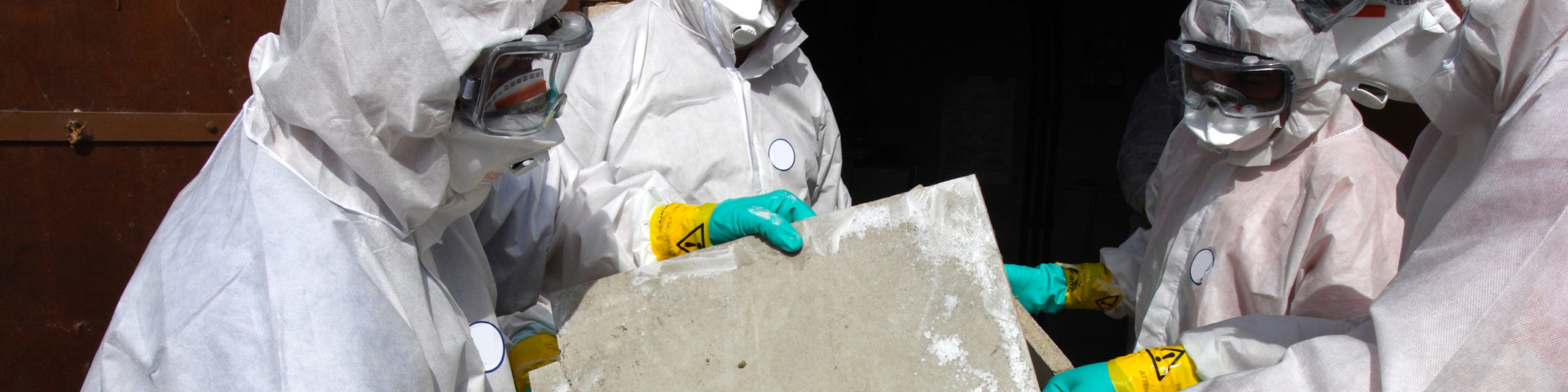
Quick answer: Once asbestos is removed from a Melbourne property, it is double-wrapped on site in heavy-duty 200-micron polyethylene, sealed, labelled “CAUTION ASBESTOS”, loaded into a covered secure vehicle, and transported as Reportable Priority Waste (RPW) under the Environment Protection Regulations 2021 (Vic) to one of a small number of EPA-licensed landfills authorised to receive asbestos around Greater Melbourne. Every load is tracked through EPA Victoria’s Waste Tracker system from cradle to grave. At the landfill, asbestos is buried in dedicated cells, covered immediately with clean fill, and recorded with GPS coordinates. It is not recycled, not incinerated, and not reused — asbestos cannot currently be safely destroyed at commercial scale, so the regulatory model is permanent, monitored containment. The property owner receives a complete documentation pack — manifests, disposal receipts, and an independent clearance certificate under Regulation 297 — that should be retained indefinitely for insurance, sale and audit purposes.
If you are about to have asbestos removed from a property in Melbourne or Victoria — or you’ve just had it removed and you want to understand where it actually went — this guide walks you through the full disposal journey, step by step, in plain English.
Why This Question Matters More Than People Realise
Most Melbourne homeowners and builders focus their attention on the removal day. The truck pulls up, the crew puts on PPE, the sheeting comes off, the trailer leaves the driveway — and at that point, the job feels finished.
Legally and biologically, it is not. The removal is only the first half of the story.
The other half is what happens to the wrapped material after it leaves the kerb. That part of the project is governed by an entirely separate Victorian regulator — EPA Victoria — under entirely separate legislation, and a meaningful share of the most serious asbestos prosecutions in this state relate not to the removal, but to what happened to the material afterwards. Illegal dumping, untracked manifests, unlicensed disposal sites, broken chain-of-custody — these are the failure modes that turn a routine residential job into a six-figure prosecution.
There is also a practical reason to care: the documentation generated by compliant disposal is the asset that protects you long after the job is forgotten. Your insurer wants to see it. Your council may ask for it. Your future buyer’s solicitor will almost certainly request it. And if WorkSafe Victoria or EPA Victoria ever audits the site, that paperwork is your legal shield.
Understanding the disposal journey is, in other words, not academic. It is the part of the process that converts an asbestos removal job from “a thing we did” into “a thing we can prove we did properly.”
The Legal Framework Governing Asbestos Disposal in Victoria
Before walking through the journey itself, it helps to understand the regulatory architecture that shapes every step of it.
Asbestos disposal in Victoria sits under three overlapping frameworks:
- Environment Protection Act 2017 (Vic) — the primary statute governing waste, pollution and contamination.
- Environment Protection Regulations 2021 (Vic) — the operational rules, including the classification of asbestos as Reportable Priority Waste (RPW).
- EPA Victoria Publication IWRG611.2 — Asbestos Transport and Disposal — the practical “how-to” guidance document used by industry and inspectors.
In parallel, the Occupational Health and Safety Regulations 2017 (Vic) govern how the material was wrapped and prepared at the source, and the lead-up to disposal must comply with the WorkSafe Victoria Compliance Code: Removing Asbestos in Workplaces.
Translation: from the moment a sheet of asbestos cement leaves the wall of your house to the moment it is buried in a landfill cell, at least two regulators are watching the chain of custody, and at least three pieces of paperwork are being generated. If any link in that chain is broken, the legal exposure flows back upstream — to the removalist, to the transporter, and ultimately to the person who commissioned the work.
Step 1 — Containment on Site: How Asbestos Is Prepared for Disposal
Disposal begins before the asbestos ever leaves the property. The way the material is handled at the source determines whether the rest of the chain is compliant.
Removal whole, not broken
Compliant removal keeps materials as intact as possible. Asbestos cement sheets are unscrewed and lifted off whole, not broken to fit a trailer. Corrugated roofing comes off in full lengths. Vinyl floor tiles are lifted methodically with hand tools, not chiselled or fragmented. The reason is biological: every broken edge releases fibres, and every fibre release upstream creates contamination that must be remediated downstream.
Wet methods
Throughout removal, the material is sprayed continuously with water and a wetting agent (typically a PVA solution) to suppress fibres at the surface. Power tools — angle grinders, circular saws, drills, sanders, high-pressure washers — are never used on asbestos-containing material. The combination of hand tools and wet methods is what keeps airborne fibre concentrations within safe limits.
Double-wrapping in 200-micron polyethylene
Once removed, each item is immediately wrapped in two layers of heavy-duty 200-micron polyethylene sheeting, sealed with quality cloth duct tape, and given a third taped reinforcement around any corners or sharp edges. The standard is set out in EPA Publication IWRG611.2 and is non-negotiable — thinner builder’s plastic does not meet the requirement.
Labelling
Every wrapped bundle is clearly marked with a pre-printed “CAUTION ASBESTOS” label. The label is not decorative — it is a legal requirement, it identifies the material to every subsequent handler in the chain, and it triggers the correct receiving protocols at the landfill weighbridge.
Decontamination of tools, PPE and the work zone
Disposable PPE (coveralls, gloves, boot covers, used respirator filters) and any single-use tools or sheeting used as drop cloths are themselves bagged as asbestos waste, double-wrapped, and labelled. Anything that touched the asbestos travels with the asbestos. The work area is then vacuumed with an H-class hazardous-dust vacuum cleaner — a household vacuum is never used because it would exhaust microscopic fibres straight back into the air.
By the end of Step 1, the property is left with sealed bundles ready for transport, and zero loose asbestos fragments. This is the state in which the material enters the regulated transport phase.
Step 2 — The Manifest and EPA Victoria’s Waste Tracker System
Before a single bundle is loaded onto a truck, the EPA Waste Tracker entry is created.
What is Reportable Priority Waste?
Under the Environment Protection Regulations 2021, asbestos waste generated from a commercial or trade activity is classified as Reportable Priority Waste (RPW). This category captures the wastes that pose the highest environmental and human-health risks if mismanaged — asbestos sits alongside other hazardous waste streams that require formal cradle-to-grave tracking.
Practically, RPW classification means three things:
- The waste cannot be transported by anyone other than an EPA-permissioned operator.
- The waste cannot be disposed of anywhere other than an EPA-licensed landfill authorised to receive that specific waste type.
- Every movement of the waste must be recorded electronically in the EPA Waste Tracker system.
What the manifest captures
EPA Victoria’s Waste Tracker is the online system that records the journey of every load of asbestos waste in the state. For each consignment, the system captures:
- The source address where the waste was generated.
- The type and quantity of waste (asbestos cement sheeting, lagging, contaminated PPE, etc., measured in tonnes or cubic metres).
- The transporter — name, EPA permission number, vehicle registration.
- The destination — the EPA-licensed landfill name and licence number.
- The time of pickup and delivery.
- The receiving signature at the landfill once the load has been accepted.
This data is queryable by EPA Victoria, by WorkSafe Victoria, and by inspectors. It is also retained as evidence in the event of a complaint, an audit, or a future contamination investigation.
Why the manifest matters to you, the property owner
The manifest is the document that proves the asbestos went where it was supposed to go. Without it, there is no evidence that the material was disposed of legally — and no defence if, years from now, someone alleges that contaminated waste from your project was illegally dumped elsewhere. A licensed removalist provides you with a copy of the completed manifest as part of the documentation pack delivered at project close-out. This pack should be retained indefinitely.
Step 3 — Transport: How Asbestos Travels From Your Property to the Landfill
The transport phase is where many illegal disposal cases originate. The temptation — particularly for unlicensed operators — is to “save the tip fee” by quietly dumping the material in a creek bed, on a vacant block, or in a regional bushland reserve. Victorian penalties for this are severe, and EPA enforcement has hardened significantly.
Compliant transport in Victoria looks like this:
The vehicle
Asbestos waste must be transported in a covered, secure vehicle. In practice, this means:
- A fully enclosed van or truck, or
- An open trailer or tipper with a securely fastened heavy-duty tarpaulin that cannot lift, flap or release material in transit.
The load must be stable, restrained, and unable to escape under braking, acceleration, or windy conditions on the freeway. Bundles are typically stacked on a protective base layer of polythene that lines the load space, so any accidental fibre release stays contained within the vehicle.
The operator
The transport operator must hold the appropriate EPA permission to carry Reportable Priority Waste. This permission is separate from a standard heavy-vehicle licence and is registered against the operator’s ABN and vehicles. Licensed asbestos removalists in Victoria typically hold these permissions in-house, so the same business that removes the material is authorised to transport it.
The route
There is no formal “asbestos transport route” through Greater Melbourne — vehicles use the standard road network. However, the load is registered against a known destination, the journey is timestamped in Waste Tracker, and any significant detour or delay is recorded. Loads do not stop at unauthorised intermediate locations, are not transferred between vehicles mid-journey, and are not left unattended in publicly accessible places.
What happens if there’s an incident in transit
In the rare event of a road accident, mechanical failure, or load disturbance during transport, the operator is required to:
- Make the load safe and prevent further fibre release (covering, isolating, calling emergency services).
- Notify EPA Victoria.
- Arrange a licensed clean-up of any contamination at the incident location.
- Re-secure the remaining load before continuing or transferring to a replacement vehicle.
These protocols exist because once asbestos is in the back of a truck, the regulatory chain of custody is live — and any deviation from the planned destination triggers compliance attention.
Step 4 — EPA-Licensed Landfills: Where Asbestos Actually Goes
Around Greater Melbourne, there are a limited number of EPA-licensed landfills authorised to receive asbestos waste. These sites are licensed individually by EPA Victoria, hold specific permissions for hazardous waste streams, and operate under strict conditions covering acceptance, burial, recording and long-term monitoring.
Asbestos is not accepted at standard suburban transfer stations or recycling centres. It is not accepted at most regional council tips. Drop-off is restricted to the small group of licensed sites, and most of them require pre-booked slots, have restricted opening hours, and charge per cubic metre or per tonne.
A licensed removalist will already know which landfill your job is heading to, will have the booking arranged in the background, and will manage the weighbridge process on arrival.
What an EPA-licensed asbestos landfill looks like
EPA-licensed landfills authorised to receive asbestos share a set of physical and operational features:
- A dedicated asbestos cell or trench, separated from general municipal waste.
- A lined base (typically clay or engineered geomembrane) to prevent any potential leachate migration into groundwater.
- A deep burial protocol — asbestos is buried below specified depths to prevent surface exposure.
- An immediate covering of the load with clean fill once tipped, to prevent any incidental fibre release.
- GPS-recorded burial locations so the position of every load can be retrieved decades later if required.
- Long-term capping and monitoring of the cell once it is full.
- Restricted public access — landfills authorised for asbestos do not allow self-haul members of the public to wander the tip face.
The weighbridge process
When a removalist arrives at the landfill, the load goes through a structured acceptance process:
- Booking confirmation — the operator presents the pre-booked slot reference and Waste Tracker manifest.
- Weighbridge — the vehicle is weighed loaded, the weight is recorded against the manifest.
- Visual inspection — landfill staff confirm the load is properly wrapped, labelled, and not mixed with non-permitted materials.
- Direction to the active asbestos cell — the vehicle is guided to the designated tipping area.
- Tipping under supervision — the load is tipped into the cell, with landfill staff supervising.
- Immediate covering — clean fill is pushed over the load within minutes, often by a dedicated dozer or loader operating at the cell.
- Exit weighbridge — the vehicle is weighed empty; the net waste weight is calculated.
- Receipt and signature — the receiving signature is captured electronically in Waste Tracker, and a paper tip receipt is issued.
The tip receipt is the document that closes the loop. It is the proof that your specific load reached its specific destination, and it is one of the key documents in your final compliance pack.
Step 5 — Burial and Long-Term Containment
Once asbestos waste has been tipped and covered, it enters the long-term containment phase. This is the part of the journey that lasts effectively forever.
The cell
A modern asbestos cell at an EPA-licensed Victorian landfill is engineered, not improvised. Typical specifications include:
- Engineered base liner — typically a compacted clay layer combined with a high-density polyethylene (HDPE) geomembrane to prevent any leachate migration.
- Leachate collection — pipes at the cell base capture any liquid that percolates through, directing it to treatment.
- Defined burial depth — asbestos waste is buried at depths that prevent it from being disturbed by surface activity, erosion or future site works.
- Daily cover — clean fill is applied over each day’s loads to maintain a barrier between any newly tipped waste and the atmosphere.
- Final capping — once the cell reaches capacity, it is capped with engineered cover layers (clay, geomembrane, drainage layer, topsoil) designed to prevent water infiltration, plant root intrusion, and burrowing animals.
Long-term monitoring
EPA-licensed landfills are required to monitor their cells long after they have stopped accepting waste. Monitoring typically includes:
- Groundwater testing at boreholes around the site to detect any contamination.
- Surface inspections to identify any erosion, settling or damage to the cap.
- Methane and gas monitoring at sites where the asbestos cell sits alongside general landfill.
- Maintenance of the cap — re-vegetation, repair of any damage from storms, fire or vehicle access.
- Land-use controls — restrictions on future development of the site, including bans on excavation, deep building footings, or land uses that could disturb the burial layer.
Many former landfill sites in Victoria are now public open space (golf courses, recreational reserves, solar farms) precisely because their long-term containment obligations preclude development. The land remains usable for low-impact purposes, but the asbestos cell beneath stays sealed indefinitely.
Why permanent containment, not destruction?
The reason asbestos disposal looks like permanent containment rather than destruction is that asbestos fibres are physically and chemically extraordinarily stable. The very properties that made asbestos commercially attractive in the 20th century — heat resistance, chemical resistance, durability — are the same properties that make it almost impossible to safely break down at industrial scale.
Asbestos does not biodegrade. It is not attacked by acids or alkalis at temperatures and pressures achievable in normal industrial conditions. It does not burn in any conventional incinerator. The mineral structure that gives asbestos its dangerous needle-like fibre geometry survives essentially any process you can apply to it at commercial volumes.
The result is that the most reliable, most cost-effective, most scalable disposal pathway available in 2026 is still safe burial under engineered controls — exactly the model used in Victoria.
What Happens to Contaminated PPE, Wrapping, and Tools?
A common question from homeowners watching the disposal process: “Where do the gloves, suits and tarps go?”
Answer: everything that touched the asbestos travels with the asbestos.
- Disposable coveralls, gloves, boot covers, respirator cartridges are all bagged as asbestos waste at the end of the removalist’s shift, double-wrapped, labelled, and consigned to the same landfill load as the structural ACM.
- Drop sheets and floor protection used during the removal are likewise treated as contaminated and disposed of with the load.
- Reusable tools and equipment — H-class vacuums, fixed scaffolding components, lifting equipment — are decontaminated on site using wet methods and H-class vacuuming, then bagged-and-tagged for use on the next job. The decontamination process itself produces small quantities of contaminated rinse water and wipes, which are also disposed of as asbestos waste.
- Respirators and reusable PPE have their disposable filters removed and bagged; the masks themselves are wet-wiped and stored separately for re-use after thorough decontamination.
This is the part of the process that significantly inflates the volume of waste disposed compared to the apparent volume of asbestos removed. A 30m² removal job can generate two or three times its visible material in associated wrapping, PPE and consumables — all of which is tracked through the same EPA Waste Tracker manifest under the same RPW classification.
Can Asbestos Be Recycled, Treated or Destroyed?
This question comes up regularly, particularly from environmentally conscious property owners who are uncomfortable with the idea of permanent burial. The honest answer in 2026 is not at any commercial scale relevant to your project.
The science
Researchers around the world have explored several pathways for breaking down asbestos:
- Thermal denaturation — heating asbestos to extremely high temperatures (above approximately 1,000–1,250°C) can transform the fibrous mineral into a non-fibrous, non-hazardous glassy material. This works in laboratory conditions and at small pilot scale, but the energy cost is enormous, the throughput is low, and the gas-handling requirements are demanding.
- Chemical treatment — strong acids can dissolve some forms of asbestos under specific conditions, but the volumes of acid required, the management of the resulting waste streams, and the cost of containment make this impractical at scale.
- Microwave and plasma processing — emerging research is exploring electromagnetic and plasma-based denaturation. Results are promising in laboratory settings but commercially unproven.
- Mechanochemical processing — high-energy milling combined with chemical additives can alter the fibre structure of some asbestos forms. Again, the science exists; the commercial economics do not.
The reality in Australia in 2026
No commercial-scale asbestos destruction facility operates in Australia. Every tonne of asbestos waste generated from removal work in Victoria — residential, commercial, industrial — is currently disposed of by safe burial at an EPA-licensed landfill. That includes waste from jobs run by the most environmentally rigorous contractors in the state. There is currently no alternative.
The Asbestos and Silica Safety and Eradication Agency (ASSEA) and EPA Victoria both monitor the international research on destruction technologies and assess their potential applicability to Australia. As of 2026, the assessment remains that engineered burial in licensed landfills is the safest, most reliable, most cost-effective and most scalable option available. If that changes — and there are credible research programs that may eventually shift the calculus — the regulatory framework will adapt. For now, “disposal” means “burial under controlled conditions.”
What this means for the homeowner
You will sometimes see online claims of “asbestos recycling” services. In Australia in 2026, this is not legitimate at scale. Any operator claiming to recycle asbestos rather than landfill it is either:
- Mischaracterising what they actually do (in which case the waste is still going to a landfill, with extra handlers and extra contamination opportunities in the chain), or
- Operating outside the regulated framework (in which case you do not want your project name attached to their manifest, or absence of one).
Compliant disposal in Victoria means the EPA-licensed landfill pathway. Treat any claim to the contrary with caution.
Documentation: What You Receive, and Why You Keep It Forever
By the time the disposal phase is complete, your project has generated a stack of paperwork that a reputable removalist will compile into a single documentation pack and hand to you. This pack is the single most important deliverable of the entire job, and it should be retained indefinitely.
What’s in a compliant documentation pack
A complete pack from a licensed Class B asbestos removalist in Victoria typically includes:
- A copy of the removalist’s WorkSafe Victoria licence.
- The site-specific Asbestos Removal Control Plan (ARCP).
- The site-specific Safe Work Method Statement (SWMS).
- The WorkSafe Victoria notification (lodged at least five days before work commenced).
- NATA-accredited laboratory sample results where sampling was conducted, in line with AS 5370:2024.
- The EPA Waste Tracker manifest for each load transported.
- The landfill tip receipt for each load, identifying the receiving site.
- The independent clearance certificate issued under Regulation 297 of the OHS Regulations 2017.
- Photographs of the site before, during and after the work (where part of the standard handover).
Why retain it indefinitely?
There are at least five future scenarios in which this documentation matters:
- Insurance — most home and building insurance policies in Australia exclude losses arising from unlicensed asbestos work. The documentation pack is your evidence that the work was licensed.
- Sale of the property — buyer-side legal teams increasingly request evidence of past asbestos work on pre-2004 properties. A clean documentation pack closes the question instantly; the absence of one can re-price or collapse a sale.
- Rental — if your property is or ever becomes a rental, the workplace status engages OHS obligations that look back at past works. Documentation is the only way to prove historical compliance.
- Future renovation or demolition — the next contractor to work on the property needs to know what has and has not already been remediated. Your documentation pack feeds directly into their pre-work survey.
- Audit or investigation — in the event of a contamination complaint, an EPA investigation, or a WorkSafe Victoria audit, the documentation pack is your legal shield. Without it, you are arguing from memory.
The cost of compiling this pack on the day is trivial. The cost of recreating it ten years later, when one of the above scenarios is live, is enormous — and in most cases, recreation is simply not possible.
The Dark Side: Illegal Dumping and Why It Happens
It would be misleading to walk through the legal disposal pathway without acknowledging the parallel reality: a meaningful volume of asbestos waste in Victoria is still illegally dumped every year.
Where it happens
EPA Victoria’s enforcement data consistently identifies the same hotspots:
- Roadside verges and laybys on outer-metropolitan and regional roads — particularly between Greater Melbourne and the closer regional centres.
- Vacant blocks and “informal” rubbish piles in industrial estates and outer-growth corridors.
- Bushland and forestry reserves along the Melbourne fringe — the Dandenongs, the Yarra Ranges, the Otways, the Macedon Ranges.
- Creek lines, drains and waterway easements — particularly downstream of industrial areas.
- Skip bins on third-party properties, where the dumper takes advantage of someone else’s waste disposal arrangement.
- Rural properties where a previous owner has buried asbestos waste on the land itself — illegal under the Environment Protection Act 2017 even on private rural land.
Why it happens
The economic driver is straightforward. Compliant asbestos disposal costs money: EPA-licensed landfill tip fees, transport permission, manifest preparation, and the contractor’s time. Illegal dumping costs nothing in the short term — until it’s discovered.
The operators who illegally dump are almost always:
- Unlicensed handymen offering “cash jobs” at well below market rates.
- Self-haul DIY operators who didn’t book a slot at a licensed landfill and improvised an alternative.
- Unscrupulous contractors who quoted at a compliant price and then pocketed the difference by skipping the proper disposal.
Why illegal dumping flows back to the property owner
Here is the part many Melbourne homeowners do not realise: the legal exposure for illegal dumping does not end with the dumper. EPA Victoria can — and routinely does — pursue:
- The person who commissioned the removal, on the basis that they had a duty to verify compliant disposal.
- The landowner of the property where the dumping occurred (if different from the dumper).
- Any intermediate handler in the chain who knew or should have known the destination was not legitimate.
This is why the documentation pack matters so much. It is the documentary chain that demonstrates you commissioned a licensed removalist, who used a licensed transporter, who delivered to a licensed landfill. Without that chain, “I assumed they did the right thing” is not a defence.
Penalties
Illegal dumping of asbestos waste under the Environment Protection Act 2017 attracts:
- Fines exceeding $50,000 for serious individual breaches, and substantially more for body corporates.
- Mandatory remediation costs at the dump site, which routinely run into six figures for any significant volume.
- Recovery of EPA investigation and disposal costs.
- Reputational consequences — EPA Victoria publishes prosecutions, and they are now indexed by every search engine.
And under the OHS Act 2004, reckless conduct endangering workers or the public can attract imprisonment of up to five years in aggravated cases.
The lesson, repeated across every prosecution: cheap quotes that cut the disposal corner are not cheap. They are deferred liabilities that activate the moment EPA Victoria identifies the dump site.
How This Looks for a Typical Melbourne Job
Putting it all together, here is what the disposal journey actually looks like for a typical residential job — a Melbourne home in Northcote, Coburg, Reservoir, Footscray, Sunshine, Box Hill, Glen Iris, Caulfield, Bentleigh, Oakleigh, Frankston or any similar suburb — with an asbestos garage, eaves and fence being removed.
| Step | What happens | Where it happens |
|---|---|---|
| 1 | Material removed whole, sprayed with water, double-wrapped in 200-micron poly, labelled “CAUTION ASBESTOS” | Your property |
| 2 | EPA Waste Tracker manifest created; source, weight, transporter, destination logged | Online system, before vehicle leaves |
| 3 | Wrapped bundles loaded into covered, secure vehicle | Your property / kerbside |
| 4 | Transport to pre-booked slot at an EPA-licensed landfill | Greater Melbourne |
| 5 | Weighbridge in, manifest verified, load inspected | At the landfill |
| 6 | Load tipped into dedicated asbestos cell under supervision | Landfill working face |
| 7 | Clean fill applied within minutes to cover the load | Landfill working face |
| 8 | Weighbridge out, net weight calculated, tip receipt issued | At the landfill |
| 9 | Manifest closed in EPA Waste Tracker with receiving signature | Online system |
| 10 | Cell continues to fill with subsequent loads; engineered cover applied at capacity | Landfill, over months/years |
| 11 | Cell capped, GPS coordinates recorded, long-term monitoring begins | Landfill, indefinitely |
| 12 | Documentation pack — manifests, tip receipts, clearance certificate — delivered to you | Your records, forever |
From the moment the first sheet is wrapped on your property to the moment the documentation pack lands in your inbox, every step is recorded, every handler is licensed, and every load can be traced backwards from the burial cell to the source property.
Geographic Considerations for Melbourne and Regional Victoria
The disposal journey looks the same in principle across Victoria, but the geographic logistics differ meaningfully.
Greater Melbourne
For removals in inner, middle and outer-ring Melbourne suburbs — the City of Melbourne, Yarra, Boroondara, Whitehorse, Knox, Casey, Wyndham, Hume, Maribyrnong, Moonee Valley, Glen Eira, Stonnington, Kingston, Melton, Brimbank, Banyule, Darebin, Manningham, Monash, Frankston and the rest — the nearest EPA-licensed asbestos landfill is generally within a reasonable drive. Single-vehicle, same-day disposal is the norm for residential jobs.
Outer-metropolitan and growth corridors
For removals in the outer growth corridors — Melton, Wyndham, Hume, Casey, Cardinia, Whittlesea — distances to licensed landfills can be longer, particularly for the larger industrial removals associated with greenfield site preparation. This is sometimes reflected in the disposal portion of the quote.
Regional Victoria
For removals in Geelong, Ballarat, Bendigo, Shepparton, the Mornington Peninsula, the Yarra Valley, the Latrobe Valley and further afield, the disposal logistics often involve longer transport runs to one of the metropolitan-fringe EPA-licensed sites. Some regional centres have closer authorised facilities; some do not. A licensed removalist quoting on regional work will factor the transport distance into the disposal price transparently — and will never solve the problem by tipping somewhere closer that isn’t authorised.
Rural properties
A frequent question on rural Victorian properties: “Can I just bury the asbestos on my own land?” The answer is no. Under the Environment Protection Act 2017, burial of asbestos on private rural land is illegal, regardless of property size or location. The same goes for burning, which is also explicitly prohibited. Fines exceed $50,000 plus remediation. Rural property owners are not exempt from the licensed landfill pathway.
How Asbestos Gone and Clean Handles the Disposal Phase
We are a WorkSafe Victoria licensed Class B (non-friable) asbestos removalist and demolition contractor based in Melbourne, servicing all of Greater Melbourne and regional Victoria — from the inner suburbs out to Geelong, Ballarat, Bendigo, the Mornington Peninsula, the Yarra Valley, the Latrobe Valley and beyond.
For every project we take on, the disposal phase is handled in-house under the same compliance framework, so you never have to worry about what happens to the material after it leaves your kerb.
- Wrapping and labelling at source — every item double-wrapped in 200-micron polyethylene, sealed with quality cloth tape, and labelled “CAUTION ASBESTOS” before it leaves the work zone.
- EPA Waste Tracker manifest prepared and lodged for every load.
- Covered, secure vehicles with the appropriate EPA permissions, driven by trained operators who do not deviate from the booked destination.
- Pre-booked slots at EPA-licensed landfills authorised to receive asbestos, with weighbridge arrival times confirmed before the truck leaves your property.
- Same-day disposal wherever possible, or next-morning where the removal finishes late.
- Tip receipts retained and included in your documentation pack.
- Independent clearance certificate under Regulation 297 booked to attend on the day of completion or the next working day.
- Complete documentation pack delivered within 1 to 3 working days of clearance — licence, ARCP, SWMS, WorkSafe notification, manifests, tip receipts and clearance certificate.
For builders, developers and owner-builders, the disposal phase dovetails into the broader soft strip and demolition program under one ABN — removing the risk of two contractors handing off waste and paperwork between themselves, and ensuring the entire chain of custody sits with one accountable party from removal to clearance.
Frequently Asked Questions
What happens to asbestos after it’s removed from a Melbourne property?
It is double-wrapped on site in 200-micron polyethylene, sealed, labelled “CAUTION ASBESTOS”, transported as Reportable Priority Waste in a covered secure vehicle by an EPA-permissioned operator, and disposed of at an EPA-licensed landfill authorised to receive asbestos. Every movement is tracked through EPA Victoria’s Waste Tracker system. At the landfill, the material is buried in a dedicated cell, immediately covered with clean fill, and recorded with GPS coordinates for long-term containment.
Where does asbestos go after it’s removed in Victoria?
To one of a small number of EPA-licensed landfills authorised to accept asbestos waste, located around Greater Melbourne and a limited number of regional sites. It is not accepted at standard transfer stations, recycling centres, or municipal tips. Most authorised landfills require pre-booked slots.
Is asbestos recycled in Australia?
No. There is no commercial-scale asbestos recycling or destruction facility operating in Australia in 2026. Every tonne of asbestos waste from compliant Victorian removal jobs is disposed of by safe burial at an EPA-licensed landfill. Operators claiming to “recycle” asbestos should be treated with extreme caution.
Can asbestos be destroyed or broken down?
Research has demonstrated that asbestos can be denatured at very high temperatures (above approximately 1,000–1,250°C) or via specific chemical processes, but none of these methods is commercially viable at scale. The mineral structure of asbestos is extraordinarily stable, which is why permanent engineered burial remains the global standard for disposal.
How is asbestos transported in Victoria?
In covered, secure vehicles — either fully enclosed vans/trucks, or open trailers with securely fastened heavy-duty tarpaulins. The operator must hold appropriate EPA permissions to transport Reportable Priority Waste, and every movement is logged in EPA Victoria’s Waste Tracker system.
What is the EPA Waste Tracker system?
EPA Victoria’s electronic waste tracking system, used to record the cradle-to-grave journey of Reportable Priority Waste, including asbestos. Each load is logged with source, weight, transporter, destination, pickup time and receiving signature. It is the regulatory backbone of compliant disposal in Victoria.
Can I take asbestos to my local tip?
Only if your local tip is EPA-licensed to accept asbestos, and only if it accepts public drop-offs (most do not). Around Greater Melbourne, the list of authorised sites is short, opening hours are restricted, and most require pre-booked slots. Standard municipal transfer stations do not accept asbestos.
Can I bury asbestos on my own rural property?
No. Burial of asbestos on private land — including private rural land — is illegal under the Environment Protection Act 2017. The same prohibition applies to burning. Penalties exceed $50,000 plus remediation costs.
How long does asbestos stay safe at a landfill?
Once buried in an engineered, capped and monitored cell, asbestos remains safely contained indefinitely. The disposal model is permanent containment, not destruction. Landfill cells are monitored long after they cease accepting waste, and land-use controls prevent future development that could disturb the burial layer.
Why can’t asbestos be incinerated like other hazardous waste?
Asbestos fibres are mineral, not organic, so they don’t burn in conventional incinerators. The temperatures required to actually transform the mineral structure of asbestos (well above 1,000°C) are significantly higher than standard hazardous-waste incinerators reach, and the gas-handling required to safely capture any released fibres during the process is not commercially available at scale. Burial in licensed landfills remains the most reliable disposal pathway.
What documentation should I receive after asbestos disposal?
A complete compliance pack including: the removalist’s WorkSafe Victoria licence, the site-specific ARCP and SWMS, the WorkSafe Victoria notification, any NATA-accredited laboratory sample results, the EPA Waste Tracker manifest for each load, the landfill tip receipt for each load, and the independent clearance certificate under Regulation 297. Retain this pack indefinitely for insurance, sale and audit purposes.
What happens to the PPE, plastic wrapping and tools used during removal?
Anything that touched the asbestos travels with the asbestos. Disposable coveralls, gloves, respirator filters, drop sheets and contaminated wrapping are all bagged as asbestos waste, double-wrapped, labelled and disposed of through the same EPA-licensed landfill pathway as the structural material. Reusable equipment is decontaminated on site using wet methods and H-class vacuuming.
How much does asbestos disposal cost in Melbourne?
Disposal is typically charged per cubic metre or per tonne at the EPA-licensed landfill, with rates set by individual sites. For a typical residential removal in Melbourne, the disposal portion is built into the licensed removalist’s fixed-price quote, so you do not pay it separately. Quotes that appear dramatically below market are usually a sign that the disposal cost is being avoided — which is exactly where illegal dumping cases originate.
What happens if my asbestos waste is illegally dumped by a contractor?
Under Victorian law, the legal exposure for illegal dumping can flow back to the person who commissioned the removal — particularly if they did not retain a documentation pack proving compliant disposal. EPA Victoria can pursue the dumper, the landowner where the dumping occurred, and the original commissioning party. This is why retaining the manifest and tip receipt matters: they are the documentary chain that demonstrates you contracted a licensed pathway.
Can I see the EPA-licensed landfill that my asbestos was disposed at?
Yes. The receiving landfill is identified on the manifest and on the tip receipt, both of which form part of your documentation pack. Some landfills also publish their licence details on the EPA Victoria public register.
Does asbestos waste from a single Melbourne home really need this much paperwork?
Yes — and the paperwork is proportional, not bureaucratic. The manifest is electronic and is prepared by the removalist as part of the standard job. The tip receipt is issued at the weighbridge. The clearance certificate is a single document. From your perspective as the property owner, the disposal phase produces three or four pages of documentation that protect you indefinitely. The administrative burden sits with the licensed removalist; the benefit sits with you.
What’s the difference between asbestos disposal and general construction waste disposal?
General construction and demolition waste can typically go to standard transfer stations and is not individually tracked. Asbestos waste is Reportable Priority Waste, requires licensed transport, EPA Waste Tracker manifests, EPA-licensed disposal, and lifetime documentation retention. The two streams must never be mixed — combining asbestos with general C&D waste contaminates the entire load and dramatically increases disposal costs.
The Bottom Line on What Happens to Asbestos After Removal
The disposal phase of an asbestos removal project is the half of the job that most homeowners never see — and it is the half that determines whether the project produces a clean compliance trail or a deferred liability that activates years later.
In Victoria in 2026, the answer to “What happens to asbestos after it’s removed?” is unambiguous: it is wrapped, manifested, tracked, transported, weighed, buried, covered, capped and monitored under a regulatory framework that treats every load as Reportable Priority Waste from cradle to grave. It is not recycled, not incinerated, and not reused, because the science of asbestos disposal in 2026 still points to permanent engineered containment as the safest, most reliable, most scalable option available.
For the property owner, the practical implications are simple. Use a licensed removalist who handles the disposal in-house, insist on the documentation pack at project close-out, and retain that pack indefinitely. Those three steps are what convert a routine asbestos removal into a documented compliance record that will protect you on insurance, on sale, on rental, on future renovation, and on any regulatory audit that may come decades after the dust has settled.
Get a Compliant, Fixed-Price Quote — Including Full Disposal Documentation
If you are planning a renovation, strip-out, roof replacement, or demolition anywhere in Melbourne or Victoria, Asbestos Gone and Clean can provide a no-obligation site inspection, a fixed-price Class B non-friable asbestos removal quote, and a complete disposal documentation pack — manifests, tip receipts and independent clearance certificate included.
☎ Call us: 0475 143 106
✉ Email: asbestosgoneandclean@gmail.com
???? Contact Us: Asbestos Gone and Clean – Contact
We service all Melbourne metropolitan suburbs — including the inner-north, inner-east, inner-west, bayside, south-east and outer-growth corridors — and travel throughout regional Victoria for larger residential, commercial, industrial and demolition projects.
Related Reading
- Asbestos Regulations and Legal Requirements in Australia: The 2026 Compliance Guide for Melbourne & Victoria — our deep-dive on the Victorian regulatory framework, licensing, registers and penalties.
- Asbestos Removal During Demolition: What You Need to Know (2026 Melbourne & Victoria Guide) — the full pre-demolition-survey-to-clearance-certificate sequence for builders, developers and owner-builders.
- DIY vs Professional Asbestos Removal: Risks, Laws & Costs (2026 Melbourne & Victoria Guide) — the honest, no-spin breakdown of the 10m² rule and the real cost of doing it yourself.
- The Health Risks of Asbestos Exposure: What the Science Says (2026 Melbourne & Victoria Guide) — the evidence-based explanation of why the regulatory framework exists in the first place.
- How Long Does Asbestos Removal Take? A Realistic Timeline (2026 Melbourne & Victoria Guide) — the realistic day-by-day timeline from first enquiry to final clearance certificate.
Sources and Further Reading
- EPA Victoria — Publication IWRG611.2: Asbestos Transport and Disposal
- Environment Protection Act 2017 (Vic)
- Environment Protection Regulations 2021 (Vic)
- WorkSafe Victoria — Compliance Code: Removing Asbestos in Workplaces
- WorkSafe Victoria — Compliance Code: Managing Asbestos in Workplaces
- Occupational Health and Safety Act 2004 (Vic)
- Occupational Health and Safety Regulations 2017 (Vic), Part 4.4 (including Regulation 297)
- Asbestos and Silica Safety and Eradication Agency (ASSEA) — Asbestos National Strategic Plan 2024–2030
- Standards Australia — AS 5370:2024 Air Quality — Bulk Materials
- EPA Victoria — Waste Tracker (Reportable Priority Waste) guidance and public register
Disclaimer: This article is general information only and is current as at May 2026. It is not legal, environmental or financial advice. Disposal pathways, licensed landfill operators and EPA permissions are subject to change. For advice on a specific project or to verify current licensed disposal sites, contact EPA Victoria, WorkSafe Victoria, your local council, or speak directly with Asbestos Gone and Clean.