
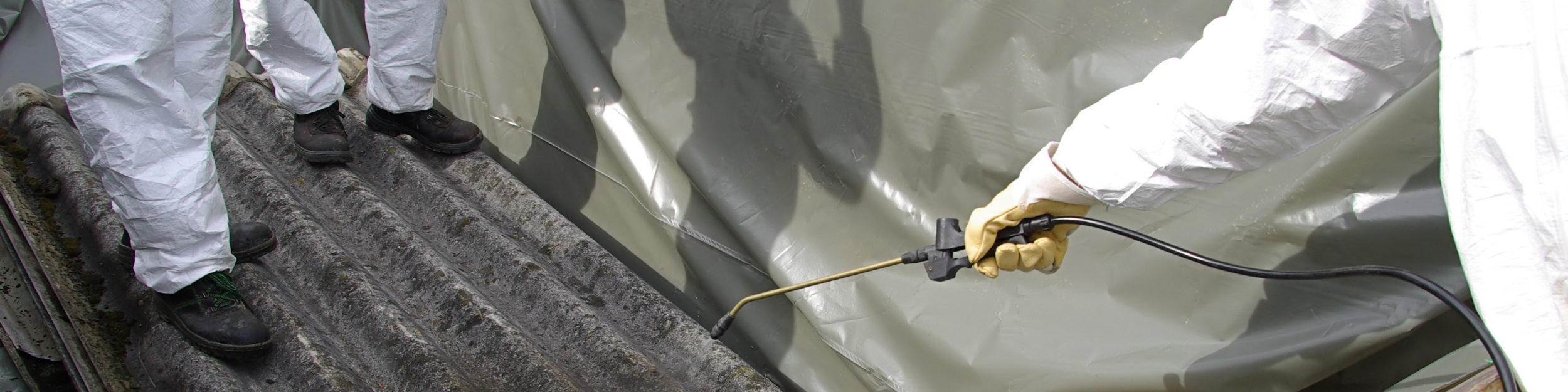
Quick answer: The difference between friable and non-friable asbestos is a simple hand test with enormous legal consequences. Non-friable (bonded) asbestos is fibre locked inside a hard matrix — typically cement — that cannot be crumbled to powder by hand pressure when dry. It covers most of the asbestos found in pre-2004 Melbourne homes: fibro cement sheeting, corrugated roofing, eaves, fences, vinyl tiles. A Class B licensed asbestos removalist can legally remove it. Friable asbestos is any asbestos that can be crumbled, pulverised or reduced to powder by hand pressure when dry — sprayed limpet insulation, pipe lagging, millboard, asbestos rope — or any non-friable material that has been damaged by fire, water, weather, age, or aggressive mechanical impact and is no longer bound in its matrix. Friable work is Class A licensed only. The single most common reason a Melbourne project blows out in cost and program is a “non-friable” job that turns out to be friable once it’s inspected properly under AS 5370:2024. This guide explains how the classification works, why it matters, and how to get it right before the quote, not after the prosecution.
If you own, manage, renovate or demolish a pre-2004 property in Melbourne or Victoria, the friable / non-friable question is the first one your removalist needs to answer — because it determines who is legally allowed to touch the material, what controls are required, what disposal pathway applies, and how the program is built.
Why This One Classification Drives Everything
A lot of Victorian asbestos regulation looks complicated on the surface. Read the Occupational Health and Safety Regulations 2017 (Vic), the WorkSafe Compliance Code: Removing Asbestos in Workplaces, and the EPA’s Publication IWRG611.2 end-to-end and the volume can feel overwhelming. But almost every operational decision in those documents flows from a single upstream question:
Is this material friable, or non-friable?
That one binary classification determines:
- Licensing — Class A (friable + non-friable) versus Class B (non-friable only).
- Removal methods — full enclosures, negative air units and air monitoring for friable, versus wet-method open removal for non-friable.
- PPE and RPE — air-fed full-face systems versus P2/P3 half-face respirators.
- Notification — both still require five days’ notice to WorkSafe Victoria, but friable jobs trigger additional supervisory and monitoring obligations.
- Program duration — friable jobs typically run one to three weeks longer than equivalent non-friable jobs.
- Cost — friable removal is materially more expensive due to controls, supervision, and air monitoring.
- Clearance — friable clearance requires air monitoring under Regulation 297; non-friable clearance is typically visual.
In other words, when a removalist quotes your job, the first thing they are quietly assessing on the site walk is not how much asbestos there is. It is what condition it’s in and which classification it falls under. Get that wrong on day one and the rest of the program is wrong with it.
The Definitions: What the Law Actually Says
Both classifications are defined in the OHS Regulations 2017 and reflected in the WorkSafe Victoria Compliance Codes. They are deliberately practical — designed to be applied by a removalist on site, not just a laboratory technician in a controlled environment.
Non-friable asbestos (also called “bonded” asbestos)
Asbestos-containing material in which the asbestos fibres are bonded within a matrix (usually cement, vinyl, resin or bitumen) such that the material cannot be crumbled, pulverised or reduced to powder by hand pressure when dry.
The defining feature is the matrix. The asbestos fibres are not loose — they are locked into a solid binder that has been formed, set and hardened during manufacture. The classic example is asbestos cement sheeting: cement is the matrix, asbestos fibres are the reinforcing component, and the resulting hardened sheet behaves mechanically like a brittle stone tile. You can break it with force, but it does not crumble to dust between your fingers.
Friable asbestos
Asbestos-containing material that, when dry, can be crumbled, pulverised or reduced to powder by hand pressure — or that is in a powdered form to begin with.
The defining feature is the absence of binding. The fibres are loose, lightly held, or so degraded that they release with minimal force. Friable asbestos behaves like a fine, fibrous powder rather than a stone-like sheet.
The hand-pressure test
Both definitions use the same diagnostic image: what happens when you squeeze it dry? This is not a precise laboratory test, but it is a remarkably effective real-world heuristic, and it is the one inspectors, removalists and lawyers refer back to.
- Non-friable: A piece of fibro cement sheeting feels and behaves like a brittle slab. Squeeze a corner between thumb and finger — it stays intact. Hit it with a hammer and it shatters into hard fragments, not powder.
- Friable: Sprayed limpet insulation feels and behaves like a hardened wool batt. Squeeze it and it crumbles to dust between your fingers. Touch it firmly with a gloved hand and visible fibres release into the air.
The clarity of this difference is precisely why the classification works — until something happens to the non-friable material that crosses it over the line. That grey zone is where Melbourne projects most commonly come unstuck, and we’ll come back to it.
Non-Friable Asbestos: What It Looks Like in Melbourne Buildings
In pre-2004 Victorian building stock, non-friable asbestos accounts for the vast majority of asbestos found in residential and light commercial properties. It is the dominant category because cement-bound products were cheap, durable and easy to manufacture at industrial scale through the mid-20th century.
A licensed Class B removalist works almost exclusively with non-friable materials. Here is what they typically look like in Melbourne homes and commercial sites:
Common non-friable materials in Melbourne
| Material | Where it’s found |
|---|---|
| Fibro cement sheeting (Super Six, Hardiplank, Versilux, Wunderlich) | External walls, internal walls, eaves, bathroom and laundry sheeting behind tiles, garage walls |
| Corrugated asbestos cement roofing | Houses, garages, sheds, factories, dairies, packing sheds |
| Asbestos cement ridge cappings, flashings and gutters | Roof junctions, gable ends |
| Asbestos cement fences (Super Six fencing) | Backyards across virtually every Melbourne suburb developed before 1990 |
| Vinyl floor tiles and sheet flooring | Kitchens, bathrooms, laundries, hallways — especially 1960s–1980s installations |
| Bituminous adhesives under vinyl flooring | The black mastic glue layer beneath asbestos-backed lino and tiles |
| Asbestos cement water pipes and drainage pipes | Underground services, particularly in older suburbs |
| Asbestos cement flues | Slow-combustion heaters, kitchen wood stoves, hot water units |
| Switchboard backing panels (Zelemite, Ausbestos, Lebah, Miscolite) | Electrical switchboards in pre-1985 homes and commercial buildings |
| Fire doors with cement-bonded asbestos cores | Older commercial fire-rated doorways |
| Brake linings and clutch facings | Pre-1990 vehicles and industrial brake systems |
What unites all of these is the same physical principle: the fibres are locked in a hard, set matrix. In good condition, these materials release very few fibres. The risk profile of non-friable asbestos in good condition is genuinely low — which is why the historical “manage in place” approach worked for decades, and why a Class B licensed removalist can safely handle it with wet methods, hand tools, P2/P3 respirators and double-wrapping rather than the full Class A enclosure framework.
Where you’ll find it in Melbourne specifically
Non-friable asbestos is essentially universal in the pre-1990 housing stock that dominates inner and middle-ring Melbourne. Walk down a residential street in Northcote, Coburg, Reservoir, Footscray, Sunshine, Box Hill, Glen Iris, Caulfield, Bentleigh, Oakleigh, Frankston, Heidelberg, Pascoe Vale, Brunswick or Dandenong, and a meaningful percentage of the fences alone are asbestos cement. The eaves of most homes built between 1945 and 1985 are asbestos cement. Many garages and sheds are entirely fibro. The bathroom and laundry sheeting behind tiles, the vinyl floor tiles in the kitchen, the flue on the wood heater — all standard non-friable applications.
Across regional Victoria — Geelong, Ballarat, Bendigo, Shepparton, the Latrobe Valley, the Mornington Peninsula and the Yarra Valley — the same materials dominate rural building stock, with the addition of asbestos cement on shearing sheds, dairies, packing sheds, pump houses, stock troughs and water tanks.
Friable Asbestos: What It Looks Like in Melbourne Buildings
Friable asbestos is far less common in residential properties but appears regularly in older commercial, industrial and institutional buildings — and in any property that has been damaged.
Common friable materials
| Material | Where it’s found |
|---|---|
| Sprayed limpet insulation | Structural steel beams in factories, warehouses and older high-rise commercial buildings; sometimes on the underside of concrete slabs |
| Pipe lagging (calcium silicate or magnesia-based asbestos insulation) | Hot water pipes, steam pipes, boilers, process pipework in factories, hospitals, schools and apartment buildings |
| Asbestos rope and gaskets | Boilers, ovens, kilns, fire doors, flange seals in industrial plant |
| Millboard and insulation board (Asbestolux, Limpet board) | Behind heating appliances, in service risers, in fire protection applications |
| Loose-fill asbestos insulation | Ceiling cavities (very rare in Victoria but documented; far more common in parts of NSW and the ACT) |
| Textured ceiling coatings (“popcorn” or stipple ceilings) | Some 1960s–1980s residential and commercial ceilings, particularly where chrysotile was used as a binder |
| Decorative wall coatings and renders | Some older institutional and commercial finishes |
| Asbestos fabrics, felts and wicks | Insulation blankets, fire blankets, gas appliance components |
The defining physical characteristic across all of these is that the asbestos was either applied loose (sprayed limpet, loose-fill), bonded with a soft and degradable binder (millboard, pipe lagging), or woven into a textile (rope, gaskets, fabric). In every case, hand pressure on the dry material crumbles it — sometimes spectacularly.
Where it appears in Melbourne specifically
For residential renovators in Melbourne, friable asbestos is most commonly encountered in:
- Pre-1985 hot water service installations with lagged pipework in the wall cavity or under-floor space.
- Slow-combustion heater installations where the original flue collar or hearth gasket has degraded.
- Older commercial conversions — warehouses, factories and offices being converted to apartments or studios, where sprayed structural steel insulation or lagged process pipework is still in place.
- Industrial heritage buildings — anything with a boiler room, a kiln, a steam plant, or process pipework, particularly across the western and northern industrial belt (Sunshine, Tottenham, Brooklyn, Campbellfield, Broadmeadows, Dandenong South) and the Latrobe Valley.
- Pre-1985 institutional buildings — older schools, hospitals, council buildings, churches and community halls, where pipe lagging and fire-protection millboard were commonly specified.
Friable asbestos in a Melbourne home is uncommon but not unheard of. When it appears, it is almost always either a relic of an older heating system or the result of damage to material that was originally non-friable — which is the next, and most important, section.
The Grey Zone: When Non-Friable Becomes Friable
This is the single most important concept in the entire friable / non-friable conversation, and the one that causes the most program upheaval on Melbourne projects.
Non-friable asbestos can become friable. The matrix that locks the fibres in place can degrade or be destroyed, releasing the fibres into a friable state. When that happens, the material is reclassified — not for paperwork purposes, but because its real-world fibre release behaviour has fundamentally changed. And that reclassification moves the work from Class B to Class A licensed.
What causes non-friable to become friable
The OHS Regulations and the WorkSafe Compliance Code identify several pathways:
1. Fire damage
Fire is the most common cause of friability in Victorian buildings. The intense heat of a structure fire destroys the cement matrix in asbestos cement sheeting, leaving behind charred fragments where the binding is gone and the fibres are exposed. After a house fire, garage fire, or shed fire, all previously non-friable ACM on the site must be treated as friable until proven otherwise. This is a Class A scenario regardless of how the material looked before the fire.
2. Water damage and weathering
Long-term water exposure — leaking roofs, persistent damp, flood inundation — slowly degrades the cement matrix. The surface becomes chalky, fibres become exposed, and what was once hard sheeting becomes soft, friable material that crumbles under hand pressure. Asbestos cement roofs that have been leaking for years, sheeting that has been buried in damp soil, and material exposed to repeated flooding all sit in this category.
3. Severe weather damage
Storm events, hail, and wind damage can crack and pulverise asbestos cement sheeting. Once material has been broken and exposed to weathering over time, the previously bound fibres can release. Victoria’s recent run of severe storms has produced exactly this category of damaged material on a meaningful scale.
4. Age and degradation
Even without specific damage, asbestos cement degrades over time. Decades of UV exposure, freeze-thaw cycling, and ordinary weathering can render very old material chalky and brittle. The Asbestos National Strategic Plan 2024–2030 explicitly addresses this — one of the reasons Australian policy is shifting from “manage in place” to “proactive removal” is that the legacy stock is ageing into friability as time passes.
5. Aggressive mechanical impact
This is the DIY-disaster category. A previously non-friable sheet that has been hit with a power tool, water-blasted, sanded, drilled, snapped to fit a trailer, or driven over by a vehicle is no longer non-friable. The matrix has been physically destroyed at the point of impact, and the surrounding material is now releasing fibres at friable rates. Power-tool use on ACM is explicitly prohibited under the WorkSafe Compliance Code for exactly this reason.
6. Earlier botched removal attempts
Worth calling out separately because it is more common than it should be: a site where a previous (unlicensed) attempt to demolish or strip asbestos has left broken, pulverised or crumbled material on the ground. By the time a licensed removalist arrives, what would have been a routine Class B job is now a Class A friable contamination scenario, often involving soil remediation.
Why this matters for your project
For builders, developers and property owners in Melbourne, the practical implication is that the friable/non-friable classification is not determined at the time of original construction. It is determined at the time of inspection. A 1970s fibro garage that has been weathering for 50 years, leaking for 10 years, hit by a 2024 storm, and partially broken open by a well-meaning previous owner is not a Class B job, no matter what it looked like in 1972.
This is why a competent pre-work inspection matters so much, and why pre-demolition surveys in particular are intentionally destructive — they need to find the damaged material that’s been hiding behind the surface.
Reality check for owners receiving cheap quotes: A contractor who quotes a fire-damaged or long-derelict site as a Class B job is either not licensed for Class A work, is hoping you won’t notice, or hasn’t actually inspected the material properly. All three are red flags. The reclassification has to happen on quote day, not on demolition day.
Side-by-Side Comparison
For quick reference, here is the friable / non-friable distinction set out in a single table.
| Feature | Non-Friable (Bonded) | Friable |
|---|---|---|
| Definition | Cannot be crumbled to powder by hand pressure when dry | Can be crumbled to powder by hand pressure when dry, or is already a powder |
| Matrix | Fibres locked in cement, vinyl, resin or bitumen | Fibres loose, lightly bound, or unbound |
| Hand-pressure test | Intact, stone-like behaviour | Crumbles, dusts, releases visible fibres |
| Typical examples | Fibro sheeting, corrugated roofing, eaves, fences, vinyl tiles, switchboards | Sprayed limpet, pipe lagging, millboard, asbestos rope, fire-damaged cement sheet |
| Common location in Melbourne | Most pre-2004 residential and light commercial | Older industrial, institutional, and damaged buildings |
| Fibre release in good condition | Low | High — releases fibres easily on disturbance |
| Licence required | Class B (or Class A) | Class A only |
| DIY threshold | <10m² AND <1 hr / 7 days (Vic residential only) | No DIY permitted under any circumstances |
| Removal method | Open removal with wet methods, hand tools, P2/P3 RPE | Full enclosure, negative air units, air-fed RPE, decontamination units |
| Air monitoring | Generally not required for clearance | Required throughout work and for clearance |
| Typical clearance | Visual inspection | Visual + air monitoring (analytical clearance) |
| WorkSafe notification | 5 days minimum | 5 days minimum + supervisory requirements |
| Disposal classification | Reportable Priority Waste (RPW) | Reportable Priority Waste (RPW) |
| Disposal pathway | EPA-licensed landfill | EPA-licensed landfill |
| Typical cost ratio | Baseline | Materially higher — controls, supervision, monitoring |
| Program impact | Standard | Typically 1–3 weeks longer end-to-end |
| Can become the other? | Yes — through damage, fire, water, age, impact | No — friable cannot revert to non-friable |
Why Class A and Class B Are Two Different Licences
Victorian asbestos removal licensing is structured directly around the friable / non-friable classification. WorkSafe Victoria issues two licence classes, and the distinction is legally enforced.
Class B (non-friable) licence
A Class B asbestos removal licence authorises the holder to remove all forms of non-friable asbestos. This covers the vast majority of asbestos work in Victorian residential and light commercial properties — fences, garages, eaves, roofs, fibro sheeting, vinyl tiles, switchboards, fences.
Class B licensees must demonstrate:
- Trained removalists holding the nationally recognised unit CPCCDE3014 — Remove non-friable asbestos.
- A nominated site supervisor with CPCCBC4051A — Supervise asbestos removal.
- Compliant respiratory protection (P2/P3), H-class hazardous-dust vacuums, and protective clothing.
- Medical fit-for-work certificates for each removalist (renewed every two years).
- A documented Safe Work Method Statement (SWMS) and Asbestos Removal Control Plan (ARCP) for every job.
A Class B licence holder is legally prohibited from undertaking Class A work under any circumstances — even with the homeowner’s permission. There is no flexibility on this point.
Class A (friable + non-friable) licence
A Class A asbestos removal licence authorises removal of all asbestos types — friable and non-friable. Requirements include everything in Class B, plus:
- An external Occupational Health and Safety (OHS) Management System certificate.
- Mandatory on-site supervision throughout the works (not just nominated supervision).
- Enclosures sealing the work area from the rest of the building or site.
- Negative air units with HEPA filtration to keep the work zone at lower air pressure than the surroundings.
- Decontamination units — typically a three-stage shower system through which workers must pass when leaving the zone.
- Air monitoring before, during and after the removal, analysed at NATA-accredited laboratories.
The capital cost, training cost, and operational overhead of a Class A licence are materially higher than a Class B licence, which is why most asbestos removalists in Victoria are Class B specialists and Class A holders are fewer in number.
What this means in practice for a Melbourne project
If your job is straightforward non-friable removal — a fence, a garage, a roof, eaves, a bathroom strip on a pre-2004 home — a Class B licensed contractor like Asbestos Gone and Clean can handle it end-to-end.
If your job turns out to involve friable material — sprayed insulation, pipe lagging, fire-damaged sheeting, or a derelict site with degraded ACM — a Class A specialist needs to handle the friable portion. The good news is that a Class A specialist can be coordinated under a Class B project as a subcontracted scope, so you still get one project manager and one documentation pack. The bad news is that this needs to be identified at quote time, not on the morning the excavator is supposed to arrive.
For a fuller breakdown of Victorian licensing and the regulatory framework, see our deep-dive on Asbestos Regulations and Legal Requirements in Australia.
How Removal Methods Differ in Practice
The reason friable and non-friable carry different licence classes is that the physical methods used to remove them safely are genuinely different.
Non-friable removal — the Class B approach
Non-friable removal is typically conducted as controlled open work with engineering controls focused on suppressing fibre release at the source:
- Wet methods — continuous spraying of the material with water and a PVA wetting agent to keep fibres bound while the material is removed.
- Hand tools only — no angle grinders, no circular saws, no high-pressure washers, no drills on the ACM itself.
- Whole-sheet removal — materials are unscrewed and lifted off intact rather than broken.
- Immediate double-wrapping — every removed item goes straight into 200-micron polyethylene, sealed and labelled.
- P2/P3 respiratory protection — half-face respirators with appropriate filters.
- Disposable PPE — coveralls, gloves, boot covers, all bagged as asbestos waste at end of shift.
- H-class hazardous-dust vacuum cleaning of the work zone before standdown.
- Visual clearance inspection by an independent competent person under Regulation 297 before re-occupation.
This approach works because non-friable material in good condition releases very few fibres when handled correctly. The PPE is the last line of defence; the wet methods and intact removal are the primary fibre controls.
Friable removal — the Class A approach
Friable removal cannot rely on the same controls because the material is releasing fibres simply by being touched. The Class A approach is built around containment:
- Full enclosures — the work area is sealed with critical-barrier polythene and sealed tape, isolating it from the rest of the building.
- Negative air units — fans equipped with HEPA filters draw air out of the enclosure through a controlled exhaust, keeping the enclosure at lower pressure than the surroundings so that any fibre release is drawn into filtration rather than leaking out.
- Air-fed full-face respiratory protection — workers breathe filtered air supplied from outside the contaminated zone.
- Three-stage decontamination units — workers pass through a dirty zone (PPE removal), a shower zone, and a clean zone before exiting the enclosure.
- Continuous air monitoring — fibre concentrations are measured throughout the work and analysed at NATA-accredited laboratories.
- Mandatory on-site supervision — a licensed supervisor is present for the duration of the work, not just on call.
- Wet methods plus chemical encapsulation — the material is often sealed with a binding agent (similar to PVA on steroids) before removal to lock down loose fibres.
- Analytical clearance — clearance under Regulation 297 includes air monitoring results below the workplace exposure standard before the enclosure can be dismantled.
The cost differential between the two approaches is significant. The control system itself — enclosures, negative air units, decontamination units, air monitoring, supervisory time — adds meaningful overhead to every Class A job, which is why even a small friable scope can shift a project’s economics substantially.
The Health Risk Profile: Are They Equally Dangerous?
The honest scientific answer is yes, all asbestos is dangerous, but their risk-on-disturbance profiles are very different.
What the science says
All forms of asbestos — chrysotile (white), amosite (brown) and crocidolite (blue) — are classified as Group 1 human carcinogens by the International Agency for Research on Cancer (IARC). The World Health Organization, Safe Work Australia, the Asbestos and Silica Safety and Eradication Agency (ASSEA), and WorkSafe Victoria all formally adopt the position that there is no safe level of exposure. Asbestos causes mesothelioma, lung cancer, asbestosis, ovarian cancer, laryngeal cancer, and a range of non-malignant pleural diseases. Latency periods run from 10 to 50 years depending on the disease.
None of that varies between friable and non-friable. A fibre is a fibre, and once it is lodged in lung tissue the body cannot remove it.
What does vary: fibre release rate
The difference between friable and non-friable lies entirely in how readily the material releases fibres when disturbed:
- Non-friable in good condition: Releases very few fibres in normal handling. The cement matrix holds the fibres in place. Risk is low until the material is broken, cut, drilled, weathered or pulverised.
- Non-friable that has been damaged or aggressively worked: Releases dramatically more fibres. A single angle-grinder cut on a fibro sheet can release more fibres than an entire compliant industrial removal.
- Friable in any condition: Releases fibres continuously on contact. Walking through a friable contamination zone in normal clothing aerosolises fibres simply by air movement. This is the worst-case airborne release scenario.
The translation is simple: non-friable is risky only when disturbed badly; friable is risky whenever touched. That is why the engineering controls differ, why the licensing differs, and why a DIY exemption exists for small non-friable jobs but not for any friable work.
For the full evidence-based picture, see our companion piece on The Health Risks of Asbestos Exposure: What the Science Says.
How To Tell Which One You Have: Identification and Sampling
Visual identification of asbestos materials by an experienced inspector is often reliable for common, intact non-friable products — a Super Six fence is a Super Six fence, and there’s not much ambiguity about it. But visual identification is not legally sufficient for many regulatory purposes, and it is genuinely unreliable for damaged, weathered, painted, or unusual materials.
The role of NATA-accredited laboratory sampling
The Australian standard AS 5370:2024 — Air Quality — Bulk Materials sets out the methods for laboratory analysis of suspect ACM. Compliant identification involves:
- A trained, licensed assessor or removalist takes a small bulk sample of the suspect material using a wet sampling technique that minimises fibre release.
- The sample is sealed, labelled, and chain-of-custody documented.
- The sample is delivered to a NATA-accredited laboratory for analysis using polarised light microscopy (PLM) with dispersion staining, the standard method specified in AS 5370:2024.
- The lab issues a written report identifying whether asbestos is present, what type (chrysotile, amosite, crocidolite or mixed), and at what concentration band.
- Standard turnaround is 2 to 5 working days, with express services sometimes available.
The cost is modest — typically $40 to $80 per sample — and it is included as standard practice in any reputable removalist’s quote where the material is not unambiguously identifiable on sight.
Can the lab tell you if it’s friable?
The lab confirms the asbestos type and presence. The friable / non-friable classification is a determination made by the licensed assessor on site, based on the physical condition of the material and the hand-pressure test. The lab report provides the supporting evidence; the classification itself is a field call.
This is why a destructive pre-demolition survey matters so much on older buildings. The assessor needs to physically inspect the material — including damaged, hidden, or weather-exposed sections — to make an accurate friable / non-friable classification across the whole site. A management-level survey that didn’t lift floors or open cavities will systematically under-identify friable material that has been hiding for years.
What you cannot do
A few common DIY shortcuts that do not work:
- You cannot tell by colour. White asbestos cement is the same chrysotile-bound product whether it’s grey, off-white, painted cream or weathered green-black with moss.
- You cannot tell by manufacturer. Super Six, Hardiplank, Versilux, Wunderlich — all manufactured non-friable cement sheeting through different eras. The classification depends on current condition, not original brand.
- You cannot tell by age alone. A 1980s sheet in mint condition is non-friable; a 1980s sheet that’s been weathering on a leaking roof since 2005 may not be.
- You cannot rely on a home asbestos test kit. Some retail kits exist, but the sample they generate is still going to a lab, and the field test alone is not legally sufficient. If you’re sampling at all, sample properly and send to a NATA-accredited facility.
- You cannot rely on a previous owner’s word. Even a well-intentioned previous owner often misremembers what was renovated, when, by whom, and to what standard.
The single reliable answer to “What is this material?” is a NATA-accredited bulk sample analysed under AS 5370:2024, combined with a competent field assessment of its current condition.
Common Misidentifications That Cost Melbourne Owners Money
A handful of patterns recur often enough on Melbourne sites that they are worth flagging specifically. These are the situations where the initial assumption of “non-friable” turns out to be wrong, with predictable cost and program consequences.
The fire-damaged garage
A 1970s fibro garage, fire-affected ten years ago and not properly cleared, gets quoted as a Class B job because the surface still looks intact at first glance. On closer inspection — particularly the rafter line, the interior wall faces, and any sheeting near the original seat of the fire — the cement matrix has been heat-destroyed, and the material is friable. Class A scope, with potential soil remediation if any debris has fallen onto the ground.
The long-leaking shed roof
A corrugated asbestos cement shed roof that has been leaking through a cracked sheet for 15 years. The cement around the cracks is now chalky and crumbles in your hand. The remainder of the roof may still be non-friable, but the damaged sections — and any debris that has dropped onto the floor below — are friable.
The “we already pulled some off ourselves” site
The owner has had a go at removing the asbestos cement themselves before deciding to call a professional. There is broken sheeting on the ground, dust on adjacent surfaces, and probably fibres tracked into the rest of the property. What would have been a Class B job is now a friable contamination scenario requiring Class A scope, sometimes with soil and subfloor testing.
The hidden pipe lagging behind a wall
A pre-1985 commercial fit-out is being stripped. The visible scope is fibro wall sheeting (non-friable, Class B). Behind one of the walls is a steam pipe with degraded asbestos lagging that wasn’t on any register. As soon as the wall comes off, the lagging is exposed — and is unambiguously friable. The Class B scope cannot continue until a Class A team handles the lagging.
The Zelemite switchboard
An electrician opens a 1970s switchboard to do a service upgrade. The backing panel is asbestos cement (Zelemite, Ausbestos, or similar). The panel itself is non-friable, but decades of arcing, drilling for additional circuits, and general age have pulverised sections of the back of the panel into friable debris inside the switchboard cavity. Class A handling for the cavity, Class B handling for the intact panel.
The textured “popcorn” ceiling
A 1960s–1970s ceiling with a heavy stipple or popcorn texture is being prepared for a renovation. Some textured ceiling coatings contained chrysotile as a binder. Where present, these are generally friable because the coating is soft and dusts easily — a fundamentally different scenario from the underlying plaster.
The pattern across all of these is the same: the surface-level assumption of “non-friable” doesn’t survive contact with what’s actually on site. A competent inspection makes the call at quote time. A cheap inspection makes the call when the project is already running.
Disposal: Same Pathway, Different Volumes
Both friable and non-friable asbestos are classified as Reportable Priority Waste (RPW) under the Environment Protection Regulations 2021 (Vic) and follow the same disposal pathway: wrapped in 200-micron polyethylene, labelled, tracked through EPA Victoria’s Waste Tracker system, transported by an EPA-permissioned operator in a covered secure vehicle, and disposed of at an EPA-licensed landfill authorised to receive asbestos.
The difference is in volume and packaging precaution. A friable job typically generates substantially more secondary waste — enclosure materials, decontamination shower water filters, more disposable PPE, more wrapping — because the engineering controls themselves become contaminated and have to go to landfill with the source material. The principle that “anything that touched the asbestos travels with the asbestos” applies more aggressively on friable jobs because more things touch it.
The disposal cost difference is therefore real but proportionate. The bigger cost drivers on friable work are the controls, supervision and air monitoring, not the tipping fee.
For the full disposal journey, see our deep-dive on What Happens to Asbestos After It’s Removed From a Property?.
What This Means for Renovations, Demolitions and Builders
For builders, developers, project managers and owner-builders, the friable / non-friable classification has three programmatic implications worth internalising:
1. Identify early, not late
The classification needs to be made at the pre-quote inspection, not at the start of the removal. The cost of getting it wrong is not a small variation — it can be a multi-week program shift and a substantially different scope of works. Build a proper inspection into the project programme, and on pre-2004 demolitions, build in a destructive pre-demolition asbestos survey.
2. Treat damaged sites as friable until proven otherwise
If the building has been fire-damaged, flood-damaged, storm-damaged, derelict for years, or previously subject to amateur removal attempts, the working assumption should be friable until a competent inspection demonstrates otherwise. This is the conservative call and it is consistently the cheaper call once the variation costs of being wrong are accounted for.
3. Use one contractor for the full scope where possible
The biggest program risk on pre-2004 sites is the coordination gap between contractors. Engaging a Class B removalist who can coordinate Class A specialists as a subcontracted scope under one ABN removes the most common cause of slippage — two crews trying to align their diaries and waste manifests after the work is already in flight. Asbestos Gone and Clean runs this integrated model on every project specifically because we’ve seen what happens when the friable scope catches a builder by surprise.
How Asbestos Gone and Clean Handles Friable / Non-Friable on Every Job
We are a WorkSafe Victoria licensed Class B (non-friable) asbestos removalist and demolition contractor based in Melbourne, servicing all of Greater Melbourne and regional Victoria — from the inner suburbs out to Geelong, Ballarat, Bendigo, the Mornington Peninsula, the Yarra Valley, the Latrobe Valley and beyond.
Our approach to the friable / non-friable classification is built into every quote and every project:
- Free site inspection with a competent assessor — not just a tape measure and a clipboard.
- NATA-accredited bulk sampling in line with AS 5370:2024 wherever the material identity is not unambiguous on sight.
- Honest field classification of friable vs non-friable — including a frank conversation about any borderline materials and what they will mean for the program.
- Class B (non-friable) removal in-house with wet methods, hand tools, H-class vacuums, P2/P3 respirators, full PPE, and full documentation.
- Coordinated Class A subcontracting for any friable scope — under our project management, one accountable contact, one documentation pack.
- WorkSafe Victoria notification at least five days before removal begins.
- EPA-tracked transport and disposal as Reportable Priority Waste to an EPA-licensed landfill, with full Waste Tracker manifests.
- Independent clearance certificate under Regulation 297 of the OHS Regulations 2017 — visual for non-friable, analytical (with air monitoring) for any friable scope.
- Complete documentation pack — licences, ARCP, SWMS, notification, manifests, tip receipts and clearance certificate — delivered for your records, your insurer and any future buyer due diligence.
For builders, developers and owner-builders, we also run integrated soft strip and demolition services under one ABN — removing the single biggest cause of program slippage on pre-2004 demolition sites.
Frequently Asked Questions
What is the difference between friable and non-friable asbestos?
Non-friable (bonded) asbestos is asbestos that is locked inside a hard matrix — typically cement — and cannot be crumbled to powder by hand pressure when dry. Friable asbestos can be crumbled to powder by hand pressure when dry, or is already in powdered form, or has been damaged in a way that destroys the binding matrix. The classification determines which licence class is legally required, which removal methods apply, and how the project is programmed and priced.
Can non-friable asbestos become friable?
Yes — and this is one of the most important practical points. Non-friable asbestos can become friable through fire damage, water damage, severe weather damage, age-related degradation, aggressive mechanical impact, or previous botched removal attempts. A 1970s fibro garage that has been fire-affected or has been leaking for years is no longer non-friable, regardless of what it looked like originally. The classification is determined by the material’s current physical condition, not its date of manufacture.
What are examples of non-friable asbestos in a Melbourne home?
Common non-friable materials in Melbourne homes include: fibro cement sheeting (Super Six, Hardiplank, Versilux), corrugated asbestos cement roofing, eaves and soffit linings, asbestos cement fences, vinyl floor tiles and their bituminous adhesive, asbestos cement water and drainage pipes, asbestos cement flues on slow-combustion heaters, and switchboard backing panels (Zelemite, Ausbestos, Lebah). The vast majority of asbestos in pre-2004 Victorian residential properties is non-friable.
What are examples of friable asbestos?
Friable asbestos is most commonly encountered as: sprayed limpet insulation on structural steel, pipe lagging on hot water and steam pipes, millboard and insulation board, asbestos rope and gaskets, textured “popcorn” ceiling coatings (where present), and any of the above non-friable materials that have been damaged by fire, water, age or aggressive impact. Friable material is far more common in older industrial, institutional and commercial buildings than in standard Melbourne homes — though damaged residential ACM crosses into friable status more often than owners realise.
How can I tell if my asbestos is friable or non-friable?
The diagnostic principle is the hand-pressure test when the material is dry. If it cannot be crumbled to powder by hand pressure, it is non-friable. If it can, it is friable. In practice, a competent field assessment combined with NATA-accredited bulk sampling under AS 5370:2024 is the only reliable way to make the classification — particularly for damaged, painted, weathered, or unusual materials. Visual identification by an experienced licensed removalist is often sufficient for clearly intact common materials.
What licence is required to remove non-friable asbestos in Victoria?
Above the DIY exemption threshold (10m² and one hour over any seven-day period in owner-occupied residential property), a WorkSafe Victoria Class B asbestos removal licence is required for non-friable removal. A Class A licence also covers non-friable work, but most non-friable jobs in Victoria are handled by Class B specialists.
What licence is required to remove friable asbestos in Victoria?
Only a WorkSafe Victoria Class A asbestos removal licence authorises friable asbestos removal. Class B licence holders are legally prohibited from undertaking Class A work under any circumstances. There is no DIY exemption for friable material — it cannot legally be removed by a homeowner regardless of quantity.
Is friable asbestos more dangerous than non-friable?
All forms of asbestos are classified as Group 1 human carcinogens, and there is no safe level of exposure for any of them. The practical difference is in fibre release behaviour: friable asbestos releases fibres continuously on contact, while non-friable asbestos in good condition releases very few fibres until the matrix is damaged. The engineering controls and licensing differ because the disturbance risk profile differs — not because one type of fibre is intrinsically more carcinogenic than another.
Can I remove non-friable asbestos myself in Victoria?
Only within a narrow exemption: the material must be non-friable, the total area must be less than 10m², the work must take less than one hour over any seven-day period, and the property must be owner-occupied residential. Above any one of those thresholds, a Class B licensed removalist is legally required. Even within the exemption, WorkSafe Victoria recommends using a licensed professional. For the full DIY-versus-professional comparison, see our companion guide.
Can I remove friable asbestos myself in Victoria?
No — never, under any circumstances, regardless of quantity or property type. Friable asbestos removal is Class A licensed work only.
What happens if my non-friable asbestos turns out to be friable on inspection?
The scope is reclassified, a Class A specialist is engaged (or coordinated by the Class B contractor as a subcontracted scope), the program is extended — typically by one to three weeks — and the cost increases to reflect the additional controls, supervision and air monitoring required. This is exactly why pre-work inspections matter: identifying the reclassification at quote time is dramatically cheaper than identifying it on demolition morning.
Does damaged or weathered fibro count as friable?
In many cases, yes. Material that has been fire-damaged, water-damaged, severely weathered, or mechanically pulverised loses the cement matrix that defines its non-friable status, and is reclassified as friable for handling purposes. A licensed assessor makes the determination on site after physical inspection.
Are vinyl floor tiles friable or non-friable?
Asbestos-backed vinyl floor tiles and their bituminous adhesive are non-friable in normal condition — the asbestos is bound in the vinyl or bitumen matrix. However, aggressive removal methods (sanders, scrapers used on dry adhesive, heat guns at high temperatures) can damage the matrix and create localised friable contamination. Wet methods and careful lifting are the compliant approach.
Is pipe lagging always friable?
Almost always, yes. Asbestos pipe lagging — typically a fibrous insulation material wrapped around hot water, steam or process pipes — is friable in essentially all field conditions. It crumbles readily to dust when handled and requires Class A removal.
What is the cost difference between friable and non-friable removal?
Friable removal is materially more expensive than non-friable removal, primarily because of the engineering controls (full enclosures, negative air units, decontamination units), the mandatory on-site supervision, the air monitoring at NATA-accredited laboratories, and the analytical clearance requirement. The exact differential depends on the job, but as a rough guide, equivalent friable work commonly runs two to four times the cost of non-friable removal, plus a longer program.
Does the friable / non-friable classification appear on the disposal manifest?
The manifest classifies the waste as Reportable Priority Waste (RPW) under the Environment Protection Regulations 2021. Both friable and non-friable asbestos waste fall within this classification and follow the same EPA-licensed landfill disposal pathway. The receiving landfill records the waste type and any specific handling requirements.
My old shed is half-broken and weathered — is that still a Class B job?
Maybe, but it’s worth getting a proper inspection. If the broken sections have weathered to the point where the cement matrix is chalky and the material crumbles readily, those sections may be friable and require Class A handling — even if the intact portions of the shed are still Class B. A licensed removalist will make the call after physical inspection and quote the correct scope from the start.
Can I tell friable from non-friable just by looking at it?
For clearly intact common materials — a sound Super Six fence, a brand-new-looking fibro garage wall — visual identification by an experienced licensed removalist is usually reliable. For damaged, painted, weathered, or unusual materials, visual identification is not sufficient. A NATA-accredited bulk sample under AS 5370:2024 combined with a competent field assessment of physical condition is the only reliable approach.
Do friable and non-friable jobs both require a clearance certificate?
Yes — both require an independent clearance certificate under Regulation 297 of the OHS Regulations 2017 before the area can be re-occupied. For non-friable jobs, clearance is typically based on visual inspection. For friable jobs, clearance requires air monitoring at NATA-accredited laboratories confirming fibre concentrations below the workplace exposure standard, in addition to visual inspection.
The Bottom Line on Friable vs Non-Friable Asbestos
The friable / non-friable classification is the single most consequential distinction in Victorian asbestos law. It determines who is legally allowed to handle the material, what controls apply, how long the project will take, what it will cost, and what kind of clearance is needed before the next trade can come back on site.
For most Melbourne residential and light commercial properties, the asbestos involved is non-friable — bonded into the cement, vinyl or resin matrix that defines fibro sheeting, corrugated roofing, eaves, fences, vinyl tiles and switchboard backing panels. A licensed Class B asbestos removalist can handle the full scope end-to-end, under controlled wet-method conditions, with full documentation.
Where projects come unstuck is the grey zone: non-friable material that has crossed over into friable status through fire damage, water damage, severe weathering, age, aggressive mechanical impact, or previous unlicensed removal attempts. Treating those scenarios as Class B work because they “started life” non-friable is one of the most expensive mistakes a Melbourne property owner can make. The classification is determined by the material’s current physical condition, and it is determined at the time of inspection — not at the time of original construction.
The practical implication for owners, builders and developers in 2026 is straightforward: before you commit to a quote, make sure the friable / non-friable call has been made by a competent assessor who has actually looked at the material — including any damaged, hidden, or weather-exposed sections — and backed it up with NATA-accredited sampling where required. Get the classification right on day one, and the rest of the project runs cleanly. Get it wrong, and the rest of the project runs over.
Get a Compliant, Fixed-Price Quote With the Correct Classification
If you are planning a renovation, strip-out, roof replacement, or demolition anywhere in Melbourne or Victoria — and you want a quote that accurately classifies the friable / non-friable scope before the program is locked in — Asbestos Gone and Clean can provide a no-obligation site inspection, NATA-accredited sampling where required, an honest field classification, a fixed-price Class B non-friable asbestos removal quote, and coordinated Class A subcontracting where friable material is identified.
☎ Call us: 0475 143 106
✉ Email: asbestosgoneandclean@gmail.com
???? Contact Us: Asbestos Gone and Clean – Contact
We service all Melbourne metropolitan suburbs — including the inner-north, inner-east, inner-west, bayside, south-east and outer-growth corridors — and travel throughout regional Victoria for larger residential, commercial, industrial and demolition projects.
Related Reading
- Asbestos Regulations and Legal Requirements in Australia: The 2026 Compliance Guide for Melbourne & Victoria — our deep-dive on the Victorian regulatory framework, licensing, registers and penalties.
- Asbestos Removal During Demolition: What You Need to Know (2026 Melbourne & Victoria Guide) — the full pre-demolition-survey-to-clearance-certificate sequence for builders, developers and owner-builders.
- DIY vs Professional Asbestos Removal: Risks, Laws & Costs (2026 Melbourne & Victoria Guide) — the honest, no-spin breakdown of the 10m² rule and the real cost of doing it yourself.
- The Health Risks of Asbestos Exposure: What the Science Says (2026 Melbourne & Victoria Guide) — the evidence-based explanation of why the regulatory framework exists in the first place.
- How Long Does Asbestos Removal Take? A Realistic Timeline (2026 Melbourne & Victoria Guide) — the realistic day-by-day timeline from first enquiry to final clearance certificate.
- What Happens to Asbestos After It’s Removed From a Property? (2026 Melbourne & Victoria Guide) — the full disposal journey from kerb to EPA-licensed landfill.
Sources and Further Reading
- WorkSafe Victoria — Compliance Code: Removing Asbestos in Workplaces
- WorkSafe Victoria — Compliance Code: Managing Asbestos in Workplaces
- Occupational Health and Safety Act 2004 (Vic)
- Occupational Health and Safety Regulations 2017 (Vic), Part 4.4 (including Regulations 273 and 297)
- EPA Victoria — Publication IWRG611.2: Asbestos Transport and Disposal
- Environment Protection Act 2017 (Vic) and Environment Protection Regulations 2021 (Vic)
- Asbestos and Silica Safety and Eradication Agency (ASSEA) — Asbestos National Strategic Plan 2024–2030
- Safe Work Australia — Code of Practice: How to Manage and Control Asbestos in the Workplace
- Standards Australia — AS 5370:2024 Air Quality — Bulk Materials
- International Agency for Research on Cancer (IARC) — Monograph Vol. 100C: Arsenic, Metals, Fibres and Dusts (Asbestos)
Disclaimer: This article is general information only and is current as at May 2026. It is not legal, health or financial advice. The friable / non-friable classification of any specific material must be made by a competent licensed assessor based on physical inspection and laboratory analysis. For advice on a specific project, contact WorkSafe Victoria, EPA Victoria, your local council, or speak directly with Asbestos Gone and Clean.