
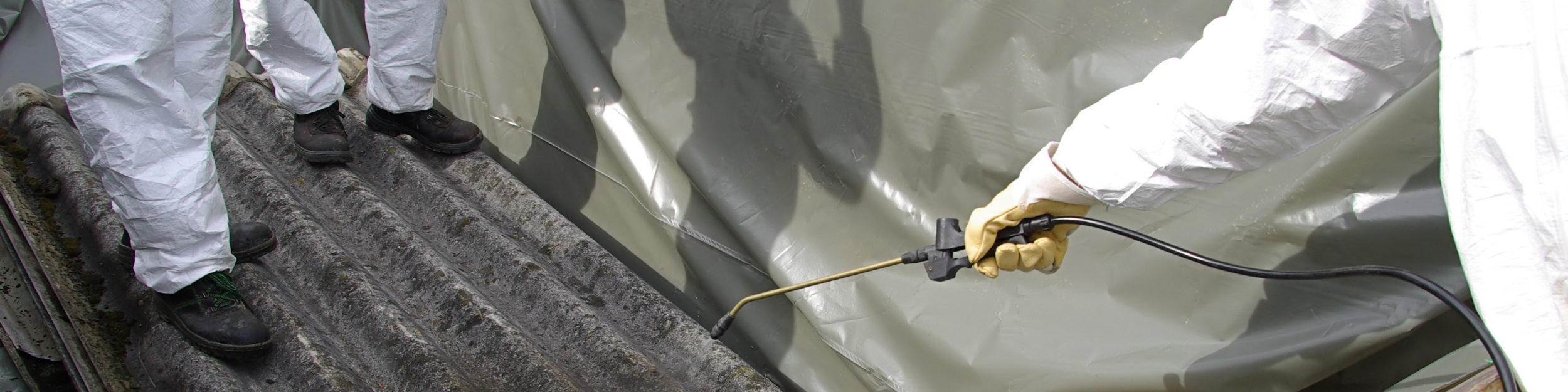
Quick answer: If your building was constructed or last renovated before 31 December 2003, it is likely to contain some form of asbestos-containing material (ACM). The most common visual giveaways in Melbourne and Victorian properties are grey corrugated cement roofs and fences (often “Super Six”), flat fibro cement sheeting on eaves, garages and wet-area walls, vinyl floor tiles with black bitumen adhesive, and dark electrical switchboard backing panels (Zelemite, Ausbestos, Lebah). Visual identification is a strong starting point — but it is not legally sufficient under Victorian regulations. Suspect material must be confirmed by a NATA-accredited laboratory sample under AS 5370:2024, and any removal above the 10m² DIY exemption must be performed by a WorkSafe Victoria licensed Class B (non-friable) or Class A (friable) asbestos removalist.
This guide walks you through the visual signs — building era, materials, patterns, textures, fixings and condition cues — that suggest asbestos may be present in a Melbourne or Victorian property. Use it as a pre-renovation, pre-purchase or pre-demolition prompt, not a substitute for a licensed inspection.
Why a Visual Checklist Matters in Melbourne
Australia was, per capita, one of the heaviest users of asbestos on Earth from the 1940s through to the late 1980s. The full ban on manufacture, supply, use and reuse of all forms of asbestos came into force on 31 December 2003. That means every Victorian building constructed or substantially renovated before 2004 sits inside the asbestos legacy window.
The Australian Government estimates that roughly 1 in 3 Australian homes built before 1990 contains asbestos somewhere on site. In Melbourne’s inner and middle-ring suburbs — Northcote, Brunswick, Coburg, Reservoir, Footscray, Sunshine, Box Hill, Glen Iris, Camberwell, Caulfield, Bentleigh, Oakleigh, Heidelberg, Frankston and dozens of others — that proportion is higher because pre-1990 housing stock dominates the streetscape.
A visual checklist gives you a structured way to walk a property and flag anything that warrants a licensed inspection before you start drilling, sanding, cutting, demolishing or buying. The cost of recognising suspect material on day one is a few hundred dollars in inspection fees. The cost of disturbing it on day fifty is a stop-work notice, a remediation scope, a denied insurance claim, and — in the worst case — a disease that takes 20 to 50 years to surface.
The Single Biggest Visual Sign: The Era of the Building
Before you look at any individual material, look at the building itself. Construction year is the strongest predictor of asbestos presence in Melbourne and Victoria.
| Build year | Probability of asbestos being present |
|---|---|
| Pre-1945 | Possible — particularly later 1930s through to the war years |
| 1945 – 1985 | Highly likely — peak asbestos cement era for Australian residential and commercial construction |
| 1986 – 1990 | Likely — declining use, but still common in fences, sheds and eaves |
| 1991 – 2003 | Possible — particularly in fences, garages and outbuildings using leftover stock |
| 2004 onwards | Generally clear, if original construction documentation is available and no pre-2004 structures remain on site |
Visual cues to a pre-2004 building
Even without a title search, certain features of the building point strongly to a pre-2004 construction:
- Weatherboard cottages, post-war brick veneer, mid-century cream-brick triple-fronts, 1970s split-level homes — these dominate Melbourne’s pre-1990 stock.
- Tile roofs with terracotta or concrete profiles common in the 1950s–1970s, often combined with cement-sheet eaves.
- Original timber-framed windows, plaster ceilings with cornice profiles, and Bakelite light switches — strong era markers.
- Older outbuildings — fibro garages, corrugated cement sheds, asbestos-cement dunnies behind the house — survive long after the main building has been renovated.
Working rule of thumb: Pre-1990 + Melbourne or Victorian location = assume asbestos is present somewhere on site until a licensed inspection proves otherwise.
The Visual Checklist: Where to Look and What to Look For
The following checklist is structured the way a licensed assessor walks a property — from the outside in, top to bottom. Use it on your own home, a property you’re buying, a rental you manage, or a commercial building you’re about to renovate or demolish.
1. The Roof
What to look for:
- Corrugated grey cement sheeting — the classic “Super Six” profile. Six broad, gentle corrugations across a sheet roughly 1,070mm wide. Often weathered to a dark grey, green-black with moss, or chalky off-white where painted.
- Cement-sheet ridge cappings and flashings at gable ends and roof junctions — thin, flat, often painted, frequently cracked at the screw holes.
- Penetration flashings around old flue pipes and vents, sometimes a separate cement collar around a slow-combustion chimney.
- Cement-sheet eaves linings running along the underside of the roof overhang — flat panels, typically 4.5mm or 6mm thick, often with butt joints covered by thin timber moulding.
Tell-tale signs the roof is asbestos cement rather than modern fibre cement:
- Heavy moss, lichen and weathering — pre-1990 sheets have been on the building 35+ years.
- Visible fixing pattern of galvanised twisted nails or large hex-head screws through the crown of each corrugation, often with bitumen washers.
- Chalky or powdery surface where the cement matrix has degraded — a warning sign that the material may have moved from non-friable into friable status.
- Faded asbestos warning labels are very rare on residential roofs; absence of a label is meaningless.
Where in Melbourne you’ll see it most:
Corrugated asbestos cement roofing dominates pre-1990 garages, sheds, dairies, factories and rural outbuildings across the western and northern industrial belt (Sunshine, Tottenham, Brooklyn, Campbellfield, Broadmeadows), regional Victoria (Geelong, Ballarat, Bendigo, Shepparton, the Latrobe Valley), and on rear outbuildings throughout the inner and middle-ring suburbs.
2. The Eaves, Soffits and Fascia
What to look for:
- Flat cement-sheet panels running along the underside of the roof overhang — usually 4.5mm or 6mm thick.
- Butt-jointed sheets with timber moulding strips covering the joins, often painted the same colour as the trim.
- Vent grilles cut into the cement sheet — round or rectangular, sometimes with a fine fly mesh behind.
- Cracked or sagging panels where moisture has worked behind the sheet — particularly common on rear and side elevations.
Visual confusion to watch for:
Modern fibre-cement eaves (Hardiflex, Villaboard and similar post-2004 products) look almost identical to asbestos cement sheeting from below. The differences are subtle: thickness, edge profile, fixing pattern and surface texture. Visual identification alone is not reliable for eaves on borderline-era buildings — a NATA-accredited sample is the only safe call.
3. External Walls and Cladding
What to look for:
- Flat fibro cement sheeting used as external cladding on whole walls or as infill panels in weatherboard or brick veneer cottages — typically 4.5mm to 7.5mm thick.
- Cover-strip systems with vertical timber battens at regular intervals (often around 600mm centres) hiding the joints between sheets.
- Imitation weatherboard in cement sheet — moulded to mimic timber weatherboards but rigid and flat to the touch.
- Decorative cement-sheet products (Hardiplank, Versilux, Wunderlich) on porch ceilings, gable infills and feature walls.
Tell-tale signs:
- Sheets sound dense and dull when tapped, not hollow like timber.
- Edges are sharp and machined, with no timber grain visible at the corners.
- Older sheets often show fine surface crazing under paint — a network of tiny cracks where the paint has aged on a slightly flexible substrate.
4. The Fences
What to look for:
- Asbestos cement fence panels — typically grey, flat sheets approximately 1,800mm tall by 600mm or 1,200mm wide, set between concrete or timber posts.
- Super Six asbestos cement fencing — corrugated panels with the same six-corrugation profile as the roofing product.
- Capped tops with a separate cement coping strip running along the top edge of the fence.
- Visible damage at the base of panels where mowers, line trimmers and dogs have impacted the lower edge — a frequent source of fibre release on otherwise non-friable material.
Where in Melbourne you’ll see it most:
Asbestos cement fencing is essentially universal in the pre-1990 backyards of Northcote, Brunswick, Coburg, Pascoe Vale, Reservoir, Footscray, Yarraville, Sunshine, Box Hill, Glen Iris, Caulfield, Bentleigh, Oakleigh, Cheltenham, Mentone, Heidelberg, Ringwood, Croydon, Werribee, Hoppers Crossing and dozens of others. Even where the house itself has been rebuilt post-2004, the fence on the boundary often dates back decades.
A standard backyard fence is regularly 30 to 60m² of sheeting once both sides and any returns are counted — well over the 10m² DIY exemption threshold.
5. The Garage, Shed and Outbuildings
What to look for:
- Fibro cement walls — flat sheets up to ceiling height, often with timber battens covering the joints.
- Corrugated cement roofing with the Super Six profile.
- Cement-sheet doors on storage cupboards, dog kennels and chook sheds — small in any single panel, but they all count toward the 10m² threshold.
- Old garden outbuildings — backyard dunnies, pump houses, workshops, lean-tos — almost universally fibro on pre-1985 Melbourne properties.
A single fibro garage clad in cement sheeting is typically 40m² and up when walls and roof are combined. Not a DIY job.
6. The Bathroom, Laundry and Kitchen Wet Areas
This is where buyers and renovators get caught out most often — because the asbestos is usually hidden behind tiles.
What to look for:
- Wet-area sheeting behind ceramic tiles — fibro cement sheet up to 6mm thick was the dominant tile substrate from the 1950s into the late 1980s.
- Vinyl floor sheeting and tiles — particularly 9-inch (~228mm) square tiles in 1960s and 1970s installations, often in beige, brown, grey, green or terracotta patterns.
- Black bituminous adhesive under lifted vinyl — the sticky black mastic that bonded asbestos-backed vinyl to concrete or timber floors.
- Asbestos-cement splashback panels behind kitchen sinks and laundry tubs.
- Old hot water service flues and the cement collar where the flue passes through ceiling or roof.
Why this matters for renovations:
A bathroom or laundry strip-out in a pre-1990 Melbourne home is one of the most common asbestos-disturbance projects. The wet-area sheet behind tiles often runs 8 to 15m² in a single bathroom alone — well over the DIY threshold. The vinyl tile area of a combined kitchen, hallway and laundry can easily exceed 20m².
7. The Electrical Switchboard
What to look for:
- Dark grey, brown or black backing panels behind the switchgear in pre-1985 switchboards.
- Brand names commonly visible: Zelemite, Ausbestos, Lebah, Miscolite.
- Smooth, slightly fibrous edges where the panel has been drilled to mount additional circuits over the years.
- Pulverised or crumbled material at the back of the cavity from decades of arcing, drilling and rewiring — a key warning sign that the panel may have moved from non-friable into friable status.
Why the switchboard is a special case:
Switchboard backing panels are non-friable in original condition, but the cavity behind them often contains decades of dust and pulverised debris that can behave as friable contamination. Electricians upgrading a pre-1985 switchboard frequently encounter material that requires a licensed removalist to handle. This is not a DIY scope.
8. The Roof Cavity and Subfloor
What to look for:
- Loose-fill insulation in the ceiling cavity — rare in Victoria but documented; far more common in parts of NSW and the ACT. Looks like grey or beige fluffy granular material.
- Pipe lagging wrapped around hot water, steam or process pipes in older roof cavities, particularly in commercial and industrial buildings. White or off-white fibrous wrap, often cracking and dusty.
- Cement-sheet ducting for old central heating or evaporative cooling systems.
- Stored fragments of original cement sheet left under the house or in the roof from past renovations.
If any of these are visible: stop, close the access hatch, do not vacuum or sweep, and call a licensed assessor. Loose-fill and damaged pipe lagging are friable materials and require Class A removal.
9. Plumbing, Pipework and Flues
What to look for:
- Asbestos-cement water and stormwater pipes — grey, cement-textured pipes running underground or in service ducts.
- Asbestos-cement flue pipes on slow-combustion heaters, gas hot water units and original wood stoves.
- Old gas appliance components — gaskets, wicks and rope seals in pre-1990 boilers, ovens and industrial plant.
10. Decorative and Textured Surfaces
What to look for:
- Textured “popcorn” or stipple ceiling coatings in some 1960s–1980s residential and commercial ceilings — where chrysotile was used as a binder, these are generally classified as friable.
- Decorative wall coatings and renders on some institutional and commercial finishes from the same era.
- Vermiculite-style finishes with a slightly sparkly or chunky texture — worth checking on older commercial fit-outs.
Damage Cues: When “Non-Friable” Quietly Becomes “Friable”
The single most expensive mistake in Melbourne asbestos work is treating a damaged or weathered material as non-friable simply because it started life that way. The classification depends on current physical condition, not date of manufacture.
Watch for these damage cues during your walk-through:
- Chalky, powdery or crumbling surfaces on cement sheet — particularly on north-facing or weather-exposed elevations.
- Fire-damaged sheeting — even surface scorching can degrade the cement matrix sufficiently to reclassify the material.
- Water damage — leaking gutters, broken downpipes, persistent damp at the base of fibro walls, or sheets with visible bowing and delamination.
- Mechanical impact damage — holes punched through fibro garage walls, cracked roof sheets from storm debris, sheeting broken open by a previous unlicensed removal attempt.
- Pulverised debris at the foot of sheeting, in garden beds, or stored as “rubble” from past works.
- Storm, fire or flood-affected pre-2004 buildings — treat as containing friable asbestos until proven otherwise.
Damaged non-friable asbestos requires a Class A licensed removalist, not Class B. A competent assessor makes the call on site. Quoting a damaged scope as Class B work is one of the most common — and most expensive — errors in Melbourne and Victorian asbestos jobs.
What Asbestos Does Not Look Like (Common Visual Myths)
Visual identification trips up homeowners and even some tradespeople because of widespread misconceptions about what asbestos “looks like.”
- You cannot tell by colour alone. White asbestos cement is the same chrysotile-bound product whether the sheet is grey, off-white, painted cream or weathered green-black with moss.
- You cannot tell by manufacturer. Super Six, Hardiplank, Versilux, Wunderlich — all manufactured non-friable cement sheeting through different eras, and some manufacturers continued producing visually similar non-asbestos cellulose-fibre cement sheeting after 2003. The brand alone does not confirm or rule out asbestos.
- You cannot tell by age alone. A 1980s sheet in mint condition is non-friable; a 1980s sheet that has been weathering on a leaking roof since 2005 may no longer be.
- Asbestos is not always grey. It can be painted, stained, weathered, moss-covered or rendered. The visual signature of the underlying material is often masked.
- Modern fibre-cement sheeting looks almost identical from a few metres away. The differences are subtle — thickness, edge profile, fixing pattern, surface texture, and most reliably, a NATA-accredited laboratory sample.
- No visible “asbestos” stamp does not mean it is safe. Original Australian asbestos cement products were very rarely labelled in residential installations.
The single reliable answer to “What is this material?” is a NATA-accredited bulk sample analysed under AS 5370:2024, combined with a competent field assessment of its current condition.
A Suburb-by-Suburb Visual Pattern for Melbourne
The patterns we see across Melbourne and Victoria are remarkably consistent by era and build type. None of these are “asbestos suburbs” — but the dominant build periods in each area set a strong starting expectation.
| Area | What you’ll typically see |
|---|---|
| Inner-north and inner-west (Northcote, Brunswick, Coburg, Pascoe Vale, Reservoir, Footscray, Yarraville, Sunshine, Maidstone, Maribyrnong) | Asbestos cement fences almost universal; eaves and soffits on most pre-1985 builds; fibro garages; wet-area sheeting behind tiles; switchboard backing panels |
| Inner and middle-east (Box Hill, Glen Iris, Camberwell, Surrey Hills, Burwood, Doncaster, Mont Albert, Balwyn, Heidelberg, Ivanhoe) | Fences, eaves, garages, bathroom sheeting, textured ceiling coatings on some 1960s–1980s properties |
| Bayside and south-east (Caulfield, Bentleigh, Oakleigh, Murrumbeena, Carnegie, Hampton, Sandringham, Mentone, Cheltenham, Mordialloc, Aspendale, Frankston) | Fences, eaves, corrugated roofing on garages and sheds, wet-area sheeting, vinyl floor tiles |
| Outer east and south-east (Ringwood, Croydon, Bayswater, Knox, Rowville, Dandenong, Endeavour Hills, Berwick) | Fences, eaves and garage materials dominate the pre-1990 ACM scope |
| Outer west and north-west (Werribee, Hoppers Crossing, Altona, Laverton, Caroline Springs older sections, Sydenham, Broadmeadows, Roxburgh Park) | Mixed eras; asbestos cement roofing on older sheds and outbuildings more common than further in |
| Regional Victoria (Geelong, Ballarat, Bendigo, Shepparton, Warrnambool, the Mornington Peninsula, the Yarra Valley, the Latrobe Valley) | Heavy use of asbestos cement on rural shearing sheds, dairies, packing sheds, pump houses, water tanks and stock troughs into the early 1990s |
What to Do If You Spot Suspect Material
If you walk a property with this checklist and flag anything suspect, the order of operations is straightforward.
1. Do not disturb it. Do not drill, cut, sand, scrape, pressure-wash, vacuum or sweep. Do not lift vinyl tiles to “have a look.” Do not crack open a fibro panel to test its weight.
2. Photograph the location. Wide shot for context, close-up for detail. This becomes the brief for the licensed assessor.
3. Note the building’s construction era and any known renovation history. If you know the year a bathroom was redone, the eaves were replaced or the garage was built, that informs the inspection scope.
4. Book a licensed inspection. A pre-renovation, pre-purchase or pre-demolition asbestos inspection in Melbourne typically costs $400 to $900 for a standard residential property, including three to eight NATA-accredited samples. Larger residential and pre-demolition surveys run $700 to $1,800. On a multi-hundred-thousand-dollar property, this is among the lowest-cost, highest-yield pieces of due diligence available.
5. Obtain a written asbestos register and removal scope. This is the document your renovation builder, plumber, electrician and tiler will rely on to do their work without disturbing asbestos. It is also what your insurer, the council, and any future buyer will want to see.
6. Engage a WorkSafe Victoria licensed Class B (non-friable) or Class A (friable) asbestos removalist for any removal above the 10m² DIY exemption. Most pre-1990 residential scopes — fences, eaves, garages, bathroom sheeting, vinyl flooring — sit comfortably in Class B territory, unless the material has been damaged into friable status.
The Legal Backbone: Why Visual Suspicion Triggers an Inspection
Under Part 4.4 of the Occupational Health and Safety Regulations 2017 (Vic), anyone with management or control of a workplace must — so far as is reasonably practicable — identify asbestos-containing material before any work that could disturb it begins. For a renovation or demolition, that translates directly into a pre-works inspection.
For any workplace constructed before 31 December 2003, an asbestos register is mandatory. A renovation triggers the obligation to review and update that register before disturbance work begins. If the building has never been used as a workplace and does not have a register, the renovation itself is often the trigger that requires one to be created.
The DIY exemption is narrow:
| Condition | Threshold |
|---|---|
| Asbestos type | Non-friable (bonded) asbestos only |
| Total area | Less than 10m² |
| Time on tools | Less than 1 hour in any seven-day period |
| Property type | Owner-occupied residential only (not rentals, not workplaces) |
| Disposal | Must still go to an EPA-licensed landfill |
Above any one of those thresholds, a WorkSafe Victoria licensed Class B asbestos removalist is legally required. For a typical Melbourne pre-1990 property — fence, garage, eaves, switchboard, bathroom sheeting — almost every scope exceeds 10m² by a significant margin.
Frequently Asked Questions
Can I tell if my building has asbestos just by looking at it?
For some clearly intact common materials — a sound Super Six fence, a brand-new-looking fibro garage wall — visual identification by an experienced licensed assessor is usually reliable. For damaged, painted, weathered or unusual materials, visual identification is not legally sufficient. A NATA-accredited bulk sample analysed under AS 5370:2024, combined with a competent field assessment of physical condition, is the only reliable approach.
What does asbestos cement sheeting look like in a Melbourne home?
The most common appearance is a flat or corrugated grey cement-coloured sheet, typically 4.5mm to 7.5mm thick for flat product. Corrugated roofing and fencing usually carries the “Super Six” profile — six broad corrugations across a sheet roughly 1,070mm wide. Flat sheets are commonly used on eaves, soffits, external walls, garage cladding and behind bathroom tiles. Surface finishes vary from raw cement grey to painted, rendered, weathered or moss-covered. Modern fibre-cement sheeting looks similar from a distance — sampling is the only reliable distinguisher.
My home was built in the 1970s — does it definitely contain asbestos?
Not definitely, but the working assumption should be that asbestos is present somewhere on site until a licensed inspection proves otherwise. In Melbourne, roughly 1 in 3 Australian homes built before 1990 contains some form of asbestos-containing material, and that proportion is higher in the inner and middle-ring suburbs where pre-1990 stock dominates. Common 1970s ACM locations include the fence, eaves, garage, bathroom and laundry sheeting, vinyl floor tiles, switchboard backing panel and any backyard outbuildings.
Is asbestos always grey?
No. The underlying cement matrix is typically grey, but original asbestos cement products were routinely painted, rendered or left to weather to a range of colours — off-white, cream, brown, green-black with moss, or chalky pale grey from sun exposure. Vinyl floor tiles with asbestos backing came in beige, brown, grey, green, terracotta and patterned finishes. Colour alone never confirms or rules out asbestos.
What does friable asbestos look like compared to non-friable?
Non-friable asbestos has the asbestos fibres bound in a hard cement matrix and feels solid, dense and rigid under hand pressure — fibro sheeting, corrugated roofing, fences, vinyl tiles and switchboard backing panels are the everyday Melbourne examples. Friable asbestos crumbles to powder under hand pressure when dry — sprayed limpet insulation on structural steel, pipe lagging, millboard, asbestos rope, loose-fill ceiling insulation, and any non-friable material that has been fire-damaged, water-damaged, severely weathered or mechanically pulverised. The diagnostic principle is the hand-pressure test when dry, but in practice this should be done by a licensed assessor, not the homeowner.
Can I see asbestos in a roof from the ground?
The corrugated profile of an asbestos cement roof is usually visible from ground level — particularly on garages, sheds and outbuildings where the eave line is low. From a residential streetscape, a grey-green-black moss-covered corrugated cement roof on a 1960s or 1970s garage is one of the most common visual flags in Melbourne. Roof inspections should be done from the ground or from a safe vantage point — never by walking on a suspected asbestos cement roof, which can fail under foot load and release fibres on fracture.
Does painted fibro still contain asbestos?
Yes, if the underlying sheet is asbestos cement. Paint is a surface coating only and does not change the underlying material. In fact, sound paint on intact non-friable asbestos sheeting is generally regarded as stabilising — it helps lock fibres into the surface. Problems arise when paint cracks, peels or is sanded back as part of a renovation.
What if my switchboard has a black backing panel?
A dark grey, brown or black backing panel in a pre-1985 Melbourne switchboard — particularly with brand markings such as Zelemite, Ausbestos, Lebah or Miscolite — is very likely an asbestos cement panel. The panel itself is non-friable, but the cavity behind it often contains decades of pulverised debris from drilling and rewiring, which can behave as friable contamination. Switchboard upgrades on pre-1985 homes should be coordinated between a licensed electrician and a licensed asbestos removalist.
Should I be worried about asbestos in soil or garden beds?
Where past unlicensed removals or demolitions dumped fragments into garden beds, under paving or as backyard fill, buried asbestos contamination is one of the most expensive surprises for new owners of pre-1990 Melbourne properties. Look for fragments of grey, cement-textured material in garden soil, exposed in driveway edges, or surfacing after landscaping works. Confirmed soil contamination triggers a soil testing and remediation scope and should never be raked or rotary-hoed.
Can I use a home asbestos test kit to confirm what I’ve found?
Retail kits exist, but the sample they generate is still going to a laboratory, and the field assessment of friability is not legally sufficient under Victorian regulations. If you are sampling at all, sample properly through a licensed assessor and send to a NATA-accredited laboratory under AS 5370:2024. Sample cost is typically $40 to $80, with a 2 to 5 working-day turnaround.
What’s the difference between a Class A and Class B asbestos removalist, and which do I need?
Class B removalists are licensed by WorkSafe Victoria to remove non-friable asbestos only — bonded cement materials like fibro sheeting, corrugated roofing, fences, eaves, vinyl tiles and switchboard backing panels. Class A removalists are licensed for both friable and non-friable material, including sprayed limpet, pipe lagging, millboard, asbestos rope, and any non-friable material that has been damaged into friable status. For most Melbourne residential and light commercial jobs — fences, garages, eaves, bathroom strip-outs, vinyl flooring, switchboards on standard pre-1990 properties — a Class B licensed removalist is the correct choice.
How much does it cost to remove the asbestos I’ve identified?
Costs vary with material, quantity, access and disposal route. Indicative fixed-price ranges for 2026 Melbourne non-friable Class B work:
| Removal scope | Typical fixed-price range |
|---|---|
| Asbestos cement fence (30–60 linear metres) | $2,500 – $6,500 |
| Eaves and soffits (full perimeter, single-storey) | $3,500 – $9,000 |
| Asbestos cement garage (walls and roof) | $4,000 – $12,000 |
| Corrugated asbestos cement roof (150–250m²) | $9,000 – $25,000 |
| Bathroom wet-area strip-out | $2,500 – $6,000 |
| Vinyl floor tile removal with bitumen substrate | $3,500 – $9,500 |
| Switchboard backing panel replacement | $1,200 – $2,800 |
| Combined pre-1990 home scope (fence, eaves, garage, switchboard) | $12,000 – $30,000 bundled |
These ranges include the items that cheap quotes routinely leave out: independent clearance certificate, EPA-licensed landfill disposal, EPA Waste Tracker manifests, full documentation pack, and public liability cover.
The Bottom Line: A Visual Checklist Is the Start, Not the Finish
A visual walk-through using the checklist above is the single most useful first step you can take on a pre-2004 Melbourne or Victorian building. It tells you whether to commission an inspection, where the inspector should focus, and roughly what scope of removal to expect.
What a visual checklist cannot do is replace the regulated identification pathway. Under Victorian law, the only legally sufficient identification is a NATA-accredited bulk sample under AS 5370:2024, combined with a field assessment by a competent person. Above the 10m² DIY exemption, removal must be performed by a WorkSafe Victoria licensed Class B (non-friable) or Class A (friable) asbestos removalist, with WorkSafe notification, an Asbestos Removal Control Plan (ARCP), a Safe Work Method Statement (SWMS), EPA-tracked disposal, and an independent Regulation 297 clearance certificate before re-occupation.
If your checklist walk has flagged anything — a Super Six roof on the garage, fibro under the bathroom tiles, a Zelemite backing in the switchboard, a chalky weathered fence, vinyl tiles over black bitumen, or just the simple fact that your home was built in 1972 and has never been formally inspected — the next step is a competent licensed assessment. Done early, it costs a few hundred dollars and protects the entire project. Done late, it costs five figures and stops the program in its tracks.
Get a Compliant Class B Asbestos Inspection and Removal Quote in Melbourne or Victoria
Asbestos Gone and Clean is a Melbourne-based WorkSafe Victoria licensed Class B (non-friable) asbestos removalist and demolition contractor servicing all metropolitan Melbourne suburbs and regional Victoria — from the inner-north (Brunswick, Northcote, Coburg, Preston, Reservoir) through the inner-east (Hawthorn, Kew, Camberwell, Balwyn), inner-west (Footscray, Yarraville, Sunshine, Maribyrnong), bayside (St Kilda, Brighton, Sandringham, Mentone), south-east (Glen Iris, Malvern, Caulfield, Bentleigh, Cheltenham), outer-growth corridors (Wyndham, Casey, Cardinia, Whittlesea, Hume) and out to Geelong, Ballarat, Bendigo, the Mornington Peninsula, the Yarra Valley and the Latrobe Valley.
When you call us after your visual checklist walk, here is what you receive:
- A free, no-obligation on-site inspection by a licensed assessor.
- NATA-accredited bulk sampling under AS 5370:2024 where required.
- A written Asbestos Register and Removal Scope identifying every ACM, its location, condition and classification.
- A fixed-price written quote covering survey, sampling, ARCP, SWMS, WorkSafe Victoria notification, licensed Class B removal, EPA-tracked transport to an EPA-licensed landfill, independent clearance certificate, and full documentation pack.
- A copy of our current WorkSafe Victoria Class B asbestos removal licence and Certificate of Currency for public liability and asbestos-specific insurance.
- If anything on site looks friable, we’ll tell you on day one — not on demolition day — and coordinate a Class A specialist for that portion of the work.
☎ Call us: 0475 143 106
✉ Email: asbestosgoneandclean@gmail.com
???? Contact Us: Asbestos Gone and Clean – Contact
We service all Melbourne metropolitan suburbs and travel throughout regional Victoria for residential, commercial, industrial and rural projects.
Related Reading
- Friable vs Non-Friable Asbestos: Key Differences Explained (2026 Melbourne & Victoria Guide) — the underlying classification that drives the Class A vs Class B split, with the hand-pressure test, common Melbourne examples and the AS 5370:2024 sampling pathway.
- Do I Need an Asbestos Inspection Before Renovating in Melbourne? — the legal trigger, what an inspection involves, and what it costs.
- DIY vs Professional Asbestos Removal: Risks, Laws & Costs (2026 Melbourne & Victoria Guide) — the honest breakdown of the 10m² rule, real DIY costs, and when licensed removal is the cheaper option.
- Asbestos Removal for Older Homes: A Pre-1990 Buyer’s Guide for Melbourne — the due-diligence checklist for first-home buyers, upgraders, investors and developers eyeing pre-1990 Victorian housing stock.
- Class A vs Class B Asbestos Licence in Melbourne — which licence covers which scope, and what to verify before signing a quote.
- How to Choose a Licensed Asbestos Removalist in Australia — the seven things every licensed removalist must prove and the 12 questions to ask before signing.
Sources and Further Reading
- WorkSafe Victoria — Asbestos: Safety Basics, Licensing and Compliance Codes
- WorkSafe Victoria — Compliance Code: Removing Asbestos in Workplaces
- WorkSafe Victoria — Compliance Code: Managing Asbestos in Workplaces
- Occupational Health and Safety Regulations 2017 (Vic), Part 4.4
- EPA Victoria — Publication IWRG611.2: Asbestos Transport and Disposal
- Environment Protection Regulations 2021 (Vic)
- Asbestos and Silica Safety and Eradication Agency (ASSEA) — Asbestos National Strategic Plan 2024–2030
- Standards Australia — AS 5370:2024 Air Quality — Bulk Materials
Disclaimer: This article is general information only and is current as at May 2026. It is not legal advice, and it is not a substitute for a competent licensed inspection. For advice on a specific property, contact WorkSafe Victoria, EPA Victoria, or speak directly with Asbestos Gone and Clean.