
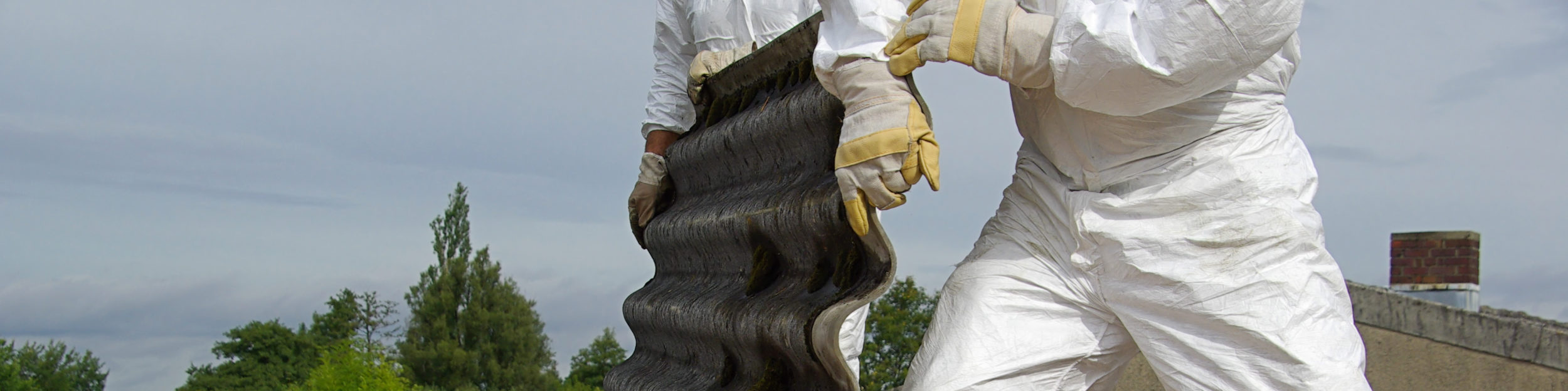
If your Melbourne home, garage, shed, factory or rural outbuilding was built or re-roofed before the year 2000, there is a very real chance the roof sheeting is asbestos cement. Across the inner-north, inner-west, bayside, south-east and outer-growth corridors — and through almost every regional Victorian town — corrugated asbestos cement roofing is one of the single most common asbestos-containing materials still in service.
Replacing an asbestos roof is not a difficult job to understand — but it is a tightly regulated one to execute. The on-tools work might be one or two days. The end-to-end project, done legally, is two to three weeks. And the price difference between a compliant fixed-price quote and a corner-cutting “mate’s rate” is almost never about skill — it’s about which legal, environmental and clearance obligations the cheap quote is quietly omitting.
This guide breaks down what asbestos roof sheeting actually is, how it’s removed correctly under Victorian law, what it costs in 2026 across Melbourne and regional Victoria, and what a legitimate fixed-price quote should — and should not — include. It’s written from the perspective of a WorkSafe Victoria licensed Class B (non-friable) asbestos removalist that handles asbestos roofing across Greater Melbourne and Victoria every week.
What Asbestos Roof Sheeting Actually Looks Like
Asbestos roof sheeting in Australia is almost always bonded asbestos cement — a hard, set matrix of cement reinforced with chrysotile, amosite or mixed asbestos fibres. In its undamaged state it is non-friable (Class B), which is the work category most Melbourne residential and light commercial roofs fall into.
The materials you are most likely looking at on a pre-2000 Victorian building include:
- Corrugated asbestos cement roofing — the classic “Super Six” profile. Six broad, gentle corrugations across a sheet roughly 1,070mm wide. Often weathered to a dark grey, green-black with moss and lichen, or chalky off-white where it was painted in the 1990s.
- Trimdek and small-corrugation asbestos cement sheets. Less common than Super Six but found on commercial and industrial buildings of the 1960s–1980s.
- Asbestos cement ridge cappings, hip cappings and gable flashings. Thin, often painted, frequently cracked at the screw holes.
- Penetration flashings around old flues and vents. Cement collars around slow-combustion chimneys, vent pipes and skylight kerbs.
- Eaves and soffit linings. Flat cement-sheet panels under the roof overhang — strictly speaking these are eaves rather than roof sheeting, but they almost always come off in the same scope of work and are quoted together.
Tell-tale signs your roof is asbestos cement (not modern fibre cement)
- Heavy moss, lichen and weathering — pre-1990 sheets have been on the building 35 to 60 years.
- Galvanised twisted nails or large hex-head screws through the crown of each corrugation, usually with bitumen washers.
- Chalky or powdery surface where the cement matrix has degraded — a warning sign that the material may have moved from non-friable into friable territory.
- No manufacturer stamp visible, or a faded James Hardie / Wunderlich / CSR Hardiplank legend along the edge of a removed sheet.
- Brittle behaviour at the screw line — old asbestos sheet snaps cleanly, modern fibre cement flexes.
Visual inspection alone is not legally sufficient identification. Under Victorian law, the only definitive identification is a NATA-accredited bulk sample analysed under AS 5370:2024. A licensed assessor will collect that sample under controlled conditions during the site inspection. For a deeper look at how to walk a property visually before formal sampling, see our companion guide on the Signs Your Building May Contain Asbestos.
Where in Melbourne and Victoria you’ll see it most
Asbestos cement roofing dominates pre-1990 garages, sheds, dairies, factories, packing sheds and rural outbuildings across:
- The western and northern industrial belt — Sunshine, Tottenham, Brooklyn, Footscray, Campbellfield, Broadmeadows, Coolaroo, Hume.
- Regional Victoria — Geelong, Ballarat, Bendigo, Shepparton, the Latrobe Valley, the Goulburn Valley, the Wimmera and the Mallee.
- Rear outbuildings throughout the inner and middle-ring — Northcote, Coburg, Reservoir, Brunswick, Box Hill, Glen Iris, Caulfield, Bentleigh, Oakleigh, Heidelberg, Pascoe Vale and Dandenong.
- Mornington Peninsula and Yarra Valley holiday and rural properties built between the 1950s and the late 1980s.
If your roof is corrugated, grey, weathered and pre-2000 — assume asbestos until a NATA-accredited sample proves otherwise.
Why an Asbestos Roof Cannot Be Treated Like a Normal Roof
Asbestos cement roofing sits at the intersection of three legal frameworks in Victoria, and a failure under any one of them invalidates the work:
- Occupational Health and Safety Regulations 2017 (Vic) — Regulations 273, 274 and 297 govern who can remove asbestos, how, and how the area is cleared for re-occupation.
- Environment Protection Regulations 2021 (Vic) and the Environment Protection Act 2017 — asbestos waste is classified as Reportable Priority Waste (RPW) and must be tracked end-to-end through EPA Victoria’s Waste Tracker system.
- WorkSafe Victoria’s Compliance Code: Removing Asbestos in Workplaces — the operational rulebook for licensed removalists.
In practical terms, this means an asbestos roof cannot legally be:
- Pressure-washed.
- Cut, sanded, drilled or angle-ground.
- Walked on directly (sheets become brittle and walking through one is a known fatality pathway as well as a fibre-release event).
- Dropped from height into a skip.
- Disposed of at a general transfer station or recycling centre.
- Buried, burnt or stockpiled on a rural property.
Each one of those activities is prohibited, and each is a leading cause of WorkSafe Victoria and EPA enforcement action against owners and contractors who tried to shortcut the process. Burning or burying asbestos under the Environment Protection Act 2017 carries penalties exceeding $50,000 plus remediation costs.
For owner-occupied residential property, the only DIY exemption is non-friable asbestos under 10m² removed in less than one hour over a seven-day period. A standard suburban garage roof alone is typically 40m² and up, and a house roof regularly exceeds 150m². The 10m² exemption almost never covers a real roof. Above the threshold, removal must be performed by a WorkSafe Victoria licensed Class B asbestos removalist (or a Class A holder).
When an Asbestos Roof Becomes a Class A Job
Most intact asbestos cement roofs are Class B work. But several scenarios common in Melbourne and regional Victoria push the material out of the non-friable category and into Class A territory — which materially changes both the contractor required and the price:
- Fire-damaged roofs. Once the cement matrix has been heat-degraded, the material is friable. WorkSafe Victoria treats fire-damaged cement sheeting as Class A regardless of how it started life.
- Long-leaking, heavily weathered roofs. Where the cement around cracks and screw holes has become chalky and crumbles in your hand, those sections — and any debris that has dropped onto the floor below — are friable.
- Storm-damaged or impact-damaged roofs. Sheeting smashed by fallen trees, hail at scale, or third-party impact during construction has often pulverised at the break lines.
- “We already pulled some off ourselves” scenarios. Where an owner has had a go at the roof before deciding to call a professional, broken sheeting, dust on adjacent surfaces and fibres tracked into roof cavities create a friable contamination scenario.
- Derelict structures. Where the condition of the remaining ACM cannot be confirmed as non-friable on inspection.
A Class A licence holder is required for any of the above, with full enclosures, decontamination units, negative-air units and air monitoring. A reputable Class B contractor will identify these scenarios at the site inspection and either coordinate the Class A scope directly or refer it to a Class A specialist — never quietly proceed under a Class B scope where it isn’t legal. For more detail on the distinction, see our guide Friable vs Non-Friable Asbestos: What’s the Difference?
The Asbestos Roof Removal Process, Step by Step
Here is the full sequence a compliant Class B asbestos roof removal follows from first enquiry to final documentation. The on-tools roof work is in the middle. Most of the timeline lives in the regulatory wrap-around.
Phase 1 — Site inspection and identification (Day 1 to Day 5)
A licensed assessor attends the property, visually inspects the roof from below and (where access allows) from above using safe access equipment, takes representative bulk samples of the sheeting, ridge cappings and any associated eaves, and sends them to a NATA-accredited laboratory for analysis under AS 5370:2024.
The assessor also confirms the friable / non-friable classification by physically examining the condition of the material, particularly at screw holes, edges, broken sections and any weathered or chalky areas.
Typical duration: Inspection takes 30 to 90 minutes on site. Lab turnaround is 2 to 5 working days standard.
Phase 2 — Fixed-price quote, ARCP and SWMS (Day 5 to Day 7)
Once the material is confirmed, the contractor issues a fixed-price quote for the removal scope, drafts an Asbestos Removal Control Plan (ARCP) specific to the roof, and prepares a Safe Work Method Statement (SWMS) covering working at heights, fall protection, wet methods, decontamination and waste handling.
A legitimate roof removal quote covers:
- Survey, sampling and lab fees.
- ARCP and SWMS.
- WorkSafe Victoria notification.
- Scaffold, edge protection, harness systems or boom-lift access as the height of the building requires.
- Wet-method removal of all roof sheeting, ridge cappings, flashings and penetrations.
- H-class hazardous-dust vacuum cleaning of gutters, valleys and any debris-affected roof cavity.
- 200-micron polyethylene double-wrapping, labelling and decontamination.
- EPA-tracked transport to an authorised landfill.
- EPA-licensed landfill disposal fees.
- Independent clearance certificate under Regulation 297 of the OHS Regulations 2017.
- Full documentation pack.
If any of those items is missing, the quote is not directly comparable to a quote that includes them — and the missing item is almost always the one that ends up costing the owner downstream.
Phase 3 — WorkSafe Victoria notification (Day 7 to Day 12)
For licensed asbestos removal work, WorkSafe Victoria must be notified at least five clear calendar days before the work begins. This is a legal minimum, not a guideline, and it cannot be compressed for ordinary program convenience. Genuine emergencies — storm damage, structural collapse, public safety risk — can sometimes be expedited, but standard roof replacements run the full five-day window.
This is why any contractor offering to “start tomorrow” on an asbestos roof is either not licensed, not notifying, or both.
Phase 4 — On-site removal (typically Day 12 to Day 14)
This is the visible part of the job — usually one to two working days for a single residential asbestos cement roof of 150–250m². The compliant sequence on the roof is:
- Edge protection and fall protection erected first. Roof work is governed by both asbestos regulations and the working-at-heights provisions of Part 3.3 of the OHS Regulations 2017. Roof anchors, harness systems, scaffold or scissor lifts are non-negotiable.
- Internal protection inside the roof cavity. Where debris may have built up over decades — particularly under cracked sheets or around penetrations — the cavity is sheeted out with 200-micron poly to catch falling material.
- Wet methods throughout. Sheets are misted continuously with water (often with a surfactant) to suppress airborne fibres. Power tools are never used — sheets are unscrewed by hand using slow-speed manual or low-RPM drivers, and lifted off whole.
- Sheets removed whole, not broken. Each corrugated sheet is unscrewed, lifted off, and lowered to a controlled landing zone using a sheet hoist, crane bag, or hand-passing chain — never dropped to the ground.
- Ridge cappings, flashings and penetrations are removed in the same wet-method sequence.
- Continuous double-wrapping and labelling on the ground. Every sheet and capping is wrapped in two layers of 200-micron polyethylene, sealed with quality cloth or duct tape, and labelled “CAUTION ASBESTOS” before it leaves the work zone.
- Gutter and roof-cavity cleaning with an H-class hazardous-dust vacuum cleaner — domestic vacuums are never used because they exhaust microscopic fibres straight back into the air.
- Decontamination of all personnel, PPE and tools through a defined decontamination route before they leave the work zone.
For a standard suburban Melbourne home, on-site removal is typically one to two working days. Add a half-day to one day for larger homes, complex roof geometry, multiple penetrations, or restricted access.
Phase 5 — EPA-tracked transport and disposal (same day to next day)
Wrapped waste is loaded into a covered, secure vehicle authorised to transport Reportable Priority Waste. The load is transported by a permissioned operator to one of the EPA-licensed landfills around Greater Melbourne or regional Victoria that are authorised to receive asbestos. There are only a limited number of these sites, most require pre-booked tipping slots, and opening hours are restricted.
The disposal is tracked end-to-end through EPA Waste Tracker. The manifest is lodged, the weighbridge tip receipt is retained, and the load is recorded against your project. For a deeper walk-through of where your asbestos ends up, see our guide What Happens to Asbestos After It’s Removed From a Property?
Phase 6 — Independent clearance certificate (Day 14 or 15)
Under Regulation 297 of the OHS Regulations 2017, the person who commissioned the asbestos removal must obtain a clearance certificate from an independent competent person before the area is re-occupied — and, where the roof removal is part of a demolition, before mechanical demolition begins. The clearance assessor must be independent of the removal contractor. Any contractor offering to self-certify their own clearance is offering a document that will not survive scrutiny.
The assessor attends site, performs a visual inspection of the stripped roof structure, gutters and any affected ground area, and (where required) carries out air monitoring. The certificate is typically issued within 1 to 3 working days of the inspection.
Phase 7 — Documentation pack delivered
You receive a complete documentation pack including the ARCP, SWMS, WorkSafe notification, transport manifests, EPA Waste Tracker records, tip receipts, clearance certificate and any air monitoring results. This pack is what protects you with your home insurer, any future buyer, and any subsequent contractor on site.
What an Asbestos Roof Removal Actually Costs in Melbourne (2026 Pricing)
Costs vary with material, quantity, access and disposal route — but the broad ranges in 2026 Melbourne for non-friable Class B asbestos roof work are predictable. The following ranges assume a compliant fixed-price scope including all of the items listed under Phase 2 above.
Residential asbestos roof removal — typical 2026 Melbourne ranges
| Removal scope | Typical fixed-price range (2026) |
|---|---|
| Garage roof — single garage (~25–40m² corrugated sheeting) | $2,500 – $5,500 |
| Garage roof — double garage (~50–80m²) | $4,500 – $9,000 |
| Garden shed or carport roof (~10–25m²) | $1,800 – $4,500 |
| Asbestos cement house roof — small to medium home (~120–180m²) | $7,500 – $16,000 |
| Asbestos cement house roof — standard suburban home (~150–250m²) | $9,000 – $25,000 |
| Asbestos cement house roof — large or double-storey (~250–400m²) | $18,000 – $40,000 |
| Ridge cappings and flashings only (combined with new roof install) | $1,500 – $4,500 |
| Eaves and soffits — full perimeter, single-storey (often quoted with roof) | $3,500 – $9,000 |
| Roof + eaves + gutters bundled — standard pre-1990 home | $14,000 – $35,000 |
Commercial, industrial and rural asbestos roof removal — 2026 ranges
| Removal scope | Typical fixed-price range (2026) |
|---|---|
| Small commercial / workshop roof (~200–500m²) | $18,000 – $55,000 |
| Medium industrial / warehouse roof (~500–1,500m²) | $45,000 – $150,000 |
| Large industrial roof (1,500m²+) | Project-priced — typically $80 – $180 per m² delivered |
| Rural shed or dairy roof (regional Victoria) | $6,000 – $30,000 depending on area and travel |
| Light industrial roof + wall cladding combined | Project-priced — request a site-specific quote |
These ranges include independent clearance certificate, EPA-licensed landfill disposal, EPA Waste Tracker manifests, full documentation pack, and public liability cover. Quotes substantially below these ranges typically indicate the contractor is omitting one or more of those compliance elements — and the missing paperwork is almost always more expensive in the long run than the apparent saving.
What Actually Drives the Price of an Asbestos Roof Removal
Six factors explain almost all of the variation between two legitimate quotes on the same roof:
1. Roof area and sheet count
The single most direct driver. More square metres = more sheets, more screws, more wrapping, more vehicle loads, more tip fees.
2. Height, pitch and access
A single-storey suburban garage with vehicle access to the rear is fast. A two-storey 1970s home in Carlton or South Yarra on a narrow block with shared driveway, restricted street access and overhead power lines is slow. Steep pitches require additional fall protection, often a full perimeter scaffold rather than a roof-edge harness system.
3. Edge protection and working-at-heights compliance
For anything above ground-floor garage height, edge protection, scaffold, harness systems or scissor lift / boom lift access is mandatory under Part 3.3 of the OHS Regulations 2017. The cost of compliant edge protection on a two-storey roof can run $3,000 to $10,000 or more as a line item — and it has to be there whether the contractor is a one-day pro or a slow operator.
4. Condition of the sheeting (friable risk)
A clean, intact, non-friable roof comes off cleanly. A weathered, partially-broken roof with chalky sections, fallen debris in the roof cavity, or fire / impact damage may need to be reclassified as Class A, which substantially increases the cost. This is one of the largest drivers of “quote shock” on older Melbourne roofs and is precisely why the site inspection happens before the quote, not after.
5. Distance to the nearest EPA-licensed landfill
For Melbourne metropolitan jobs, disposal is straightforward. For regional Victorian sites — particularly the Mallee, the Wimmera, the High Country, parts of Gippsland — the round-trip distance to the nearest authorised landfill can add hours of vehicle time per load, and that cost flows into the quote.
6. Programming and coordination
A standalone “roof off, roof on” job for an existing owner is straightforward. A pre-demolition roof removal under a tight builder’s program, with mechanical demolition booked behind, requires precise sequencing — including the clearance certificate landing on time so the excavator can move. Builders typically value that programming discipline at a small premium because the cost of slippage is much higher.
“Why Is That Quote So Cheap?” — The Maths of a Compliant Roof Removal
Three or four legitimate Class B licensed contractors quoting the same Melbourne roof will usually land within 15–25% of each other. A quote that comes in 40–60% below the rest of the market is almost mathematically impossible to produce while still paying for:
- A licensed supervisor at award rates plus on-costs.
- Trained Class B removalists with current medicals.
- Compliant edge protection, scaffold or EWP access for the height of the building.
- H-class hazardous-dust vacuums (not cheap).
- P3 respirators, disposable coveralls, gloves and consumables.
- 200-micron polyethylene, duct tape, signage and decontamination materials.
- A vehicle authorised to transport Reportable Priority Waste.
- EPA-licensed landfill disposal fees.
- The independent clearance assessor.
- Public liability insurance with an explicit asbestos endorsement of at least $20 million.
- The administrative overhead of WorkSafe notification, EPA Waste Tracker, ARCP, SWMS and documentation pack assembly.
The maths simply does not work — which is why the dramatically low quote is almost always missing one or more of those items. The “saving” is the cost of compliance, and that cost gets deferred onto the owner when a contamination event occurs, a neighbour or building inspector notifies WorkSafe, the next contractor on site refuses to work because of residual fibres, the future buyer’s solicitor demands a clearance certificate that doesn’t exist, or the home insurer denies a claim citing unlicensed asbestos work. For the full breakdown of how to vet a contractor before signing, see our guide How to Choose a Licensed Asbestos Removalist.
Coordinating an Asbestos Roof Removal With a New Roof Install
The single most common practical question on an asbestos roof job is: “How does this work with the new roof?”
The compliant sequence in Melbourne looks like this:
- Day before removal: Tarps and temporary weatherproofing materials staged on site.
- Day 1 (and Day 2 if needed): Asbestos roof removed under the Class B scope. Where the removal extends across a day, temporary weatherproofing (heavy-duty tarps over the roof timbers, secured against wind) is installed at the end of each working day. Modern Melbourne weather forecasts make this manageable on almost every program.
- End of removal day: Independent clearance assessor attends — typically late on the final day or first thing the following morning.
- Clearance certificate issued: Usually within 24 to 48 hours of the inspection.
- New roof crew arrives: Programmed to start the morning after the clearance certificate is issued.
A well-coordinated asbestos removalist will hand off directly to the new roofing contractor, often with no gap day at all where the weather is settled. Where rain is forecast, an extra day of temporary weatherproofing is built into the program rather than rushing the clearance step.
For a deeper look at the day-by-day timeline from first enquiry to final clearance, see our guide How Long Does Asbestos Removal Take?.
Special Case: Pre-Demolition Asbestos Roof Removal
Where the asbestos roof is being removed as the first step of a full demolition — knock-down-rebuild, infill development, commercial redevelopment — the legal framework tightens significantly under Regulation 273 of the OHS Regulations 2017.
Under Reg 273, asbestos must be removed before mechanical demolition begins. The clearance certificate under Reg 297 is what permits the excavator on site. Skipping the asbestos scope and demolishing the building with the roof in place is one of the most serious — and most heavily penalised — breaches in Victorian construction law, and one of the most common WorkSafe Victoria enforcement targets.
The compliant pre-demolition sequence is:
- Pre-demolition (Type 3 / destructive) asbestos survey to identify every ACM in the building, including the roof, eaves, internal sheeting, vinyl tiles, switchboard backing and any insulation.
- Licensed Class B removal of all non-friable ACM (roof, eaves, fences, internal sheeting) and Class A removal of any friable material identified.
- EPA-tracked disposal of all asbestos waste to authorised landfills.
- Independent clearance certificate under Reg 297.
- Mechanical demolition of the now-asbestos-free structure.
- Final waste classification of demolition spoil.
Running both scopes under a single ABN — asbestos removal and demolition — eliminates the single biggest cause of program slippage on pre-2004 demolition sites: the gap between when the asbestos contractor finishes and when the demolition contractor arrives. For builders, developers and owner-builders, that integrated workflow is worth its weight in program certainty. For a deeper look at the demolition sequence, see our guide Asbestos Removal During Demolition.
Frequently Asked Questions
How much does it cost to remove an asbestos roof in Melbourne in 2026?
For a standard suburban single-storey home of 150–250m², expect a fixed-price quote in the range of $9,000 to $25,000 for the asbestos removal scope alone (excluding the new roof). Smaller garage and shed roofs run $2,500 to $9,000. Larger or two-storey homes range from $18,000 to $40,000. Commercial and industrial roofs are project-priced from $80 to $180 per square metre delivered.
Does the asbestos roof removal price include the new roof?
No. The fixed-price quote covers the asbestos removal scope: survey, ARCP, SWMS, WorkSafe notification, edge protection, wet-method removal, double-wrapping, EPA-tracked transport, EPA-licensed landfill disposal, and the independent clearance certificate. The new roof (Colorbond, tile or otherwise) is a separate scope quoted by the roofing contractor and typically programmed to start the morning after the clearance certificate is issued.
Can I remove an asbestos roof myself in Victoria?
Almost never. The DIY exemption applies only to non-friable asbestos under 10m² removed in less than one hour over a seven-day period on owner-occupied residential property. A single suburban garage roof is typically 40m² or more, and a house roof regularly exceeds 150m² — both well above the exemption. Above the threshold, removal must be performed by a WorkSafe Victoria licensed Class B asbestos removalist. See our guide DIY vs Professional Asbestos Removal for the full breakdown.
How long does it take to remove an asbestos roof?
The on-tools roof work is typically one to two working days for a standard suburban Melbourne home. The full end-to-end project — including the mandatory five-day WorkSafe Victoria notification window, NATA sampling, disposal and the independent clearance certificate — runs 2 to 3 weeks from first enquiry. Larger homes, commercial roofs and industrial roofs add days on the tools but the regulatory wrap-around is the same.
Why is there a five-day waiting period before the work can start?
Licensed asbestos removal work must be notified to WorkSafe Victoria at least five clear calendar days before it begins. This is a legal minimum under the OHS Regulations 2017 and applies to every licensed job. Any contractor offering to “start tomorrow” on an asbestos roof is either not licensed or not notifying.
What licence does my contractor need to remove an asbestos roof?
For an intact, non-friable asbestos cement roof, a WorkSafe Victoria Class B (non-friable) asbestos removal licence is the correct authority. If the roof has been fire-damaged, severely weather-degraded, or impact-damaged to the point where the cement matrix is friable, a Class A licence is required instead. A reputable Class B contractor will identify the correct classification at the site inspection — not after the work is half-finished.
Will my home insurance cover problems caused by an asbestos roof removal?
Only if the removal was performed by a WorkSafe Victoria licensed removalist with current asbestos-endorsed public liability insurance, and a clearance certificate under Regulation 297 was issued by an independent competent person. Most home and contents policies in Australia exclude losses arising from unlicensed asbestos work — which is why the licensing and clearance paperwork is the single most important risk control on any roof replacement project.
Can I paint or seal the asbestos roof instead of removing it?
In the very short term, an intact, well-maintained asbestos cement roof in good condition can be encapsulated under a specialist asbestos-rated coating, applied without high-pressure cleaning or aggressive surface preparation. However, this is a deferral strategy — not a permanent solution. Once the matrix begins to degrade, encapsulation extends life by years, not decades, and any future works on the roof (new aerials, solar panels, skylights, gutter replacement) reactivate the asbestos scope. For pre-2000 roofs that are already weathered, replacement is generally the better long-term decision.
Can I install solar panels on an asbestos roof?
This is one of the most common questions Melbourne homeowners ask in 2026. The answer is almost always no — and most reputable solar installers will not work on asbestos cement roofing because drilling, screwing and walking on the sheets creates fibre-release events and working-at-heights risks beyond their licence. The compliant pathway is: remove the asbestos roof under a licensed Class B scope, install a new Colorbond or tile roof, then install the solar panels on the new roof. The combined sequence adds three to four weeks to a solar project but is the only compliant approach.
What if I find asbestos roof debris on the ground around the building?
Treat it as friable material. Do not touch it, do not sweep it, do not water-blast it. Cordon the area off and call a licensed Class A or Class B removalist for a site inspection. Ground-level debris from a degraded roof is one of the scenarios that pushes a job from Class B into Class A, and the soil under the debris may need to be tested for contamination.
Do I need a council permit to remove an asbestos roof?
Many Melbourne councils — including the City of Melbourne, Yarra, Boroondara, Whitehorse, Knox, Casey, Wyndham, Hume, Maribyrnong, Moonee Valley, Glen Eira, Stonnington, Kingston and Melton — have notification or permit requirements for asbestos work, particularly where it intersects with a building permit (such as a new roof install). Where the roof replacement is over a heritage-overlay property, council approval can add 2 to 6 weeks. Your contractor should confirm the council requirements as part of the quote process.
Should the same contractor remove the roof and issue the clearance certificate?
No. Regulation 297 of the OHS Regulations 2017 requires the clearance certificate to be issued by an independent competent person — not by the removal contractor. A reputable Class B contractor will coordinate the independent assessor as part of the project, but the certificate itself comes from the independent party. Any contractor offering to self-certify their own clearance is offering you a document that will not survive scrutiny.
Get a Fixed-Price Quote for Your Asbestos Roof Removal
If you have an asbestos cement roof on a Melbourne home, garage, shed, factory, warehouse or rural property — and you want a transparent, compliant, fixed-price quote that includes survey, ARCP, SWMS, WorkSafe notification, edge protection, wet-method removal, EPA-tracked disposal and the independent clearance certificate — Asbestos Gone and Clean can help.
We are a WorkSafe Victoria licensed Class B (non-friable) asbestos removalist and demolition contractor based in Melbourne, servicing all of Greater Melbourne and regional Victoria — from the inner suburbs out to Geelong, Ballarat, Bendigo, Shepparton, the Mornington Peninsula, the Yarra Valley, the Latrobe Valley and beyond.
For builders, developers and owner-builders, we run integrated asbestos removal + soft strip + demolition services under one ABN, removing the program risk between scopes.
☎ Call us: 0475 143 106
✉ Email: asbestosgoneandclean@gmail.com
???? Contact Us: Asbestos Gone and Clean – Contact
Free site inspection. No-obligation fixed-price quote. Full documentation pack delivered on completion.
Related Reading
- Asbestos Regulations and Legal Requirements in Australia: The 2026 Compliance Guide for Melbourne & Victoria — the Victorian regulatory framework, licensing, registers and penalties.
- Class A vs Class B Asbestos Licence: Which One Do You Need? — the decision framework for choosing the right removalist.
- Friable vs Non-Friable Asbestos: What’s the Difference? — the classification that determines the licence class, the price and the program.
- Signs Your Building May Contain Asbestos: A Visual Checklist — how to walk a property visually before booking an inspection.
- DIY vs Professional Asbestos Removal: Risks, Laws & Costs — the honest breakdown of the 10m² rule and the real cost of doing it yourself.
- How Long Does Asbestos Removal Take? A Realistic Timeline — day-by-day from first enquiry to final clearance certificate.
- What Happens to Asbestos After It’s Removed From a Property? — the full disposal journey from kerb to EPA-licensed landfill.
- Asbestos Removal During Demolition: What You Need to Know — the full pre-demolition-survey-to-clearance-certificate sequence for builders.
- How to Choose a Licensed Asbestos Removalist in Australia — the checklist for vetting a contractor before signing.
This article is general information about asbestos roof removal in Melbourne and Victoria as at 2026. It is not legal, engineering or occupational health advice. Always engage a licensed assessor and a WorkSafe Victoria licensed asbestos removalist for your specific site.