
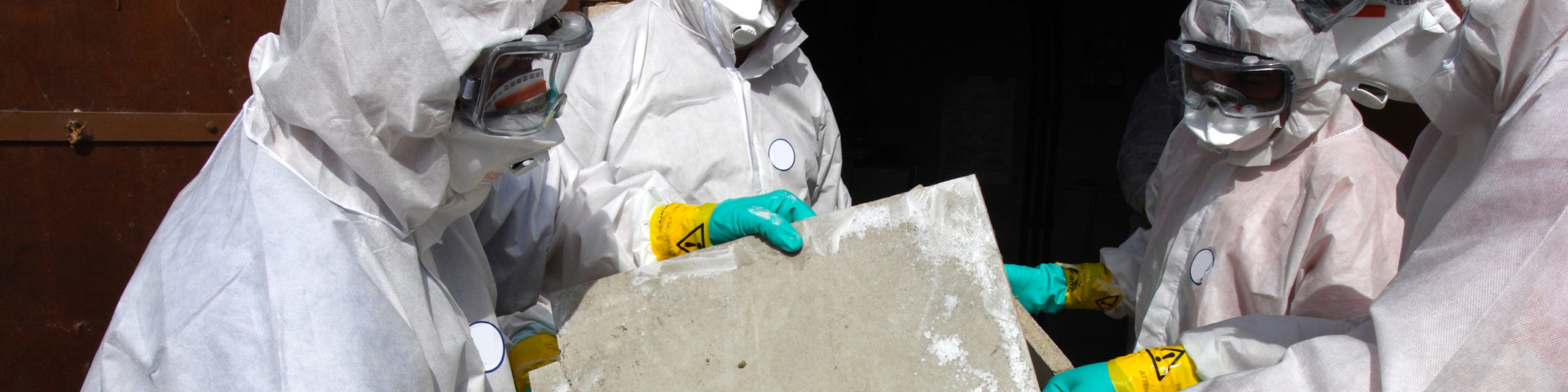
Quick answer: If your Melbourne or Victorian property was built or last refurbished before 31 December 2003, any vinyl or thermoplastic floor tile underfoot — especially 9-inch (229mm) or 12-inch (305mm) squares set in a tarry black bitumen adhesive — should be treated as asbestos-containing material (ACM) until a NATA-accredited laboratory sample under AS 5370:2024 proves otherwise. Asbestos vinyl floor tiles and their black bitumen backing are classified as non-friable in good condition, which sits squarely inside the work scope of a WorkSafe Victoria licensed Class B asbestos removalist. They become friable (and immediately escalate to a Class A scope) the moment they are sanded, ground, scraped dry, heated or smashed — which is exactly why the wrong removal method on a small bathroom floor can trigger a five-figure decontamination event. Above the 10m² owner-occupied residential DIY exemption, removal must be performed by a licensed Class B contractor under a WorkSafe Victoria notification, ARCP and SWMS, with EPA-tracked disposal at a licensed landfill and an independent Regulation 297 clearance certificate before re-occupation.
This guide walks you through how to identify asbestos floor tiles in a Melbourne or Victorian property, what the safe (and unsafe) removal methods actually look like, what a compliant Class B job involves end-to-end, what it costs in 2026, and how to avoid the single most common DIY mistake we see in inner and middle-ring Melbourne homes.
TL;DR — Do You Have Asbestos Floor Tiles?
| Clue | Likelihood of Asbestos |
|---|---|
| Tile installed before 1990 in any Australian building | High |
| 9 × 9 inch (229 × 229mm) square tile | Very high — virtually all 9-inch vinyl tiles in Australia were asbestos-backed |
| 12 × 12 inch (305 × 305mm) square tile, pre-1990 | High |
| Black, tarry adhesive visible at edges or under lifted tiles | High — the cutback/bitumen adhesive is itself an ACM |
| Brittle, snaps cleanly when broken (rather than flexes) | High |
| Brand markings such as Armstrong Excelon, Marley, Vinylite, Floorscape, Hardies on the reverse | High |
| Tile installed 1990–2003 with no documentation | Possible — sample required |
| Tile installed after 2004 with documentation | Very low |
| Modern vinyl planks, LVT, laminate or tile-effect lino over original concrete | Check what’s underneath — original ACM tiles are often left in place and covered over |
If any row above describes the floor you are looking at, the rest of this guide is for you.
Why Asbestos Floor Tiles Are the Single Most Overlooked ACM in Melbourne Homes
Australia was one of the world’s heaviest per-capita users of asbestos from the 1940s through to the late 1980s. The full ban on manufacture, supply, use and reuse of all forms of asbestos came into force on 31 December 2003. Anything laid before that date sits inside the asbestos legacy window — and floor tiles are one of the easiest categories to forget about because they are quite literally underfoot.
Three things make asbestos floor tiles uniquely under-identified compared to the more famous fibro sheet, Super Six roofing and switchboard panels:
- They are usually covered. Across the inner and middle-ring suburbs of Melbourne — Northcote, Coburg, Brunswick, Preston, Reservoir, Footscray, Yarraville, Sunshine, Box Hill, Glen Iris, Caulfield, Bentleigh, Oakleigh, Heidelberg, Pascoe Vale, Dandenong, Frankston — it is the rule rather than the exception that an original 1960s or 1970s asbestos vinyl tile floor has been covered at some point with carpet, floating laminate, vinyl planks or modern tile. When the new floor lifts during a renovation, the original ACM tiles are still there.
- They are physically small, individually. A single 9-inch tile is a 229mm square — barely larger than a sheet of A5 paper. Owners under-estimate the total area because they’re thinking tile-by-tile, not square-metres across kitchen + laundry + hallway + bathroom.
- The adhesive is also asbestos. Even where the tiles themselves test negative, the black bitumen “cutback” adhesive that bonded them to the slab is almost always an asbestos-containing material on its own — and lifting tiles without lifting and disposing of the adhesive leaves the ACM in place under the new floor.
This is the combination that catches owners out: a small-looking floor, easily mis-measured, sitting on an adhesive that is itself an ACM, hidden under a more modern surface, in a property where the renovation budget never accounted for any of it.
What Asbestos Floor Tiles Actually Look Like
There is no single visual signature, but there is a profile. The vast majority of asbestos floor tiles installed in Australia between roughly 1950 and 1985 belong to a category known internationally as vinyl-asbestos tiles (VAT) or asphalt-asbestos tiles. Their identifying characteristics include:
Size
- 9 × 9 inches (229 × 229mm) — by far the most common pre-1980 size in Australian residential and commercial buildings. If you measure a square tile and it lands at 229mm, the working assumption is asbestos until tested.
- 12 × 12 inches (305 × 305mm) — became more common from the late 1970s onward, and continued into the early 1990s. Many post-1980 12-inch tiles were also ACM.
- Occasionally 6 × 6 inches — rare, but seen in older commercial installations.
Modern post-2004 vinyl tiles are usually metric (300mm, 450mm, 600mm) and almost never 229mm.
Thickness and feel
- Typically 2.5mm to 3.2mm thick, dense and rigid.
- They feel hard and brittle rather than flexible. A sound asbestos tile snaps cleanly when bent; a modern vinyl tile flexes considerably before breaking.
- The face is usually smooth or lightly textured, not the deep embossed-grain finish of modern luxury vinyl tile (LVT).
Colour and pattern
- Solid blocks of beige, brown, cream, grey, terracotta, dark green, black or charcoal.
- “Marbled” or “swirled” patterns mimicking stone or marble are extremely common in the 1960s and 1970s product.
- Speckled or “confetti” patterns with small contrasting flecks against a paler background are another classic VAT look.
- Colour alone never confirms or rules out asbestos — the matrix and adhesive are what matter.
The black bitumen adhesive
This is the single most reliable visual clue on a Melbourne floor. When asbestos vinyl tiles were laid in the 1950s–1980s, they were almost universally bedded into a black, tarry, asphalt-based “cutback” adhesive. That adhesive itself routinely contains asbestos fibres. You will typically see it:
- Squeezed out around the edges of tiles.
- Visible under a corner-lifted tile.
- Smeared across the concrete slab where a tile has been removed and the adhesive remains.
A floor showing dark, tarry, brittle black adhesive on the substrate is, in our day-to-day experience across Melbourne, an asbestos floor until proven otherwise — regardless of what the tile on top tests as.
Brand markings on the reverse
Where tiles have lifted or been removed, the underside sometimes carries a brand or product stamp. Common Australian and imported VAT brands of the era include Armstrong Excelon, Marley, Vinylite, Floorscape, Hardies and various imported European and US lines. None of these brand markings confirm asbestos by themselves — the same manufacturers produced non-asbestos vinyl after the late 1980s — but they place the tile firmly in the era when sampling is required before any disturbance.
Where Asbestos Floor Tiles Hide in Melbourne and Victorian Properties
A compact summary of the rooms and property types where we find them most often.
| Property type | Typical locations |
|---|---|
| Pre-1990 residential — inner Melbourne (Brunswick, Northcote, Coburg, Preston) | Kitchen, laundry, bathroom, hallway, sunroom, garage |
| Pre-1990 residential — inner-west and west (Footscray, Yarraville, Sunshine, Maribyrnong) | Kitchen, laundry, bathroom, separate WC, back porch |
| Pre-1990 residential — bayside and south-east (St Kilda, Brighton, Glen Iris, Caulfield, Bentleigh, Cheltenham) | Kitchen, ensuite, laundry, vestibules, original bathrooms |
| Pre-1990 residential — outer growth corridors (Werribee, Cranbourne, Berwick, Sunbury, Whittlesea) | Wet areas in original cottages, sheds and outbuildings |
| Mid-century commercial — Melbourne CBD and inner industrial (Sunshine, Tottenham, Brooklyn, Campbellfield, Broadmeadows, Dandenong South) | Office floors, mezzanines, lunchrooms, toilet blocks, hallways |
| Schools, halls and clubrooms — anywhere in Victoria pre-1990 | Corridors, classrooms, change rooms, kitchens |
| Regional Victorian properties — Geelong, Ballarat, Bendigo, Latrobe Valley, Mornington Peninsula, Yarra Valley | Wet areas of original homes, dairies, packing sheds, station offices, pump houses |
If your property sits in any of those rows and has a pre-1990 floor — visible or covered over — sampling should precede any disturbance.
How to Identify Asbestos Floor Tiles: The Compliant Pathway
Under Victorian regulations, the only legally sufficient identification is a NATA-accredited bulk sample analysed under AS 5370:2024, combined with a competent field assessment of the material’s current condition. The reasoning is identical to every other ACM category we work with in Melbourne: visual identification by an experienced licensed assessor is a strong starting point, but it is not the legal standard.
Step 1 — Stop work and don’t disturb anything
Before any tile is lifted, cut, drilled, sanded or even aggressively cleaned, the area should be left as-is. The single most common pathway from a manageable identification to a contaminated room is a homeowner or builder “just lifting a corner to check.”
Step 2 — Engage a licensed assessor
A WorkSafe Victoria licensed assessor or Class B removalist will attend site, inspect the floor, photograph it, measure it, identify the substrate condition, and take a small bulk sample of both the tile and the adhesive using a wet sampling technique that minimises fibre release.
Step 3 — NATA-accredited laboratory analysis
The sample is sealed, labelled, chain-of-custody documented, and delivered to a NATA-accredited laboratory for analysis using polarised light microscopy (PLM) with dispersion staining, the standard method under AS 5370:2024.
The lab confirms whether asbestos is present, what type (chrysotile, amosite, crocidolite or mixed), and at what concentration band. Standard turnaround is 2 to 5 working days. Cost per sample is typically $40 to $80.
Step 4 — Field classification of friability
The lab confirms asbestos presence and type. The friable / non-friable classification is a determination made on site by the licensed assessor based on the physical condition of the material. Intact vinyl tiles and intact bitumen adhesive are non-friable. Tiles that have been ground down by previous sanding, damaged by water and chemical strippers, or partly pulverised by furniture impacts may carry localised friable contamination.
Step 5 — Written asbestos register and removal scope
The output is a documented Asbestos Register and a site-specific scope of removal, both of which feed into either the renovation program, the demolition program, or the standalone removal program — and into the fixed-price quote.
What you cannot do is shortcut this pathway with a hardware-store home test kit, a previous owner’s recollection, or a builder’s visual call. The Victorian regulations don’t recognise any of those as legally sufficient.
DIY Removal of Asbestos Floor Tiles: The Honest Picture
Under Victorian regulations, a homeowner may legally remove non-friable asbestos themselves — but only inside a narrow exemption:
| Condition | Threshold |
|---|---|
| Asbestos type | Non-friable (bonded) asbestos only |
| Total area | Less than 10m² |
| Time on tools | Less than 1 hour in any seven-day period |
| Property type | Owner-occupied residential only (not rentals, not workplaces) |
| Disposal | Must still go to an EPA-licensed landfill |
Why the 10m² exemption rarely actually applies to a floor
A typical 1970s Melbourne kitchen is 8 to 14m². A laundry plus separate WC plus rear hall easily adds another 6 to 10m². A single Melbourne cottage almost never has less than 10m² of original vinyl tile across kitchen + laundry + bathroom + hallway combined. The moment two of those rooms are part of the scope, you are over the threshold and a WorkSafe Victoria licensed Class B asbestos removalist is legally required.
The methods you must not use — even within the exemption
The wet methods and careful lifting required for a compliant tile removal are very specific. The following common DIY tactics are explicitly banned under the OHS Regulations 2017 because they convert non-friable tiles into airborne friable contamination:
- Power tools of any kind on the tile or adhesive: angle grinders, oscillating multi-tools, rotary sanders, floor sanders, scrubbers.
- Heat guns or torches to soften the adhesive — heat aerosolises the bitumen and any bound asbestos fibre.
- Dry scraping of the bitumen adhesive off the slab — the dust generated is the highest-risk fraction of the entire job.
- High-pressure water blasting — strips fibres into a fine airborne mist that travels beyond the property.
- Hammering, smashing or chiselling tiles to break them up for the trailer — every fracture releases millions of fibres.
Reality check from a Melbourne removalist: The single most common DIY contamination event we are called to remediate on residential floors is a homeowner who rented a powered floor scraper or “tile lifter” from a hire yard for a Saturday morning, ran it across an original kitchen for two hours, and converted what would have been a $4,500 compliant Class B job into a five-figure decontamination, air monitoring and disposal scope across the whole house.
What “legal DIY” on a small floor actually has to look like
For owners genuinely sitting inside the exemption with a small intact floor — say, a 4m² laundry of clearly intact 9-inch tiles — compliant DIY requires:
- Full P2-rated disposable respirator (minimum), disposable coveralls, gloves and overshoes.
- Wet methods only — tiles and adhesive kept continuously damp with a fine water mist.
- Manual lifting only — a wide-blade scraper held flat to the slab, working tile by tile.
- No power tools, no heat, no aggressive scraping of bitumen.
- Double-wrapping of every removed tile in 200-micron polyethylene, sealed and labelled “CAUTION ASBESTOS”.
- Transport in a covered, lined trailer to an EPA-licensed asbestos landfill with a manifest — not a general transfer station, not a household tip.
- Disposable PPE bagged as asbestos waste and disposed of with the tiles.
- Decontamination of the work area with a HEPA H-class vacuum or licensed wet wipe-down (a household vacuum cleaner is not legal for asbestos dust).
For nearly every floor we are called to in Melbourne, the realistic answer is: it’s a licensed Class B job. Owner-builders running rental properties have no DIY exemption at all — the property is a workplace under the OHS Regulations.
The Compliant Class B Removal Process for Asbestos Floor Tiles
This is the end-to-end process a properly licensed Melbourne removalist will run for an asbestos tile floor — whether it’s a single laundry or a whole 1960s cottage being prepped for renovation.
Step 1 — Free on-site inspection
A licensed assessor attends, identifies all suspect floor areas (including those hidden beneath later floor coverings), measures, photographs, samples both tile and adhesive, and confirms whether the scope is non-friable Class B throughout or whether any localised friable contamination has occurred.
Step 2 — NATA-accredited sampling under AS 5370:2024
Samples are sealed, labelled, chain-of-custody documented and delivered to a NATA-accredited laboratory. Results in 2–5 working days. Where tiles are clearly identifiable to an experienced assessor, sampling may proceed in parallel with quoting.
Step 3 — Fixed-price written quote
Including the survey, ARCP, SWMS, WorkSafe Victoria notification, removal, decontamination, transport, EPA-licensed landfill disposal, manifest, and independent Regulation 297 clearance certificate. No surprises on tip fees, no scope creep on the adhesive, no extras on the documentation pack.
Step 4 — Asbestos Removal Control Plan (ARCP) and SWMS
A site-specific ARCP details the removal method, controls, PPE, decontamination procedures, emergency response, and waste pathway. A SWMS sits underneath it covering each task. Both are required documents under the OHS Regulations 2017.
Step 5 — WorkSafe Victoria notification
For licensed removal work, WorkSafe Victoria must be notified at least five days before work commences (with limited emergency exemptions). The notification window is its own milestone in the program.
Step 6 — Site setup and isolation
- Work area isolated from the rest of the building with polyethylene sheeting and warning signage (“CAUTION ASBESTOS REMOVAL IN PROGRESS”).
- Negative-air units where the layout requires.
- Floor adjacent to the work area protected with disposable matting.
- All HVAC penetrations into the room sealed.
- Decontamination point set up with H-class vacuum, wet-wipe station and waste bags.
Step 7 — Wet removal of tiles
- Tiles continuously misted with water (often with a wetting agent).
- Lifted manually with wide-blade scrapers, working in small sections.
- Lifted tiles placed directly into labelled 200-micron asbestos waste bags, double-wrapped, sealed.
- No power tools. No heat. No dry scraping.
Step 8 — Wet removal of bitumen adhesive
This is the step the cheap quotes routinely skip — and where most of the legacy contamination on Melbourne floors sits.
- Adhesive softened with a compliant solvent or mastic remover (never heat).
- Scraped off the slab while wet, with the slurry collected continuously.
- Slurry and adhesive bagged as asbestos waste alongside the tiles.
- Slab inspected and, where required, sealed with an encapsulating primer before any new floor is laid.
Step 9 — Decontamination and visual inspection
- All disposable PPE removed and bagged as asbestos waste at the decontamination point.
- Equipment H-class vacuumed and wet wiped.
- Work area visually inspected by the removal supervisor and prepared for clearance.
Step 10 — EPA Waste Tracker disposal
- Waste manifested in EPA Victoria’s Waste Tracker as Reportable Priority Waste (RPW) under the Environment Protection Regulations 2021.
- Transported in a covered, lined vehicle by an EPA-permissioned operator to an EPA-licensed asbestos landfill — never to a transfer station, never to a household tip, never to private land.
- Disposal receipt issued and added to the documentation pack.
Step 11 — Independent Regulation 297 clearance certificate
The single most important document on the job. An independent competent person — not the removalist — issues the clearance certificate under Regulation 297 of the OHS Regulations 2017 confirming the area is safe to re-occupy. Without it, no one should be back in the room, and no following trade (tiler, plumber, electrician) should be on the floor.
Step 12 — Documentation pack
The owner receives a full compliance pack: licences, ARCP, SWMS, WorkSafe notification, NATA lab results, EPA waste manifests, disposal receipts, and the Regulation 297 clearance certificate. Retain this pack for the life of the property — it satisfies your insurer, council, future buyer due diligence, and any WorkSafe Victoria query.
What Asbestos Floor Tile Removal Costs in Melbourne in 2026
Pricing depends on the area, the substrate condition, the adhesive thickness, access, and disposal route. The ranges below are typical fixed-price quotes for Class B non-friable work across Greater Melbourne in 2026 — including the items that cheap quotes routinely omit.
| Scope | Typical fixed-price range (2026) |
|---|---|
| Small laundry or WC (≤ 5m²), tiles only, minimal adhesive | $1,800 – $3,500 |
| Single bathroom or kitchen (8–14m²), tiles + bitumen adhesive | $3,500 – $7,000 |
| Combined kitchen + laundry + hallway (20–35m²), tiles + adhesive | $5,500 – $11,000 |
| Whole-of-house residential floor strip (50–90m²), tiles + adhesive | $8,500 – $16,500 |
| Mid-century office floor strip-out (150–400m²), tiles + adhesive | Quoted on inspection |
| School / hall / clubroom corridor and classroom strip-out | Quoted on inspection |
| Bitumen adhesive only — tiles previously removed unsafely, adhesive remaining | $2,800 – $7,500 (with decontamination scope) |
| Post-DIY contamination decontamination scope (room) | $8,000 – $25,000+ |
These ranges include: free on-site inspection, NATA-accredited sampling where required, ARCP, SWMS, WorkSafe Victoria notification, licensed Class B removal, decontamination, EPA-tracked transport to an EPA-licensed landfill, independent Regulation 297 clearance certificate, full documentation pack, and public liability cover.
If a quote you’ve received is dramatically below these ranges, ask which of those line items the contractor has quietly omitted — it is almost never their on-tools skill that is cheaper.
Common Mistakes We See Across Melbourne Floors
A short list of the most expensive misjudgements we get called to remediate, drawn from our own jobs across Greater Melbourne and regional Victoria.
- Sanding the floor before laying new vinyl planks. A floor sander running across an asbestos vinyl floor — or worse, across the remaining bitumen adhesive — is the single fastest way to contaminate an entire dwelling.
- “Just lifting one tile to check.” Lifting a tile dry, breaking the seal between tile and adhesive, releases fibres from both. If you’re checking, sample properly — don’t lift first.
- Covering the tiles with a floating laminate and assuming the problem is solved. It isn’t. The ACM is still under the new floor, it will still be there at the next renovation, and it now sits unrecorded on a property with no asbestos register. Worse, screws or fixings through the new floor into the substrate will penetrate the ACM.
- Removing the tiles but leaving the adhesive. The black bitumen adhesive is itself almost always an ACM and is the primary source of legacy contamination on Melbourne floors. A floor isn’t done until the adhesive is gone too.
- Using a household vacuum cleaner on the dust afterwards. A standard vacuum is not asbestos-rated and will exhaust fibres straight back into the room. H-class HEPA vacuum or wet wipe-down only.
- Carting the tiles in an open trailer to a general tip. The general tip is not an EPA-licensed asbestos landfill. Open-trailer transport is not compliant. The fines under the Environment Protection Act 2017 exceed $50,000 plus remediation costs.
- Assuming a 1990s renovation took care of it. Plenty of 1990s renovations in Melbourne laid a new floor directly over the original ACM tiles. The new tradesperson lifting the 1990s floor in 2026 is the one who finds out.
When Tile Removal Forms Part of a Larger Renovation or Demolition
In most of the Class B floor jobs we run, the tile removal is a milestone inside a larger project — a kitchen renovation, bathroom strip-out, whole-of-house refurbishment, or pre-demolition strip-out. The compliance pathway is the same, but the program integration matters.
- Renovation: The tile and adhesive removal is sequenced after the soft strip and before the new substrate works. The Regulation 297 clearance certificate is the gate that releases the following trades (waterproofer, tiler, plumber, electrician) onto the floor.
- Pre-demolition: A pre-demolition asbestos survey under AS 5370:2024 must identify the floor tile scope before demolition commences. Tiles and adhesive are removed under Class B before the structural demolition begins; demolition spoil from a properly cleared slab is then handled as standard construction and demolition waste rather than contaminated spoil — which is dramatically cheaper.
- Commercial fit-out: A commercial tenancy strip-out triggers the asbestos register obligations under the OHS Regulations 2017. The register must be available on site to any visiting tradesperson.
A reputable Melbourne Class B contractor will coordinate the tile removal as a discrete scope with its own ARCP, SWMS, notification, clearance certificate and documentation — and integrate it cleanly into the head contractor’s program so nothing slips.
Frequently Asked Questions
How do I know if my floor tiles contain asbestos without lifting them?
You don’t, with certainty, until a NATA-accredited laboratory sample under AS 5370:2024 confirms it. The visual indicators — 9-inch (229mm) square size, brittle feel, marbled or speckled patterning, black bitumen adhesive visible at edges, brand markings such as Armstrong, Marley or Vinylite on lifted samples, installation pre-1990 — together build a strong working assumption. The legally sufficient identification is the lab sample taken by a competent assessor without lifting tiles dry.
Are asbestos floor tiles friable or non-friable?
In normal undamaged condition, asbestos vinyl floor tiles and their black bitumen adhesive are non-friable — the asbestos is bound in the vinyl or bitumen matrix. The classification falls within Class B removal scope. However, aggressive removal methods — power sanders, dry scraping, heat guns, water blasting, hammering — damage the matrix and create localised friable contamination, at which point a Class A specialist becomes the correct contractor for the affected area. The wet, manual, low-dust methods used by licensed Class B operators are specifically designed to keep the material non-friable through removal.
Can I just cover the asbestos tiles with a new floor?
You can, technically — encapsulation by overlay is a recognised management option for ACM in good condition. But it is rarely the right answer in practice. The ACM remains in place, undocumented, and any subsequent works (re-flooring, plumbing penetrations, electrical chases through the slab, eventual demolition) will hit it again at a much higher cost. Most Melbourne owners who choose to overlay end up paying for proper removal later anyway, plus the cost of the overlay floor that has to come up first. If you do overlay, you must add the floor to an asbestos register, disclose it on sale, and never penetrate the substrate.
What size are asbestos floor tiles, exactly?
The most reliable visual cue in Australia is the 9-inch (229 × 229mm) square. Virtually all 9-inch vinyl tiles laid in Australia between the 1950s and the late 1970s were asbestos-backed. 12-inch (305 × 305mm) tiles are also common in pre-1990 buildings and a large proportion are ACM. Tiles measured in clean metric dimensions (300mm, 450mm, 600mm) are typically post-2004 and usually asbestos-free, though sampling remains the only definitive test.
Is the black adhesive under my tiles asbestos as well?
Almost certainly assume yes until tested. The black, tarry “cutback” adhesive used to bed vinyl tiles between the 1950s and the late 1980s in Australia routinely contains asbestos fibres in its own right. This is why a tile removal job is not finished when the tiles come up — the adhesive layer must also be removed and disposed of as asbestos waste, or encapsulated under a properly sealed substrate.
Can I remove a small section of asbestos floor tile myself in Victoria?
Only within the narrow DIY exemption: non-friable, less than 10m² total, less than one hour of work in any seven-day period, and owner-occupied residential property. Even then, wet methods only, no power tools, no heat, full PPE, double-wrap and dispose of at an EPA-licensed landfill. In practice, almost every floor we see exceeds 10m² once kitchen, laundry, bathroom, hallway and adhesive are all measured properly — so the realistic answer for the vast majority of Melbourne homes is: it’s a licensed Class B job.
Do I need a licensed asbestos removalist for a 5m² laundry floor?
Strictly under the OHS Regulations 2017, an owner-occupier can DIY a 5m² non-friable floor inside the exemption. WorkSafe Victoria nevertheless recommends licensed removal for any quantity. For rental properties, commercial premises, and any case where the floor is part of a wider renovation that pushes the cumulative area beyond 10m², a Class B contractor is legally required.
What licence does a Melbourne asbestos floor tile contractor need?
A WorkSafe Victoria licensed Class B asbestos removalist is the correct contractor for non-friable floor tile and bitumen adhesive removal. Class B licences cover all bonded cement and bonded vinyl ACM. If any part of the floor has become friable through prior damage — for example, where someone has previously sanded the adhesive — a Class A licensed removalist is required for that section. A reputable Class B contractor will identify any friable contamination at quote stage and coordinate Class A handling as a sub-scope under one project.
What does a clearance certificate cover, and why does it matter on a floor?
A Regulation 297 clearance certificate is issued by an independent competent person after the removal is complete, confirming the area is safe to re-occupy and for following trades to enter. On a floor, this is especially important because the next trade — tiler, waterproofer, plumber, electrician — will be working directly on the surface where the ACM used to sit. Without a clearance certificate, you have no documented evidence that the slab is safe, and the duty of care falls back on the property owner.
How long does asbestos floor tile removal take?
For a typical Melbourne residential job — kitchen plus laundry plus hallway — the on-tools removal is usually 1 to 3 working days depending on access, adhesive thickness and decontamination scope. The end-to-end project, including the 5-day WorkSafe Victoria notification window, the lab sampling turnaround, the clearance certificate and the documentation pack, is typically 2 to 3 weeks from initial inspection to handback. Whole-of-house and commercial scopes run longer.
Will my home insurance cover me if I DIY badly?
Almost certainly not. Standard Australian home and contents policies exclude losses arising from unlicensed asbestos work, and the contamination event itself typically falls within those exclusions. The same applies to landlord policies on rental properties — where the property is a workplace and DIY isn’t legal in the first place.
Does it matter if my floor tiles look fine and aren’t broken?
For management purposes, intact non-friable tiles in stable condition can be left in place — many Melbourne buildings still have original ACM floors that have been managed safely for decades. The point at which it matters is disturbance: any renovation, refurbishment, plumbing or electrical works that will cut, lift, drill, sand or break the floor triggers the identification, notification, removal and clearance pathway. Stable in place; regulated as soon as you touch them.
What if my building is a mix of pre-2004 and post-2004 floors?
This is common — a 1970s cottage with a 2010 extension, for example. The asbestos scope only applies to the pre-2004 floor sections. The inspection identifies which is which, the register documents it, and the removal scope addresses only the ACM portion.
Does this apply right across Victoria, or just metropolitan Melbourne?
The Occupational Health and Safety Regulations 2017 (Vic), AS 5370:2024, and the Environment Protection Regulations 2021 (Vic) are state-wide instruments. The same pathway applies whether your floor is in inner-city Carlton, suburban Box Hill, Geelong, Ballarat, Bendigo, the Latrobe Valley, the Mornington Peninsula or the Yarra Valley. Asbestos Gone and Clean services Greater Melbourne and travels throughout regional Victoria for residential, commercial, industrial and rural projects.
The Bottom Line
Asbestos floor tiles are the most overlooked ACM category in pre-2004 Melbourne and Victorian buildings — small underfoot, easy to mis-measure, almost always paired with an asbestos bitumen adhesive, and very commonly hidden under later floor coverings. They are also, in normal condition, non-friable Class B work — manageable, removable, fixed-price, and entirely compliant when handled correctly.
The mistake that converts a $4,500 job into a $25,000 problem is almost never about cost. It is about the wrong removal method — a hire-yard floor scraper, a dry chisel on the adhesive, a sander on the slab — running for an hour on a Saturday morning on a floor no one sampled first.
If your property was built or last refurbished before 2004 and there is any chance an original vinyl tile floor is present — visible underfoot, or hiding under a later carpet, laminate or tile — the right next step is a competent licensed inspection. It costs a few hundred dollars and protects the entire project. The wrong next step is to lift a corner with a chisel.
Get a Compliant Class B Asbestos Floor Tile Removal Quote in Melbourne or Victoria
Asbestos Gone and Clean is a Melbourne-based WorkSafe Victoria licensed Class B (non-friable) asbestos removalist and demolition contractor servicing all metropolitan Melbourne suburbs and regional Victoria — from the inner-north (Brunswick, Northcote, Coburg, Preston, Reservoir) through the inner-east (Hawthorn, Kew, Camberwell, Balwyn), inner-west (Footscray, Yarraville, Sunshine, Maribyrnong), bayside (St Kilda, Brighton, Sandringham, Mentone), south-east (Glen Iris, Malvern, Caulfield, Bentleigh, Cheltenham, Oakleigh), outer-growth corridors (Wyndham, Casey, Cardinia, Whittlesea, Hume) and out to Geelong, Ballarat, Bendigo, the Mornington Peninsula, the Yarra Valley and the Latrobe Valley.
When you call us about a suspect asbestos tile floor, here is what you receive:
- A free, no-obligation on-site inspection by a licensed assessor.
- NATA-accredited bulk sampling under AS 5370:2024 of both tile and adhesive where required.
- A written Asbestos Register and Removal Scope identifying every ACM, its location, condition and classification.
- A fixed-price written quote covering survey, sampling, ARCP, SWMS, WorkSafe Victoria notification, licensed Class B removal, EPA-tracked transport to an EPA-licensed landfill, independent Regulation 297 clearance certificate, and full documentation pack.
- A copy of our current WorkSafe Victoria Class B asbestos removal licence and Certificate of Currency for public liability and asbestos-specific insurance.
- If anything on the floor looks friable, we’ll tell you on day one — not on demolition day — and coordinate a Class A specialist for that portion of the work.
☎ Call us: 0475 143 106
✉ Email: asbestosgoneandclean@gmail.com
???? Contact Us: Asbestos Gone and Clean – Contact
We service all Melbourne metropolitan suburbs and travel throughout regional Victoria for residential, commercial, industrial and rural projects.
Related Reading
- Signs Your Building May Contain Asbestos: A Visual Checklist — the room-by-room pre-renovation walk-through that should sit alongside any floor tile assessment.
- Friable vs Non-Friable Asbestos: Key Differences Explained — the classification that drives the Class A vs Class B split, with the hand-pressure test and the AS 5370:2024 sampling pathway.
- Do I Need an Asbestos Inspection Before Renovating in Melbourne? — the legal trigger, what an inspection involves, and what it costs.
- DIY vs Professional Asbestos Removal in Melbourne — the honest cost comparison and the 10m² exemption in detail.
- Class A vs Class B Asbestos Licence in Melbourne — what each licence covers and which one you need for which job.
- How Asbestos Is Safely Disposed of in Australia — the end-to-end chain of custody from your floor to the EPA-licensed landfill.