
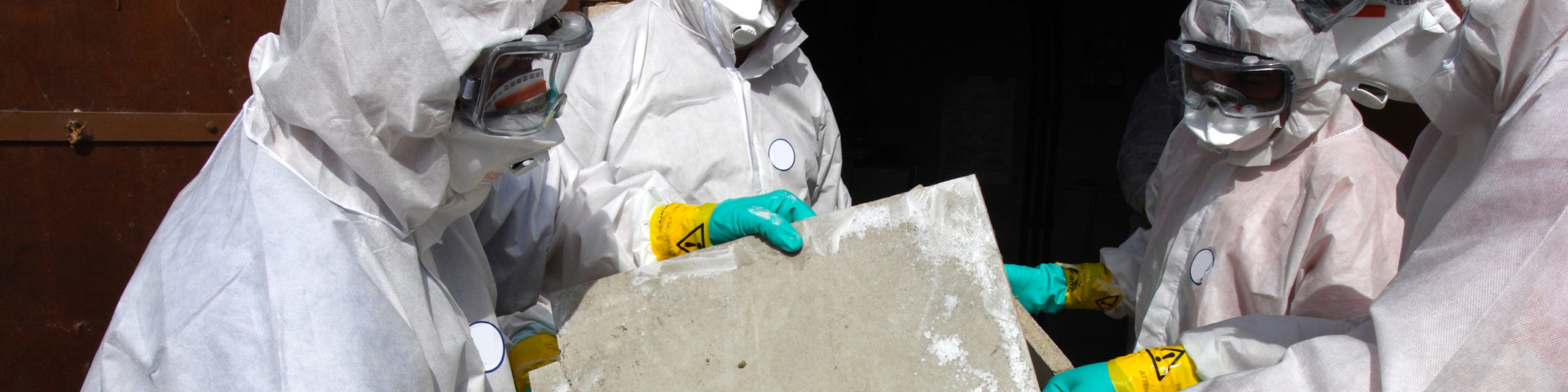
Quick answer: In Victoria, you cannot legally demolish a building constructed before 31 December 2003 until all identified or assumed asbestos-containing materials (ACM) have been safely removed first. This is a non-negotiable duty under Regulation 273 of the Occupational Health and Safety Regulations 2017 (Vic). Removing more than 10m² of non-friable asbestos requires a Class B asbestos removal licence, the works must be notified to WorkSafe Victoria at least five days in advance, and disposal must go to an EPA-licensed landfill as Reportable Priority Waste. Skipping any of these steps can stop your demolition, void your insurance, and trigger six-figure penalties.
This guide explains — in plain English — how asbestos removal fits into a Melbourne or Victorian demolition project from the first site walk-through to the final clearance certificate.
Why Demolition Is the Highest-Risk Phase for Asbestos
Demolition is where most asbestos compliance disasters happen, and it’s not hard to see why.
A demolition crew working through a 1970s factory, a 1960s weatherboard cottage in Brunswick or a 1980s warehouse in Dandenong is, by definition, breaking, smashing, cutting and crushing the very materials most likely to contain asbestos. Without proper identification and removal before the heavy machinery arrives, those materials get pulverised into the demolition spoil — at which point you no longer have a controlled removal job. You have a contaminated site.
The consequences:
- The entire demolition pile becomes asbestos-contaminated waste, multiplying disposal costs by a factor of five to ten.
- The site may require full environmental remediation before any new build can begin.
- WorkSafe Victoria can — and does — issue prohibition notices that stop the project until compliance is restored.
- Workers, neighbours and the public can be exposed to airborne fibres, with health consequences that may not appear for 20 to 40 years.
- Approximately 4,000 Australians die every year from asbestos-related diseases, and uncontrolled demolition is a known contributing source.
The lesson, repeated across every WorkSafe prosecution: asbestos must come out before the demolition starts, not during it, and never after.
The Legal Rule That Drives Everything: Remove First, Demolish Second
Part 4.4 of the Occupational Health and Safety Regulations 2017 (Vic) sets out a sequence that every demolition contractor and property owner in Victoria must follow:
“A person with management or control of a workplace must ensure, so far as is reasonably practicable, that all asbestos or ACM is identified and removed before the demolition or refurbishment is carried out.”
That single sentence has reshaped how demolitions are programmed in Melbourne. In practice it means:
- You cannot rely on visual inspection alone. If a material might contain asbestos and you can’t prove otherwise through sampling, the regulations require you to treat it as if it does.
- The owner — not just the demolition contractor — carries the duty. “I didn’t know” is not a legal defence under the OHS Act 2004.
- The asbestos register must be reviewed and updated before demolition begins. A register prepared ten years ago at fit-out is not a substitute for a fresh pre-demolition survey.
- The asbestos removal is a separate scope of works to the demolition itself. It is documented separately, notified separately, and (in most cases) cleared separately before machinery arrives.
For builders, developers and project managers, this changes the program. The asbestos removal is no longer a 3-day afterthought between “site handover” and “demo starts.” It is its own milestone with its own notification window, its own licensed contractor, and its own clearance certificate.
The Pre-Demolition Asbestos Survey: The Most Important Document on Site
A pre-demolition asbestos survey (sometimes called a “destructive” or “Type 3” survey) is the foundation of a compliant demolition. It is the document your demolition contractor, your insurer, your council and WorkSafe will all want to see.
What it covers
Unlike a management survey of an occupied building, a pre-demolition survey is intentionally destructive. The licensed assessor will:
- Lift floor coverings to inspect vinyl tiles and bituminous adhesives.
- Open up wall cavities, ceiling spaces and service risers.
- Inspect behind tiled splashbacks, under eaves, inside switchboards, and around flues.
- Sample suspect materials in line with AS 5370:2024 for laboratory analysis at a NATA-accredited facility.
- Identify every asbestos-containing material that could be disturbed during demolition — including materials that would normally be left alone in a refurbishment scenario.
What a thorough survey typically uncovers in Melbourne and Victoria
For pre-2004 buildings across Greater Melbourne, regional Victorian towns and rural properties, the most commonly identified asbestos materials in a pre-demolition survey include:
| Location | Likely ACM |
|---|---|
| External walls | Fibro cement sheeting (Super Six, Hardiplank), weatherboards over asbestos backing |
| Roofs | Corrugated asbestos cement sheeting, ridge cappings, flashing |
| Eaves & soffits | Asbestos cement lining sheets |
| Internal walls & ceilings | Asbestos cement sheets, decorative coatings, textured ceilings (“popcorn”) |
| Wet areas | Asbestos cement behind tiles, vinyl floor tiles, vinyl sheet flooring with backing |
| Floors | Vinyl tiles, bitumen adhesives, lino backing |
| Electrical | Zelemite / Ausbestos / Lebah switchboard backing panels |
| Plumbing | Asbestos cement water and stormwater pipes, flue pipes |
| Industrial | Pipe lagging, gaskets, brake linings, fire doors, rope seals, millboard |
| Fences & outbuildings | Fibro fencing, garage walls and roofs, dog kennels, chook sheds |
The survey output is a documented Asbestos Register and a site-specific scope of removal — both of which feed directly into the demolition contractor’s program.
Friable vs Non-Friable in a Demolition Context
The friable/non-friable classification is critical, because it dictates which licence class is allowed to remove the material.
Non-friable (bonded) asbestos — fibres bound in a cement matrix that cannot be crumbled by hand when dry. This includes the vast majority of materials found in residential demolitions: fibro sheeting, corrugated roofing, fences, eaves, vinyl tiles. A Class B licensed asbestos removalist is qualified to handle this work.
Friable asbestos — material that can be crumbled to powder by hand pressure when dry, or that has been damaged by fire, flood, age, water or aggressive mechanical impact. Examples include sprayed limpet insulation, pipe lagging, millboard, asbestos rope and fire-damaged cement sheets. Only a Class A licensed asbestos removalist can legally remove these.
Why this matters for demolition specifically
This is where many projects come unstuck. A material that was classified as non-friable in a management survey can become friable by the time demolition starts — particularly if:
- The roof has been weather-damaged or has been leaking for years.
- The building has suffered fire, flood or storm damage (which is increasingly common across Victoria after bushfire and storm events).
- The building has been derelict and exposed to the elements.
- An earlier (illegal) attempt to demolish or strip the building has already broken or pulverised the sheeting.
A competent pre-demolition survey will pick this up. If friable material is found, the scope expands beyond a Class B contractor and a Class A licensed removalist must be engaged for those specific items, often with full enclosures and air monitoring. The rest of the bonded material can still be handled under the Class B licence, but the program needs to reflect the staged approach.
The Compliant Demolition Sequence in Victoria
Here is how a clean, compliant demolition project should flow in Melbourne or anywhere in Victoria when asbestos is involved. This is the sequence we use on every project and the sequence WorkSafe inspectors expect to see on file.
Step 1 — Pre-demolition asbestos survey
A licensed assessor inspects the building destructively, samples suspect materials at a NATA-accredited lab, and issues a documented asbestos register and removal scope. Do not skip this step or rely on a 5-year-old register.
Step 2 — Council demolition permit
Most Melbourne councils — including the City of Melbourne, Yarra, Boroondara, Whitehorse, Knox, Casey, Wyndham, Hume, Maribyrnong, Moonee Valley, Glen Eira, Stonnington, Kingston and Melton — require a building permit for demolition under the Building Act 1993, and many require evidence of an asbestos register or removal plan as part of that approval. Regional councils follow similar processes. Check early.
Step 3 — Asbestos Removal Control Plan (ARCP) and SWMS
The licensed removalist prepares a site-specific Asbestos Removal Control Plan, a Safe Work Method Statement (SWMS), and confirms PPE, RPE, decontamination, and waste handling protocols.
Step 4 — WorkSafe Victoria notification
Licensed removalists must notify WorkSafe Victoria at least five days before asbestos removal begins. The notification includes the site address, ACM types, quantities, control measures and supervisor.
Step 5 — Utility disconnections and soft strip
Power, gas, water and telecommunications must be disconnected. Any non-asbestos soft strip (carpet, cabinetry, fittings, salvage items) is removed.
Step 6 — Licensed asbestos removal
The Class B (or Class A) removalist removes all identified ACM in accordance with the ARCP. Materials are kept whole where possible, wetted down to suppress fibres, and immediately double-wrapped in heavy-duty 200-micron polyethylene, sealed and labelled “CAUTION ASBESTOS.”
Step 7 — Decontamination
The work area, equipment and personnel are decontaminated using H-class hazardous-dust vacuum cleaners and personal decontamination units where required.
Step 8 — Independent clearance certificate
Under Regulation 297 of the OHS Regulations 2017, the person who commissioned the removal must obtain a clearance certificate from an independent competent person before the area is re-occupied or — crucially for demolition projects — before mechanical demolition begins. The clearance assessor must be independent of the removal contractor.
Step 9 — EPA-tracked transport and disposal
Asbestos waste is Reportable Priority Waste (RPW) under the Environment Protection Regulations 2021. It must be tracked through EPA Victoria’s Waste Tracker system, transported in a covered secure vehicle by a permissioned operator, and disposed of at an EPA-licensed landfill authorised to receive asbestos. Around Greater Melbourne, that is a short and well-known list of sites — your removalist should already know which one your job is heading to and have the manifest ready.
Step 10 — Mechanical demolition
Only after the clearance certificate is issued can the demolition contractor bring in the excavator and start the structural demolition. Demolition spoil from a properly cleared site can be handled as normal construction and demolition waste, which is dramatically cheaper than contaminated spoil.
Step 11 — Documentation pack
A complete compliance pack — licences, ARCP, SWMS, notification, clearance certificate, EPA waste manifests and disposal receipts — is provided to the owner. This pack is the evidence trail your insurer, your council, your future purchaser and (if it ever comes to it) WorkSafe Victoria will want to see.
Common Asbestos Hotspots in Melbourne Demolitions
Different building types throw up different surprises. Based on our experience demolishing across Melbourne and Victoria, these are the spots that catch inexperienced contractors out most often.
Pre-1990 residential — Inner and middle-ring Melbourne (Northcote, Coburg, Reservoir, Footscray, Sunshine, Box Hill, Glen Iris, Caulfield, Bentleigh, Oakleigh, Frankston):
- Fibro infill panels in weatherboard or brick veneer cottages
- Vinyl tiles and their black bitumen adhesive
- Eaves and soffit linings
- Bathroom and laundry wall sheeting behind tiles
- Backyard fences and garages — almost universally fibro until the late 1980s
Mid-century commercial and industrial — Western and northern industrial belt (Sunshine, Tottenham, Brooklyn, Campbellfield, Broadmeadows, Dandenong South):
- Corrugated asbestos cement roofing and wall cladding
- Switchboard backing panels (Zelemite / Ausbestos)
- Pipe lagging on steam and process lines (treat as Class A)
- Floor tiles in office areas
- Fire doors and rope seals around boilers and ovens
Regional Victorian properties — Geelong, Ballarat, Bendigo, Shepparton, the Latrobe Valley, the Mornington Peninsula and Yarra Valley:
- Farm sheds and dairies almost universally roofed in asbestos cement until the 1990s
- Asbestos cement water tanks, troughs and stock pipework
- Asbestos cement flues on slow-combustion heaters
- Older shearing sheds, packing sheds and pump houses
Post-fire, post-flood and post-storm sites — anywhere in Victoria:
- Any pre-2004 building damaged by fire, flood or severe storm should be treated as containing friable asbestos until proven otherwise. Class A removal almost always applies.
Council and Demolition Permit Requirements in Melbourne
Asbestos compliance and demolition permits are administered by different bodies, but they intersect at almost every project.
- The Victorian Building Authority (VBA) sets the demolition permit framework under the Building Act 1993 and Building Regulations 2018.
- The local council issues the demolition permit (or refers it through a private building surveyor) and may impose conditions relating to asbestos, dust, noise, and waste tracking.
- WorkSafe Victoria regulates the asbestos removal itself.
- EPA Victoria regulates the disposal of the asbestos waste.
Many Melbourne councils now require evidence of an asbestos register and a licensed removalist engagement before they will sign off the demolition permit. Heritage overlays add further conditions. Working with a contractor who handles both the asbestos removal and the demolition under one roof simplifies the paperwork and removes the program risk of two separate trades trying to dovetail their timing.
Penalties When Demolition Goes Wrong
Victorian asbestos enforcement has hardened year on year, and demolition-related prosecutions are a focus area for WorkSafe Victoria. The financial exposure for an unlicensed or non-compliant demolition typically includes:
- Failure to obtain a clearance certificate: 100 penalty units for an individual; 500 penalty units for a body corporate (Regulation 297).
- Performing asbestos removal without the required licence: fines well in excess of $30,000 for individuals and substantially more for companies.
- Illegal dumping or disposal of asbestos waste: fines exceeding $50,000 under the Environment Protection Act 2017, plus remediation costs.
- Reckless conduct endangering workers: imprisonment of up to five years under the OHS Act 2004.
- Civil consequences: insurance policies almost universally exclude losses arising from unlicensed asbestos work. If something goes wrong on an uninsured demolition, the entire financial exposure sits with the principal.
And then there is the consequence that does not appear in any statute: a published WorkSafe prosecution against a builder or developer is now indexed by every search engine on the planet. The reputational damage outlasts the fine by years.
What This Costs — and Why the Cheapest Quote Is Usually the Most Expensive
Honest pricing for asbestos removal during a Melbourne demolition depends on:
- The type and condition of the ACM (bonded sheets are cheaper than friable lagging).
- The quantity (m² of sheeting, lineal metres of pipe, number of items).
- Access (single-storey is easier than a three-storey walk-up; tight inner-city sites with no skip access cost more).
- Disposal distance to the nearest EPA-licensed landfill.
- The clearance certificate and any required air monitoring.
A licensed Class B job on a typical Melbourne residential demolition — a 1960s or 1970s home with fibro eaves, an asbestos garage and an asbestos fence — typically runs into the low-to-mid thousands as a standalone scope. Bundled with the demolition itself, it is usually more economical.
If you are receiving quotes that look dramatically cheaper than the rest of the market, the contractor is almost certainly cutting corners on one of three things: licensing, disposal, or the clearance certificate. All three are visible on a WorkSafe audit, and all three sit at the owner’s legal door, not just the contractor’s.
How Asbestos Gone and Clean Handles Asbestos Removal and Demolition in Melbourne
We are a WorkSafe Victoria licensed Class B (non-friable) asbestos removalist and demolition contractor based in Melbourne, servicing all of Greater Melbourne and regional Victoria — from inner suburbs out to Geelong, Ballarat, Bendigo, the Mornington Peninsula, the Yarra Valley, the Latrobe Valley and beyond.
Because we run asbestos removal and demolition under one ABN, your project doesn’t get held up waiting for two contractors to align diaries. Every demolition project we take on follows the same backbone:
- Free site inspection and pre-demolition assessment.
- Pre-demolition asbestos survey with NATA-accredited sampling where required.
- Site-specific Asbestos Removal Control Plan and Safe Work Method Statement.
- WorkSafe Victoria notification at least five days before works begin.
- Class B non-friable removal using H-class vacuums, P2/P3 RPE, and full PPE protocols. Where friable material is identified, we coordinate a Class A subcontractor under our project management.
- EPA-compliant double-wrapping, labelling, transport and disposal at a licensed landfill, with full Waste Tracker manifests.
- Independent clearance certificate under Regulation 297.
- Mechanical demolition, soft strip and site clean to slab.
- Full documentation pack — licences, certificates, manifests and clearance — delivered to you for your records, your insurer, and future buyer due diligence.
For builders, developers and owner-builders, this integrated approach removes the single biggest cause of program slippage on pre-2004 demolition sites: the gap between “asbestos guy finishes” and “demo guy starts.”
Frequently Asked Questions
Do I have to remove asbestos before demolition in Victoria?
Yes. Under Regulation 273 of the OHS Regulations 2017, the person with management or control of the workplace must ensure — so far as reasonably practicable — that all identified or assumed asbestos-containing materials are removed before the building is demolished. There are very narrow exceptions (for example, where removal would be more dangerous than controlled demolition), but they require expert sign-off and are rare in standard residential and commercial projects.
Can my demolition contractor remove the asbestos as part of the demolition?
Only if they hold a current Class B asbestos removal licence (for non-friable) or Class A licence (for friable). Most general demolition contractors are not licensed for asbestos removal and must engage a licensed removalist as a separate trade. We hold a Class B licence and run both scopes under one project.
How long does asbestos removal take on a typical Melbourne demolition?
For a standard pre-1990 residential site — house, garage and fences — asbestos removal is typically completed in one to three working days, followed by the independent clearance inspection. Commercial and industrial sites can take longer depending on quantity and access. The five-day WorkSafe notification window is usually the longest fixed element in the program.
Do I need a pre-demolition asbestos survey if I already have an asbestos register?
In almost every case, yes. A standard management register is prepared without lifting floors or opening walls, so it does not identify hidden ACM that demolition will inevitably disturb. A pre-demolition (destructive) survey extends the register to cover what’s behind every surface — which is exactly what your demolition contractor needs to plan safely.
What is a clearance certificate and why is it needed before demolition?
A clearance certificate is a written statement from an independent competent person confirming that the asbestos removal area is safe to re-occupy. Under Regulation 297, the owner must obtain one before the cleared area is used again — and on a demolition site, that practically means before the excavator starts. The clearance assessor cannot be the removal contractor.
What happens if asbestos is found mid-demolition?
Work stops. The site is isolated, the area is treated as potentially contaminated, a licensed removalist is engaged, and the area is re-surveyed and re-cleared before demolition resumes. The cost and program impact are significant, which is why pre-demolition surveys exist.
Can I burn or bury asbestos waste on a rural Victorian property?
No. Burning or burying asbestos is illegal in Victoria under the Environment Protection Act 2017, including on private rural land. Asbestos must be disposed of at an EPA-licensed landfill authorised to accept it. Illegal dumping fines exceed $50,000 plus remediation costs.
Does asbestos removal affect my demolition insurance?
Yes — significantly. Most demolition and construction insurance policies exclude losses arising from unlicensed asbestos work. If a non-licensed contractor handles asbestos and something goes wrong (contamination, exposure, prosecution), the principal is typically uninsured for the entire claim. Always confirm the licence and ask for a copy.
Do Melbourne councils require evidence of asbestos compliance for a demolition permit?
Many do, and the trend is towards more, not less, scrutiny. Councils across Melbourne — including the City of Melbourne, Yarra, Boroondara, Whitehorse, Knox, Casey, Wyndham, Hume, Glen Eira, Stonnington, Kingston and Maribyrnong — increasingly request evidence of an asbestos register, a licensed removalist engagement, and (post-removal) a clearance certificate before signing off demolition or new build approvals.
Plan Your Melbourne or Victorian Demolition the Right Way
Demolition projects do not fail because asbestos is complicated. They fail because the asbestos work is sequenced last instead of first, or handed to a contractor who isn’t licensed for it.
If you are planning a residential, commercial or industrial demolition anywhere in Melbourne or Victoria, Asbestos Gone and Clean can provide a no-obligation site inspection, a fixed-price Class B asbestos removal and demolition quote, and a complete compliance pack from survey through to clearance certificate.
☎ Call us: 0475 143 106
✉ Email: asbestosgoneandclean@gmail.com
???? Contact Us: Asbestos Gone and Clean – Contact
We service all Melbourne metropolitan suburbs and travel throughout regional Victoria for larger commercial, industrial and rural demolition projects.
Related Reading
- Asbestos Regulations and Legal Requirements in Australia: The 2026 Compliance Guide for Melbourne & Victoria — our deep-dive on the Victorian regulatory framework, licensing, and penalties.
Sources and Further Reading
- WorkSafe Victoria — Compliance Code: Removing Asbestos in Workplaces
- WorkSafe Victoria — Compliance Code: Managing Asbestos in Workplaces
- Occupational Health and Safety Regulations 2017 (Vic), Part 4.4 (including Regulations 273 and 297)
- Occupational Health and Safety Act 2004 (Vic)
- Building Act 1993 (Vic) and Building Regulations 2018
- EPA Victoria — Publication IWRG611.2: Asbestos Transport and Disposal
- Environment Protection Regulations 2021 (Vic)
- Asbestos and Silica Safety and Eradication Agency (ASSEA) — Asbestos National Strategic Plan 2024–2030
- Standards Australia — AS 5370:2024 Air Quality — Bulk Materials
Disclaimer: This article is general information only and is current as at May 2026. It is not legal advice. For advice on a specific demolition project, contact WorkSafe Victoria, EPA Victoria, your local council, or speak directly with Asbestos Gone and Clean.