
Quick answer: In Victoria, a homeowner can legally remove non-friable asbestos themselves only if the total area is less than 10m² and the work takes less than one hour over any seven-day period. Above either threshold, a WorkSafe Victoria licensed Class B asbestos removalist is legally required. Even within the DIY exemption, WorkSafe Victoria strongly recommends using a licensed professional — and once you add up correct PPE, double-wrapping, an EPA-licensed landfill disposal fee, vehicle transport, and the risk of getting it wrong, DIY is rarely cheaper than a fixed-price professional quote. Friable asbestos, commercial properties, rental properties and any work over 10m² cannot legally be done DIY in Victoria under any circumstances.
This guide is the honest, no-spin breakdown of the DIY-versus-professional decision for asbestos removal in Melbourne and Victoria — what’s legal, what’s safe, what each actually costs, and where the real risk sits.
The Two Questions Every Melbourne Homeowner Should Ask First
Before you watch a single YouTube video or price a roll of polythene at Bunnings, ask yourself two questions:
- Am I legally allowed to remove this asbestos myself in Victoria?
- Even if I am, is it the right call?
These are two completely separate questions, and a lot of homeowners — and even some builders — collapse them into one. Just because something is legal doesn’t mean it’s the smart, safe or cheapest option. Of the roughly 4,000 Australians who die every year from asbestos-related diseases such as mesothelioma, lung cancer and asbestosis, a meaningful share were exposed not on a job site decades ago, but during home renovations they did themselves.
Let’s work through both questions.
Question 1: Is DIY Asbestos Removal Even Legal in Victoria?
Victoria’s asbestos rules sit under the Occupational Health and Safety Act 2004 and Occupational Health and Safety Regulations 2017 (Vic), with WorkSafe Victoria as the lead regulator and EPA Victoria as the disposal regulator.
For a homeowner working on their own residential property — not a workplace, not a rental, not a strata block — the legal position is:
DIY is permitted only when ALL of the following apply:
| Condition | Threshold |
|---|---|
| Asbestos type | Non-friable (bonded) asbestos only |
| Total area | Less than 10 m² |
| Time on tools | Less than 1 hour in any seven-day period |
| Property type | Owner-occupied residential (not a workplace) |
| Disposal | Must still go to an EPA-licensed landfill |
If you breach any one of those thresholds, you have moved out of the DIY exemption and into territory that legally requires a Class B asbestos removal licence.
DIY is never permitted for:
- Friable asbestos (anything that crumbles to powder under hand pressure when dry — sprayed limpet, pipe lagging, millboard, asbestos rope, or fire/water-damaged cement sheets). This is Class A licensed work only.
- Workplaces, including commercial premises, factories, warehouses, retail tenancies, schools, churches and community buildings.
- Rental properties, even if you own them. A rental is a workplace for the property manager, the tradesperson and any inspector that enters it, so the OHS Regulations apply.
- Common property in strata or owners-corporation buildings.
- Any job over 10m² — and 10m² is smaller than most Melburnians realise. A typical garden fence in a suburban backyard is well over 10m². A garage wall is over 10m². A bathroom of fibro sheeting is over 10m². A roof? Multiples of 10m².
Reality check: Once you genuinely measure the asbestos on a typical pre-2004 Melbourne property — fence, garage, eaves, shed, bathroom sheeting — almost every “DIY” job is actually a licensed Class B job in disguise.
Question 2: Where Does Most DIY Asbestos in Melbourne Homes Actually Live?
The Australian Government estimates roughly 1 in 3 Australian homes built before 1990 contains some form of asbestos-containing material (ACM). In Melbourne, that proportion is higher in the inner and middle-ring suburbs where pre-1990 building stock dominates — Northcote, Coburg, Reservoir, Footscray, Sunshine, Box Hill, Glen Iris, Caulfield, Bentleigh, Oakleigh, Frankston and dozens of others.
The materials most homeowners go looking to remove themselves:
- Asbestos cement fences (Super Six and similar) — almost universal in pre-1990 backyards.
- Garage walls and roofs — fibro cement sheeting and corrugated asbestos roofing.
- Eaves, soffits and gable infills — small in any one panel, large across a whole house.
- Bathroom and laundry wall sheeting — usually hidden behind tiles.
- Vinyl floor tiles and their black bitumen adhesive — often forgotten because they’re underfoot.
- Backyard sheds, dog kennels, chook sheds and outdoor toilets — the classic “I’ll just pull it down on Saturday” job.
Almost all of these materials are non-friable in good condition. Almost all of them, in any meaningful quantity, exceed the 10m² DIY threshold.
The Health Risks of DIY Asbestos Removal
The legal threshold is one thing. The biology is another. Asbestos disease doesn’t care whether you were licensed; it cares whether you inhaled fibres.
What actually happens when DIY goes wrong
- A homeowner snaps a 2.4m sheet of fibro to fit it in a trailer. Each broken edge releases millions of microscopic fibres.
- A renovator uses a power tool — angle grinder, circular saw, drill, sander — on asbestos cement. Power tools on ACM are explicitly banned for a reason: a single cut on a fibro sheet can release more fibres than an entire industrial removal job done correctly.
- A weekend demolisher water-blasts an old asbestos roof to “clean it up.” The high-pressure water doesn’t just clean — it strips fibres into a fine airborne mist that travels well beyond the property.
- A homeowner stacks broken sheets in an open trailer, drives them across Melbourne, and contaminates the trailer (and every road verge between home and the tip) with fibre dust.
The timeline of harm
Asbestos diseases have a latency period of 20 to 40 years. The exposure you have today on a Saturday afternoon in your backyard will not produce a cough on Sunday. It produces a diagnosis in 2050.
This is what makes asbestos uniquely dangerous in a DIY context. The feedback loop is so delayed that there is no on-the-spot warning to tell you that you’ve made a serious mistake — and by the time the diagnosis arrives, there is no medical intervention that can undo the exposure.
Who else is at risk?
- Your family — fibres carried home on clothing, hair and tools. Cases of mesothelioma in the spouses and children of home renovators are well documented in Australian medical literature.
- Your neighbours — airborne fibres do not respect fence lines, particularly on a windy Melbourne afternoon.
- The next tradesperson — the plumber or electrician who turns up six months later to a “renovated” room has no way of knowing it wasn’t done properly.
- Future occupants — the family that buys your house and finds asbestos dust in the roof cavity.
What You Actually Have to Do If You DIY (The Honest Process)
If you’re genuinely under 10m², under one hour, and on owner-occupied residential land, the law allows you to proceed. But “allowed” is not “easy.” Here is what compliant DIY actually involves in Victoria.
Before you start
- Confirm the material is asbestos via a NATA-accredited laboratory sample (a small piece in a sealed bag, posted to a lab — typically $40–$80 per sample). Without this, you don’t know what you’re dealing with.
- Confirm the material is non-friable and in good condition (no cracking, no fire damage, no water damage, no flaking).
- Confirm the area is genuinely under 10m². Measure it. Don’t eyeball it.
- Notify your neighbours, particularly those sharing a fence line.
- Check that your local council (City of Melbourne, Yarra, Boroondara, Whitehorse, Knox, Casey, Wyndham, Hume, Maribyrnong, Moonee Valley, Glen Eira, Stonnington, Kingston, Melton or wherever you sit) has no additional notification or permit requirements. Some do.
Equipment you legally need
- P2 disposable respirator (a paper dust mask is not sufficient — a P2 with a proper face seal is the minimum). For larger jobs, a full-face P3 respirator.
- Disposable coveralls with hood (Type 5/6), taped at wrists and ankles.
- Disposable gloves and rubber-soled disposable boots or boot covers.
- Heavy-duty 200-micron polyethylene sheeting for double-wrapping waste.
- Duct tape for sealing wraps.
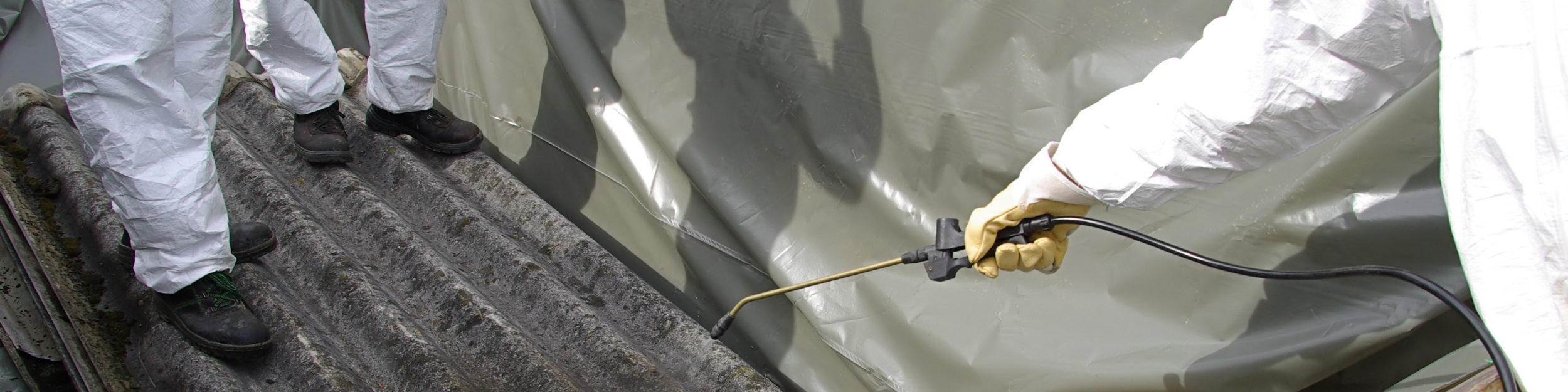
- Garden sprayer filled with water (and ideally PVA glue or wetting agent) to suppress fibres.
- Pre-printed “CAUTION ASBESTOS” labels for every wrapped bundle.
- Bucket of water, rags, and a decontamination zone.
- A booked drop-off slot at an EPA-licensed asbestos landfill.
You cannot use a household vacuum cleaner. A normal vacuum will exhaust fibres straight out the back into your home. The only compliant vacuum for asbestos is an H-class hazardous-dust vacuum, which retails for several hundred dollars and isn’t sold at general hardware stores.
During the work
- Keep all other people, pets and animals well clear.
- Wet the material continuously to suppress fibres.
- Use hand tools only — never power tools, never high-pressure washers, never angle grinders.
- Remove sheets whole. Do not break them to fit a trailer.
- Wrap each item immediately in double-layered 200-micron poly, seal with duct tape, and label.
- Do not stack unwrapped sheets, even temporarily.
- Decontaminate yourself thoroughly before leaving the work zone — coveralls into the asbestos waste, shower before re-entering the house.
After the work
- Transport in a covered, secure load. Tarpaulins must be tied down and the load must not be visible or able to escape.
- Drop off at an EPA-licensed landfill authorised to accept asbestos waste. There are a limited number of these around Greater Melbourne, opening hours are restricted, and most require you to book a slot in advance. Tip fees apply per cubic metre or per tonne.
- Retain your tip receipt. If your property is ever audited, sold or insured against contamination, that receipt is the only proof you disposed of it legally.
- Burning or burying asbestos is illegal anywhere in Victoria, including private rural properties, under the Environment Protection Act 2017. Fines exceed $50,000 plus remediation costs.
The Real Cost of DIY Asbestos Removal in Melbourne
Most DIY cost comparisons online stop at “professional removal costs $X and PPE costs $Y, so DIY is cheaper.” That math leaves out roughly half the line items.
Here is what a typical DIY job — say, a 9m² asbestos garage wall on a Melbourne suburban property — actually costs once you add everything up:
| Item | Realistic cost (2026 Melbourne) |
|---|---|
| Laboratory sample analysis (NATA-accredited) | $40 – $80 per sample |
| P2/P3 respirator + replacement cartridges | $40 – $150 |
| Disposable coveralls (3–4 sets) | $60 – $120 |
| Disposable gloves and boot covers | $20 – $40 |
| 200-micron heavy-duty poly sheeting | $80 – $150 |
| Heavy-duty duct tape | $25 – $40 |
| “Caution Asbestos” labels | $15 – $30 |
| Garden sprayer + wetting agent / PVA | $30 – $60 |
| Skip hire or trailer hire (covered) | $150 – $400 |
| Fuel and time to landfill | $30 – $80 |
| EPA-licensed landfill disposal fee | $200 – $600 |
| Your own time (weekend + prep + tip run) | 1–2 full days |
| Sub-total — direct cash cost | $690 – $1,750 |
| Plus — risk of getting it wrong | (see below) |
For the same 9m² job, a fixed-price Class B licensed quote in Melbourne typically lands in the low-to-mid thousands all-inclusive — survey, removal, decontamination, transport, EPA-licensed disposal, manifest, and clearance documentation. On smaller jobs the gap is often only a few hundred dollars. On larger jobs the professional quote is frequently cheaper than DIY, because licensed operators get bulk landfill rates and don’t burn weekends doing it.
The hidden costs DIY price comparisons leave out
- Contamination risk: if you break or pulverise the material, the cost to remediate the contaminated area is dramatically higher than the original removal would have been.
- Insurance impact: see below.
- Resale risk: see below.
- Council / WorkSafe / EPA investigation: if a neighbour complains (and they do), the cost of demonstrating you complied — and remediating if you didn’t — can run into five figures.
- Health cost: uncapped, and not realised for 20–40 years.
What a Licensed Class B Professional Actually Does Differently
When you compare DIY against a professional Class B removalist, the difference is not “they use better masks.” The difference is structural.
A WorkSafe Victoria licensed Class B asbestos removalist:
- Identifies and samples the material via NATA-accredited testing in line with AS 5370:2024 — confirming type, condition and quantity before quoting.
- Prepares a site-specific Asbestos Removal Control Plan (ARCP) and Safe Work Method Statement (SWMS) for the job.
- Notifies WorkSafe Victoria at least five days before removal begins (a legal requirement for licensed work).
- Carries appropriate insurance — public liability, workers’ compensation, and (critically) policies that cover asbestos work specifically, which DIY does not.
- Uses H-class hazardous-dust vacuums, P3 respirators, full-face air-fed systems where required, full PPE, and personal decontamination units.
- Removes materials whole, wets them down, and immediately double-wraps in 200-micron poly with proper labelling.
- Transports under EPA permissions in covered, tracked vehicles.
- Disposes at an EPA-licensed landfill with a manifest that is tracked through EPA Victoria’s Waste Tracker system — Reportable Priority Waste (RPW) is documented from cradle to grave.
- Arranges an independent clearance certificate under Regulation 297 of the OHS Regulations 2017 — issued by a competent person independent of the removalist, confirming the area is safe to re-occupy.
- Delivers a documentation pack — licence copy, ARCP, SWMS, WorkSafe notification, transport manifest, disposal receipt, and clearance certificate. This pack is the evidence trail that protects you on sale, on insurance claims, and on any future audit.
That documentation pack is the single most under-rated reason to use a licensed removalist. It is the asset DIY cannot produce — and the asset every future buyer, insurer, council and lender will eventually ask to see.
Risk Comparison: DIY vs Professional, Side by Side
| Risk area | DIY (within legal exemption) | Licensed Class B professional |
|---|---|---|
| Legal exposure if breached | Personal fines, EPA infringements, possible WorkSafe attention | Held by the contractor; documented compliance |
| Health risk to occupant | High if technique fails; latency 20–40 years | Engineered down through PPE, RPE, wet methods, H-class vacuums |
| Health risk to family / neighbours | Real — fibres travel | Contained by site setup and control plan |
| Insurance cover | Almost always excluded | Held by contractor under policy |
| Disposal compliance | Depends on homeowner getting it right | Tracked through EPA Waste Tracker |
| Documentation for future sale | None (typically) | Full compliance pack |
| Time cost | 1–2 full days minimum, plus tip run | 1–3 working days, hands off |
| Cost predictability | Variable — landfill fees, hire, PPE | Fixed-price quote |
| Quality assurance | None | Independent clearance certificate |
Insurance, Resale and Long-Tail Consequences
This is where the DIY-versus-professional decision quietly tilts hardest towards “use a professional,” and it has very little to do with the removal day itself.
Home insurance
Most home and contents and home building insurance policies in Australia exclude losses arising from unlicensed asbestos work. If you DIY a removal and:
- A fibre release contaminates your home or a neighbour’s, or
- A trade is later exposed working in the area, or
- A future buyer’s inspection turns up residual fibres in the ceiling cavity or soil,
… the insurer is highly likely to deny the claim on the basis that the work was performed by an unlicensed person. The financial exposure is uncapped.
Sale of the property
Section 32 vendor disclosure in Victoria does not currently require a positive asbestos declaration, but purchaser building and pest inspectors routinely look for asbestos in pre-2004 homes. If they find evidence of past asbestos work — broken fragments in the roof cavity, residual fibres in the subfloor, fresh patching in a known asbestos location with no clearance certificate — the deal frequently:
- Re-prices downwards by a five-figure sum, or
- Falls over entirely, or
- Becomes subject to a remediation condition that you, the vendor, pay for.
A clearance certificate from an independent competent person is the document that closes those questions before they’re asked. DIY does not produce one.
Rental properties
If your property is or ever becomes a rental, the OHS Regulations apply because the property is a workplace for tradespeople, property managers and inspectors entering it. Any DIY asbestos work that has not been properly documented — and any post-2004 occupant exposure that traces back to it — becomes the landlord’s problem. Insurance exclusions for unlicensed asbestos work apply on landlord policies too.
Future buyer due diligence
Buyer-side legal teams are increasingly asking pre-2004 vendors specifically: “Has any asbestos work been undertaken on this property? If so, please provide licences, manifests, and clearance certificates.” The professional documentation pack answers that question instantly. DIY leaves you trying to remember what you did seven years ago.
When Professional Removal Is Legally Non-Negotiable in Victoria
To be absolutely explicit — there is no DIY option, regardless of homeowner enthusiasm, in any of these scenarios:
- The material is friable (or has been damaged by fire, flood, age or aggressive impact and is therefore now friable). → Class A licensed only.
- The area is more than 10m² of non-friable asbestos. → Class B (or Class A) licensed.
- The work will take more than one hour in any seven-day period. → Licensed.
- The property is a workplace — commercial, retail, industrial, school, church, hall. → Licensed.
- The property is a rental or owners-corporation building. → Licensed.
- The work is part of a demolition under Regulation 273 of the OHS Regulations 2017. → Licensed, with clearance certificate before demolition begins.
- The asbestos is in a switchboard (Zelemite / Ausbestos / Lebah backing panels), behind tiles in wet areas, or wrapped around flues and pipes. → Licensed, often Class A.
A licensed Class B removalist can handle all the non-friable scenarios above. Class A scenarios require a Class A specialist (which a reputable Class B contractor will coordinate for you under one project).
How Asbestos Gone and Clean Prices a Typical Melbourne Job
We are a WorkSafe Victoria licensed Class B (non-friable) asbestos removalist and demolition contractor based in Melbourne. We service all of Greater Melbourne and regional Victoria — from the inner suburbs out to Geelong, Ballarat, Bendigo, the Mornington Peninsula, the Yarra Valley, the Latrobe Valley and beyond.
Our quoting approach is intentionally transparent so you can compare apples with apples against DIY:
- Free site inspection — we look at the actual material, measure it properly, identify access constraints, and confirm whether anything is borderline-friable.
- NATA-accredited sampling where required.
- Fixed-price written quote — including survey, ARCP, SWMS, WorkSafe notification, removal, decontamination, transport, EPA-licensed landfill disposal, manifest, and independent clearance certificate.
- No surprises on tip fees — disposal is built into the price.
- Complete documentation pack delivered to you on completion for your records, your insurer, and any future buyer due diligence.
For builders, developers and owner-builders, we also run integrated soft strip and demolition services so your asbestos removal and demolition dovetail under one project manager — removing the single biggest cause of program slippage on pre-2004 demolition sites.
Frequently Asked Questions
Is it legal to remove asbestos yourself in Victoria?
Yes, but only within a narrow exemption: the asbestos must be non-friable, the total area must be less than 10m², the work must take less than one hour over any seven-day period, and the property must be owner-occupied residential. Above any one of those thresholds, a Class B licensed asbestos removalist is legally required.
How much does professional asbestos removal cost in Melbourne in 2026?
For most non-friable residential jobs — a fence, garage, eave replacement or bathroom strip — expect a fixed-price quote after a free site inspection. Pricing depends on the material, quantity, access and disposal route. Quotes that look dramatically below the rest of the market typically indicate the contractor is cutting corners on licensing, disposal or the clearance certificate — all of which sit at the owner’s legal door if they go wrong.
Is DIY asbestos removal actually cheaper than hiring a professional?
Rarely, once you cost it properly. Add NATA-accredited sampling, P2/P3 respirators, disposable coveralls, 200-micron poly, EPA-licensed landfill tip fees, covered trailer hire, fuel, your own time across a weekend, and the unpriced risk of getting it wrong, and DIY for a typical Melbourne garage or fence job often lands within a few hundred dollars of a professional fixed-price quote — without the documentation, insurance cover, or clearance certificate.
Can I use a normal vacuum cleaner to clean up asbestos dust?
No. A standard household vacuum will exhaust microscopic fibres straight out the back into your home. The only compliant vacuum for asbestos work is an H-class hazardous-dust vacuum cleaner, which is not sold at general hardware stores.
Can I use power tools on asbestos cement sheeting?
No. Power tools — angle grinders, circular saws, drills, sanders, high-pressure washers — are explicitly prohibited because they generate massive numbers of airborne fibres. A single power-tool cut on a fibro sheet can release more fibres than an entire compliant industrial removal. Hand tools only.
Can I take asbestos waste to my local tip?
Only to EPA-licensed landfills authorised to accept asbestos. Standard transfer stations and recycling centres do not accept it. Around Greater Melbourne, the list of authorised sites is short, opening hours are restricted, and most require a pre-booked slot. Your removalist (or, if DIYing, you) must hold and retain the tip receipt as proof of compliant disposal.
Can I burn or bury asbestos waste on my rural property?
No. Burning or burying asbestos is illegal anywhere in Victoria — including private rural land — under the Environment Protection Act 2017. Penalties exceed $50,000 plus remediation costs.
Do I need to notify the council if I’m removing asbestos myself?
Many Melbourne councils — including the City of Melbourne, Yarra, Boroondara, Whitehorse, Knox, Casey, Wyndham, Hume, Maribyrnong, Moonee Valley, Glen Eira, Stonnington, Kingston and Melton — have notification or permit requirements for asbestos work, particularly where it intersects with a building permit. Check your local council before starting.
Will doing asbestos work myself affect my home insurance?
Almost always, yes. Standard home insurance policies in Australia exclude losses arising from unlicensed asbestos work. If something goes wrong — contamination, exposure, future buyer claim — the insurer is highly likely to deny the claim.
Will DIY asbestos removal affect the sale of my house?
It can. Building and pest inspectors routinely look for asbestos in pre-2004 Victorian homes. If they find evidence of past removal without licences, manifests or a clearance certificate, the sale can re-price downwards, fall over, or proceed with a vendor-funded remediation condition. A professional clearance certificate under Regulation 297 closes that question before it’s asked.
What if I’ve already done DIY asbestos work and now I’m worried?
Stop work, isolate the area, do not vacuum or sweep, and contact a licensed removalist for an assessment and remediation plan. The earlier this is dealt with, the cheaper and simpler it is. Hiding the issue almost always costs more later.
Can I do DIY asbestos removal on a rental property I own?
No. Rental properties are workplaces under the OHS Regulations because tradespeople, property managers and inspectors enter them in the course of their work. A licensed Class B removalist is required regardless of area or time.
What’s the difference between Class A and Class B asbestos removal?
A Class B licence covers non-friable (bonded) asbestos — fibro sheeting, corrugated roofing, eaves, fences, vinyl tiles. A Class A licence covers friable asbestos (sprayed limpet, pipe lagging, millboard, asbestos rope, fire- or water-damaged cement sheeting) as well as non-friable. Class B holders are legally prohibited from undertaking Class A work.
Does WorkSafe Victoria actually enforce DIY breaches?
Yes — particularly where there has been a complaint, a contamination event, or a workplace incident. WorkSafe Victoria publishes prosecutions and infringements, and EPA Victoria pursues illegal dumping aggressively. The cost of a single contested infringement typically far exceeds the cost of doing the job professionally in the first place.
The Bottom Line on DIY vs Professional Asbestos Removal
Yes, Victorian law leaves a narrow door open for a homeowner to remove small amounts of non-friable asbestos themselves. And yes, with the right PPE and the right technique, that door can be walked through safely.
But for the vast majority of Melbourne homes — where the fence alone is over 10m², the garage is fibro, the eaves are asbestos cement, and the bathroom sheeting is hidden behind tiles — the DIY door is closed by law before the homeowner even reaches it. And on the small jobs where the door is genuinely open, the all-in cost of doing it properly, the insurance exposure, and the absence of a clearance certificate usually make a fixed-price licensed quote the cheaper and safer option.
The honest comparison isn’t “DIY is cheap, professional is expensive.” It’s “DIY looks cheap until you cost it properly — at which point professional is usually cheaper, always safer, and the only option that produces the paperwork your future self will need.”
Get a Compliant, Fixed-Price Quote in Melbourne or Victoria
If you’re weighing up DIY versus professional asbestos removal anywhere in Melbourne or Victoria, Asbestos Gone and Clean can give you the numbers you need to compare honestly. We provide:
- A free site inspection to confirm whether your job is legally DIY-eligible or licensed-only.
- A fixed-price written quote — survey, ARCP, SWMS, WorkSafe notification, removal, EPA-tracked disposal and independent clearance certificate, all included.
- A complete compliance pack delivered on completion for your insurer, your council, and any future sale.
☎ Call us: 0475 143 106
✉ Email: asbestosgoneandclean@gmail.com
???? Contact Us: Asbestos Gone and Clean – Contact
We service all Melbourne metropolitan suburbs — including the inner-north, inner-east, inner-west, bayside, south-east and outer-growth corridors — and travel throughout regional Victoria for larger residential, commercial and demolition projects.
Related Reading
- Asbestos Regulations and Legal Requirements in Australia: The 2026 Compliance Guide for Melbourne & Victoria — our deep-dive on the Victorian regulatory framework, licensing, registers and penalties.
- Asbestos Removal During Demolition: What You Need to Know (2026 Melbourne & Victoria Guide) — the full pre-demolition-survey-to-clearance-certificate sequence for builders, developers and owner-builders.
Sources and Further Reading
- WorkSafe Victoria — Asbestos: Safety Basics, Licensing and Compliance Codes
- WorkSafe Victoria — Compliance Code: Removing Asbestos in Workplaces
- WorkSafe Victoria — Compliance Code: Managing Asbestos in Workplaces
- Occupational Health and Safety Act 2004 (Vic)
- Occupational Health and Safety Regulations 2017 (Vic), Part 4.4 (including Regulations 273 and 297)
- EPA Victoria — Publication IWRG611.2: Asbestos Transport and Disposal
- Environment Protection Act 2017 (Vic) and Environment Protection Regulations 2021 (Vic)
- Asbestos and Silica Safety and Eradication Agency (ASSEA) — Asbestos National Strategic Plan 2024–2030
- Standards Australia — AS 5370:2024 Air Quality — Bulk Materials
Disclaimer: This article is general information only and is current as at May 2026. It is not legal, health or financial advice. For advice on a specific project, contact WorkSafe Victoria, EPA Victoria, your local council, or speak directly with Asbestos Gone and Clean.