
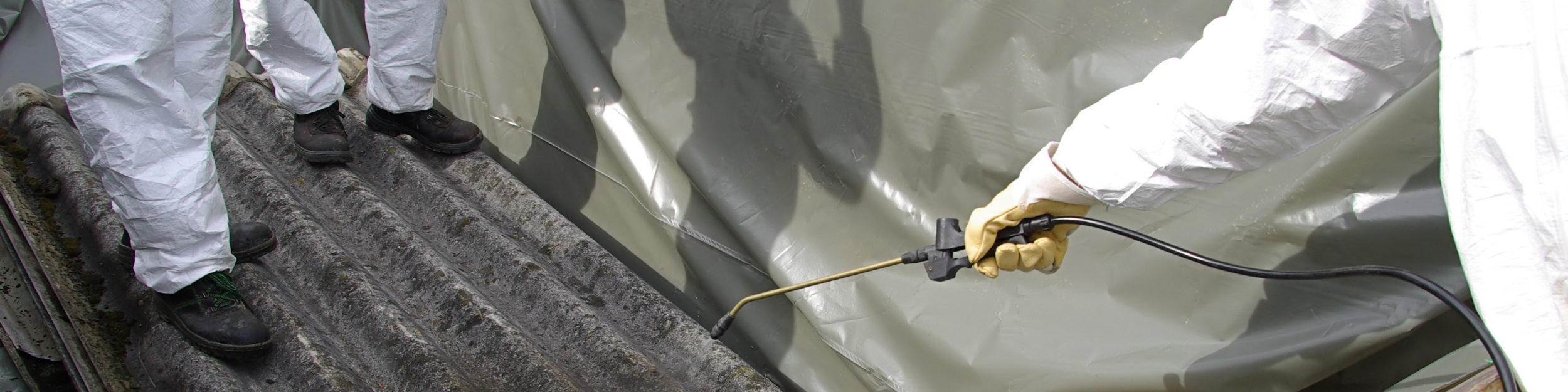
Quick answer: In autumn 2026, following a severe overnight thunderstorm that swept through Melbourne’s outer-eastern foothills, we delivered an emergency asbestos removal response on an early-1980s brick veneer home in Boronia (City of Knox). High winds and golf-ball-sized hail had torn off most of the Super Six corrugated asbestos cement garage roof, cracked the asbestos eaves on three elevations of the main dwelling where a large gum branch came down, and scattered ACM fragments across the backyard, the side drive, a children’s trampoline and two neighbouring properties. We received the homeowner’s call at 0712 on the Sunday morning, had a licensed Class B supervisor on site by 1115 the same day, established the urgent containment perimeter before 1500, lodged the WorkSafe Victoria emergency exemption for the immediate public-safety scope on Monday morning, and ran a coordinated Class A + Class B program over the following nine working days. Total documented ACM removed: approximately 152m² of non-friable material plus an estimated 6 to 9kg of friable fragment debris across three properties. End-to-end project duration from the first phone call to the documentation pack landing with the homeowner and their insurer was 14 calendar days. Final fixed-price cost — including emergency call-out, NATA-accredited sampling, Class A friable scope, Class B non-friable scope, two adjoining-property decontaminations, EPA-tracked transport, EPA-licensed landfill disposal, independent Regulation 297 clearance certificate and the full insurance documentation pack — was $36,400 (incl. GST). The homeowner’s insurer settled the claim eight working days after the documentation pack was lodged.
This is the kind of project that nobody plans for and almost every pre-1990 Melbourne homeowner is one big storm away from. It is also the kind of project where the gap between a compliant emergency response and an unlicensed one is not a few thousand dollars — it is the difference between an insurance settlement and an uninsured rebuild, a clean handover to the next contractor and an EPA prosecution, a child playing safely on the lawn next weekend and a fibre-exposure incident that follows the family for decades.
The case study below walks you through every hour of the first day, every phase of the response, what each phase cost, what could have gone sideways and didn’t, and what the homeowner would do differently next time. Identifying details and the precise address have been generalised for privacy, but the scope, sequencing, costs and compliance pathway are exactly as the project ran.
If you own a pre-2000 home, garage, shed, factory or outbuilding anywhere in Melbourne or Victoria with an asbestos cement roof, eaves or wall sheeting, this is what a compliant, fixed-price, end-to-end emergency asbestos removal after storm damage actually looks like in 2026 — and what the alternative looks like when it goes wrong.
Why We Wrote Up This Case Study
Most online content about emergency asbestos events speaks in abstractions. “Call a licensed removalist.” “Don’t touch the fragments.” “Cordon the area.” All true, all useful, and none of it answers the question that every homeowner standing in their backyard at 7am the morning after a storm is actually asking:
“What is the next twelve hours going to look like? Who do I call first? Who pays for it? When can my kids go back outside? Will my insurer cover this? What happens to the neighbours’ lawn?”
A storm-damaged asbestos roof is the single most common involuntary asbestos event in Melbourne. Owners of pre-1990 homes do not choose to disturb their roof — the weather does it for them. And when it happens, the response has to be fast, compliant, evidenced, insurable and coordinated across boundary lines. None of those words are optional.
This case study is one project, but the pattern is repeatable across the dozens of Melbourne and Victorian suburbs where pre-1990 housing stock dominates the streetscape — Boronia, Bayswater, Ferntree Gully, Croydon, Mooroolbark, Mitcham, Vermont, Ringwood, Heathmont, Lilydale, Healesville, Olinda, Belgrave, Upwey, Tecoma, Emerald through the outer-east; Reservoir, Thomastown, Preston, Coburg, Pascoe Vale, Glenroy, Broadmeadows, Greensborough, Eltham, Diamond Creek through the north; Sunshine, Footscray, Yarraville, Altona, Werribee, Hoppers Crossing, Point Cook, Sunbury, Melton through the west; Frankston, Seaford, Carrum Downs, Mornington, Mount Eliza, Hastings, Rosebud through the south-east and the Mornington Peninsula; and across all of regional Victoria from Geelong, Ballarat, Bendigo, Shepparton, the Latrobe Valley, the Goulburn Valley, the Yarra Valley, the Otways and the High Country.
If you live in any of those areas in a pre-1990 home with a fibro roof, fibro eaves, a fibro garage or fibro outbuildings, this is your storm-event playbook. Read it before the storm, not after.
The Property at a Glance
| Detail | Description |
|---|---|
| Suburb | Boronia, Melbourne (outer east, City of Knox) |
| Build year | 1982 (Council records) |
| Style | Single-storey brick veneer home with detached fibro garage |
| Land size | 720m² |
| House footprint | Approx. 165m² |
| Garage footprint | Approx. 36m² (single + storage end) |
| Occupants at time of event | Two adults, two children (ages 6 and 9), one dog |
| ACM identified post-event | Garage roof (Super Six), garage eaves, house eaves all elevations, outdoor laundry/lean-to roof, fragments across three properties |
| Storm event | Severe thunderstorm, 65–95 km/h gusts, golf-ball-sized hail, large gum branch failure |
| Time of call to our after-hours line | 0712 Sunday |
| Time of first site attendance | 1115 Sunday (same day) |
| Total project duration (call to documentation pack) | 14 calendar days |
| On-site removal days | 9 working days (across Class A + Class B scopes) |
| Total ACM removed | ~152m² non-friable + ~6–9kg friable fragment debris |
| Properties decontaminated | 3 (subject property + 2 adjoining) |
| Final fixed-price cost (incl. GST) | $36,400 |
| Insurance outcome | Settled in full within 8 working days of documentation pack lodgement |
This is a representative mid-density outer-eastern Melbourne home of its era. The exact same scope and sequencing would have applied — with very minor variations in disposal travel time and access — anywhere from Frankston to Sunbury to Lilydale.
The Storm Event
The storm that triggered the call was a typical Melbourne late-autumn thunderstorm sweeping in from the north-west across the Dandenong foothills overnight Saturday into Sunday. The Bureau of Meteorology had issued a severe thunderstorm warning around 2200 Saturday. The peak gust at the nearest official AWS reached 94 km/h at 0341 Sunday. Hailstones up to 48mm were reported across Knox, Maroondah and the Yarra Ranges.
At the subject property, the storm produced three separate but related asbestos events in the space of approximately ninety minutes:
- Garage roof failure. Sustained gusts and direct hail impact dislodged approximately fourteen Super Six asbestos cement roof sheets from the detached garage. Six sheets were torn off entirely and blown into the rear yard, the side drive and over the side fence onto the eastern neighbour’s lawn. The remaining eight sheets were cracked, partially lifted, or punctured by hailstone impact and were left precariously hanging.
- Eaves failure on the main house. A large limb from a backyard Eucalyptus cinerea came down across the rear and northern eaves of the main dwelling, cracking the asbestos cement eaves lining across approximately twelve linear metres of soffit. Fragments fell into the garden beds directly below.
- Outdoor laundry / lean-to damage. A separate piece of windborne debris (a piece of the neighbour’s Colorbond fence capping) impacted the asbestos cement roof of the rear outdoor laundry, cracking three sheets and creating a localised friable debris field on the floor inside the laundry.
The homeowners woke at approximately 0530 Sunday to find their back porch wet, the backyard littered with grey-white sheeting fragments, a section of the garage roof visibly missing, the dog refusing to leave the laundry, and a fragment of cement sheeting wedged in the trampoline mat.
The decisive moment in the entire response sequence was what happened next. The homeowner did not start picking up the fragments. He did not let the kids or the dog out. He took two photographs from inside the back door, googled “asbestos roof storm damage Melbourne emergency” and called the after-hours line on the third result.
That single decision — don’t touch, don’t sweep, don’t ventilate, don’t let anyone outside, call — is what made this case study a clean compliance outcome rather than an open-ended remediation nightmare. It is also the entire content of our companion guide on what to do if you disturb asbestos during a renovation, applied to a non-renovation event.
Phase 1 — The First 60 Minutes: Phone Triage (0712 – 0815 Sunday)
The after-hours line picked up on the second ring. The supervisor on rotation that Sunday morning ran the standard storm-event triage script — a structured set of questions designed to scope the response without panicking the homeowner.
The triage questions
- Is anyone injured? Is anyone currently in the affected area?
- Where are you calling from inside the building? Are doors and windows on the affected side closed?
- Roughly how old is the house? Are you the original owner or do you know the build year?
- Can you see broken grey-white cement sheeting on the ground, the roof, or both?
- Are there fragments visible on neighbouring properties?
- Is anything still loose, hanging, or at risk of further detachment in the next few hours?
- Has anyone — including children, pets or well-meaning neighbours — walked through, touched or moved the debris?
- What is the weather doing now? Is more rain or wind forecast?
- Do you have home insurance? Do you have the policy number handy?
- Can you photograph the affected area from a safe vantage point (inside a window, or from the front of the house) without going near it?
The triage outcome
By 0738 we had a clear picture:
- A pre-1990 home with confirmed visual indicators of asbestos cement roof sheeting and eaves.
- Multiple separate disturbance events affecting the garage, the main house and the lean-to.
- Cross-boundary contamination — fragments visible on at least one neighbour’s lawn and likely a second.
- No injuries, no current ingestion or inhalation events, but a 6-year-old who had been on the trampoline at the time of an aftershock gust.
- Forecast for the day: further showers, easing winds, fine evening.
The supervisor delivered five short instructions and committed to a site attendance time:
- Keep everyone inside the house, on the front side, with the windows on the rear and side elevations closed. Don’t open the back door. Don’t go into the backyard. Don’t go into the garage. Don’t let the dog into the laundry.
- Do not touch, sweep, vacuum, hose, pressure-wash or photograph-up-close any fragments. Take all photos from inside, through windows.
- Knock on the immediate neighbours’ front doors and ask them to keep everyone — particularly children and pets — off any visible debris on their property until we attend. Do not enter their property to clean it.
- Email the photos you have already taken to the address provided, with the property address and a contact phone number.
- Call your insurer’s emergency claims line and lodge the event now. Tell them a licensed asbestos removalist is attending the same day, that the property is contained and safe, and that you will follow up with a fixed-price scope and documentation pack within 48 hours.
The supervisor committed to on-site arrival before 1200 Sunday with a two-person rapid-response crew, encapsulant spray, polyethylene containment sheeting, hazard signage, a portable decontamination unit and the after-hours sampling kit.
The triage call ran 63 minutes. By 0815, the homeowner had completed all five instructions, the insurer had a claim reference number, and both immediate neighbours had been briefed and were keeping their families inside.
This is what good emergency response looks like before anyone has set foot on site. It is process discipline, not heroics. The first 60 minutes set the entire trajectory of the next two weeks.
Cost of Phase 1 (after-hours triage): included in the emergency call-out fee within the fixed-price scope.
Phase 2 — Same-Day Site Attendance and Emergency Containment (1115 – 1500 Sunday)
The rapid-response crew arrived at 1115 Sunday, four hours and three minutes after the initial call. On a metropolitan emergency event with no traffic and a clear road, a two-hour response window is typical; for a Sunday morning with debris on multiple roads in the Dandenong foothills, four hours was a clean result.
The site walk-through (1115 – 1145)
The supervisor conducted the initial visual assessment from the front of the property, the street-side driveway and a careful perimeter walk along the side and rear fences from the neighbours’ sides. No-one stepped onto the contaminated areas yet. The objectives of the first walk-through were threefold:
- Confirm the materials. Visual identification of pre-1990 Super Six corrugated asbestos cement (high confidence), pre-1990 asbestos cement eaves lining (high confidence), pre-1990 asbestos cement lean-to roof (high confidence). Confirmation by NATA-accredited sampling would follow.
- Map the contamination footprint. Three properties affected: the subject property (backyard, side drive, garage interior, lean-to interior, back porch), the eastern neighbour (front lawn, rear lawn, vegetable garden) and the rear neighbour (rear lawn, paved area near pool).
- Identify the friable hazards. Several of the broken sheet edges showed clear chalking, pulverisation and fibre release indicators. The trampoline mat fragment was significantly comminuted. The laundry interior debris was, in the supervisor’s professional judgement, friable for handling purposes — meaning Class A scope.
The classification call at this point was the single most important technical decision of the entire project. A weathered Super Six roof that fails under storm load almost never comes off in clean sheets. It breaks. Cement matrix integrity is lost. Powdered cement and free fibre are generated at the crack lines. The intact sheets that remain on the roof structure may still be Class B, but the debris field on the ground is functionally friable in almost every storm-damage case we attend.
This is the call that separates a compliant emergency response from a non-compliant one. A contractor who treats every storm-damaged fibro job as straightforward Class B work is either not paying attention, not licensed for Class A, or hoping nobody notices on the clearance day. We coordinate Class A specialist subcontracting under our project management precisely so that this call can be made honestly on the morning of the event, not retrofitted into a quote later. For the underlying framework, see our companion guide on friable vs non-friable asbestos.
Emergency containment (1145 – 1500)
With the classification confirmed, the rapid-response crew moved into urgent containment mode. The objective at this stage was not to remove anything — it was to stop the fibre release, stabilise the affected area, secure the perimeter and prevent any further cross-contamination before the formal removal program began.
The sequence:
- 1145: Site perimeter established with star pickets and high-visibility orange mesh fencing across the subject property’s full backyard and along the affected sections of both neighbouring boundaries. Asbestos warning signage (“CAUTION — DO NOT ENTER — ASBESTOS REMOVAL IN PROGRESS — AUTHORISED PERSONNEL ONLY”) posted at every access point.
- 1215: Both neighbours formally briefed in person by the supervisor, with a printed information sheet covering the regulatory pathway, the indicative timeline, the cost path (the subject property’s home insurer would be handling the cross-boundary remediation), and the supervisor’s direct mobile number for any concerns. Both neighbours signed an access agreement for the duration of the response.
- 1240: The dog, the children’s outdoor toys (other than the trampoline, which was directly contaminated and would be disposed of as ACM waste), and a load of laundry hanging on the line on the affected side were all retrieved by a fully-suited crew member under wet-method protocol and either decontaminated and returned, or bagged for asbestos disposal.
- 1310: Encapsulant spray applied across the entire visible debris field on all three properties. The encapsulant is a low-viscosity polymer suspension that wets the fibres, binds them to the substrate, and prevents wind re-entrainment until controlled removal can occur. The crew worked from the perimeter inwards, never disturbing the debris field, never walking over it. Coverage took approximately 90 minutes and used roughly 60 litres of encapsulant across the three properties.
- 1430: Hanging garage roof sheets stabilised in place with poly sheeting and timber battens screwed into the underlying purlin. No attempt to remove sheets yet — the objective was simply to prevent any further sheets falling between Sunday afternoon and the Class A crew arriving on Tuesday.
- 1445: Damaged eaves on the main house wrapped with 200-micron polyethylene and taped to the underside of the gutter line. Same principle — no removal, just containment to prevent further fall-out into the garden beds.
- 1500: Initial NATA-accredited bulk samples collected from four locations: the garage roof, the main house eaves, the lean-to roof, and a composite sample from the comminuted fragment field on the eastern neighbour’s lawn. Express turnaround requested for the lab — results expected by close of business Monday.
By 1500 Sunday, the property and both neighbouring properties were stable, contained, signed, encapsulated and physically isolated. The homeowners were able to return to the front of the house and use the front rooms normally. The children could not yet use the backyard, but the immediate risk of fibre release into occupied space had been eliminated.
The supervisor confirmed the next steps with the homeowner before leaving site at 1545:
- A scoping inspection on Monday morning to fully document the contamination footprint and develop the fixed-price quote.
- The WorkSafe Victoria emergency exemption application to be lodged Monday morning for the urgent Class A friable scope.
- The standard five-day WorkSafe Victoria notification to be lodged Monday morning for the balance of the Class B works.
- A draft fixed-price quote with insurance breakdown to land in the homeowner’s inbox by close of business Monday.
- The Class A subcontractor’s site supervisor to be introduced via phone Monday afternoon.
- A printed information pack handed to the homeowner: the licence number, the insurance certificate of currency, the supervisor’s direct mobile, the after-hours line, and a copy of the WorkSafe Victoria Compliance Code: Removing Asbestos in Workplaces with the relevant emergency-event sections tabbed.
Cost of Phase 2 (Sunday rapid response, containment, encapsulation, sampling, neighbour coordination): $4,800 (incl. GST), included in the final fixed-price scope.
Phase 3 — Scoping, Sampling Results and the Fixed-Price Quote (Monday)
Monday morning scoping inspection (0700 – 1100)
The supervisor returned at 0700 Monday with a senior estimator. The scoping inspection covered:
- A detailed measure-up of every intact and damaged ACM location on all three properties.
- A photographic record of every damaged area, every fragment cluster and every encapsulation perimeter.
- A condition assessment of the intact asbestos that remained on the property — the garage eaves (intact), the house eaves on the unaffected southern and western elevations (intact), the lean-to walls (intact). The honest question for the homeowner was: do we remove only what’s damaged, or do we remove all of it while the access, the scaffolding, the skips and the crew are already mobilised? The maths almost always favours full removal in storm events. We documented both options for the quote.
- An access and logistics assessment — single-car driveway, neighbour’s driveway available for skip placement by agreement, MEWP access possible via the side gate, no overhead power lines obstructing.
- An EPA-licensed landfill booking check — the nearest authorised facility confirmed availability for three transport movements during the planned removal window.
Sampling results (received 1430 Monday)
The lab returned all four bulk samples positive for chrysotile asbestos in the cement matrix. The fragment-field composite sample additionally returned a small fraction of amosite (consistent with mixed-fibre Super Six sheeting from the late 1970s into the early 1980s). All four results were consistent with the visual identification on Sunday.
The Asbestos Register and Removal Scope
By Monday afternoon we had a complete written Asbestos Register and Removal Scope for the project, with each item classified as Class A (friable, in the post-storm condition) or Class B (non-friable, intact).
| Location | Material | Quantity | Classification | Scope |
|---|---|---|---|---|
| Garage roof (damaged + intact remaining) | Super Six corrugated cement | ~36m² | Class B (intact) + Class A (fragmented sheets) | Full removal |
| Garage eaves | Flat asbestos cement | ~14m² | Class B (intact, but disturbed by adjacent works) | Full removal |
| Garage walls (internal, contaminated by fall-out) | Flat asbestos cement | ~22m² | Class B (intact) | Full removal |
| Main house eaves — northern elevation (damaged by branch) | Flat asbestos cement | ~9m² | Class A (cracked, fibre release at break lines) | Damaged section + flanking 1m each side |
| Main house eaves — rear (eastern) elevation (damaged) | Flat asbestos cement | ~7m² | Class A (cracked) | Damaged section + flanking 1m |
| Main house eaves — southern + western elevations (undamaged) | Flat asbestos cement | ~18m² | Class B (intact) | Optional full perimeter — quoted |
| Outdoor laundry/lean-to roof (damaged) | Super Six corrugated cement | ~12m² | Class A (cracked, friable debris on floor) | Full removal of roof + interior decontamination |
| Lean-to wall sheeting | Flat asbestos cement | ~8m² | Class B (intact) | Full removal (access dictates it) |
| Trampoline mat + frame | Direct contamination | n/a | Class A | Whole unit double-wrapped, disposed as ACM waste |
| Eastern neighbour — front lawn, rear lawn, vegetable garden | Comminuted fragment field | Est. 3–4kg | Class A | Full visual recovery + HEPA vacuum + topsoil skim |
| Rear neighbour — rear lawn, paved area | Comminuted fragment field | Est. 2–3kg | Class A | Full visual recovery + HEPA vacuum + paving wash |
| Subject property — backyard, side drive, garage interior, lean-to interior | Comminuted fragment field | Est. 1–2kg | Class A | Full visual recovery + HEPA vacuum |
| Total non-friable scope | ~119m² | Class B | ||
| Total damaged / fragment-field scope | ~28m² + 6–9kg debris | Class A |
The fixed-price quote (issued 1700 Monday)
The quote was structured as a single fixed-price line item with full transparency on what was included and what could trigger a variation. The total ran $36,400 (incl. GST) for the recommended full-removal option, with an alternative damage-only scope quoted at $28,900 (incl. GST) for comparison.
The full-removal scope included:
- Sunday emergency call-out, triage, encapsulation, perimeter containment and sampling (already performed).
- NATA-accredited sampling results and the written Asbestos Register.
- The Class A subcontractor’s scope under our integrated project management — fragment recovery on three properties, friable-debris cleanup in the lean-to and garage interior, damaged-eaves removal under full enclosure, trampoline disposal, HEPA vacuum sweep and topsoil skim where required.
- The Class B in-house scope — full garage roof removal, garage eaves, garage internal walls, lean-to roof + walls, full perimeter house eaves (all four elevations).
- Site-specific ARCP and SWMS for both scopes.
- WorkSafe Victoria emergency exemption application for the Class A urgent scope.
- WorkSafe Victoria standard five-day notification for the Class B scope.
- Air monitoring throughout the Class A works (NATA-accredited laboratory).
- All edge protection, scaffold, MEWP and harness systems for the working-at-heights scope.
- EPA Waste Tracker manifests for all transport movements (estimated three loads).
- EPA-licensed landfill disposal of all ACM waste.
- Independent Regulation 297 clearance certificate covering all three properties.
- Two neighbouring-property re-occupation sign-offs.
- Full documentation pack delivered digitally and in hard copy.
- Insurance-ready invoicing, with line-item cost coding to align with standard home insurance asbestos sub-limits.
The homeowner accepted the full-removal option Monday evening. The reasoning that swung the decision was straightforward: the scaffold, the MEWP, the crew, the skip and the disposal slots were going to be on site anyway for the damaged scope; the marginal cost of removing the remaining intact ACM while everything was mobilised was approximately $7,500, and the alternative was to leave intact pre-1980s asbestos eaves on a house that had just demonstrated, in front of the family, how a storm event proceeds when ACM is present. The insurance policy covered the damaged scope; the homeowner self-funded the marginal cost of the full removal. That trade-off is consistent with what we see on virtually every storm-damage job we attend.
Cost of Phase 3 (scoping, sampling, register, quote, insurance pack): included in the fixed-price scope.
Phase 4 — Regulatory Pathway: The Emergency Exemption and the Standard Notification
This is the phase that almost no homeowner sees, that runs in parallel with everything else, and that determines whether the work can actually start on Tuesday morning or whether the program slips by a week.
Under Regulation 460 of the Occupational Health and Safety Regulations 2017 (Vic), licensed asbestos removalists must notify WorkSafe Victoria at least five clear calendar days before licensed Class B (or Class A) removal work commences. The five-day clock is a legal minimum and is the regulatory backbone that allows WorkSafe inspectors to attend if they choose. For the full legal framework, see our deep-dive on asbestos regulations and legal requirements in Australia.
However, the same regulation contains a tightly-scoped emergency exemption pathway. Under WorkSafe Victoria’s published guidance, the five-day notification window can be reduced — including to a same-day notification in exceptional cases — for genuine emergency works where:
- There is an immediate and unmitigated risk to public health or safety; and
- The works are limited to the scope necessary to make the site safe; and
- The principal contractor has the licensing, insurance, ARCP, SWMS and competent personnel ready to proceed compliantly.
Storm-damage events with friable fragment dispersal across multiple properties — particularly residential properties with children — are one of the most common scenarios under which the emergency exemption is granted in Victoria. Fire-damage events and impact-damage events affecting occupied buildings are the others. The exemption is not a permission slip to skip notification; it is a permission to compress the lead time on the urgent scope only, with the balance of the works proceeding under the standard five-day window.
Monday morning — what we lodged
By 0930 Monday morning the licensing administrator at our office had lodged two separate documents with WorkSafe Victoria:
- An emergency exemption application for the Class A friable scope — the fragment recovery on three properties, the lean-to interior cleanup, and the immediately damaged eaves sections. The application included the rapid-response report from Sunday, the photographs, the encapsulation record, the Class A subcontractor’s licence number, the ARCP for the urgent scope, and a clear public-safety rationale (children in adjoining property, friable fibre release into open-air residential environment, ongoing weather risk).
- A standard five-day Class B notification for the balance of the works — the full garage roof, the garage eaves and walls, the lean-to walls, and the full-perimeter house eaves.
By 1430 Monday — within five working hours — WorkSafe Victoria had granted the emergency exemption for the Class A scope, effective Tuesday morning, with two conditions: (a) air monitoring at a NATA-accredited laboratory throughout the Class A works, with results forwarded to the inspector on close-out; and (b) the standard five-day notification clock to apply to the Class B scope, meaning the Class B works could commence no earlier than the following Monday.
This two-track structure — urgent friable scope on Tuesday, standard non-friable scope from the following Monday — is the most common shape of a properly-run storm-damage program in Melbourne. Any contractor offering to “do the whole thing this week” on a multi-scope storm event is either not licensed, not notifying, or both. Any contractor offering to “wait the five days on everything” is unnecessarily extending the friable risk window when the regulator clearly permits a faster path.
Cost of Phase 4 (exemption application, notification lodgement, regulator liaison): included in the fixed-price scope.
Phase 5 — The Class A Friable Scope (Tuesday – Thursday)
The Class A subcontractor mobilised at 0700 Tuesday. The Class A scope ran across three consecutive working days, under a single integrated project management line back to our supervisor. The homeowner had one point of contact throughout — that is the entire point of running an integrated Class A + Class B program rather than two parallel contracts.
Tuesday — fragment recovery, eastern neighbour and rear neighbour
- 0700: Class A crew on site. Pre-start briefing. Site induction. Final ARCP and SWMS walk-through. Class A supervisor confirmed PPE and RPE — full air-fed respiratory protection, disposable Type 5/6 coveralls, double gloves, decontamination unit pre-staged in the subject property’s side drive.
- 0800: Both neighbours visited in person to confirm the day’s program and to physically walk them around the work zones before any work began. This is not regulatory theatre — it is the conversation that determines whether the relationship with the neighbour holds up over the next nine days.
- 0830: Eastern neighbour’s front lawn worked first. Fragment-by-fragment hand recovery under wet-method, each fragment double-wrapped in 200-micron poly and labelled. Recovered material went into a dedicated Class A skip on the subject property’s driveway, separated from the (eventual) Class B stream.
- 1100: Eastern neighbour’s vegetable garden — the trickiest zone. Fragments mixed into mulch and topsoil. Recovery was followed by a topsoil skim of the contaminated patches, with the removed topsoil double-bagged and disposed of as ACM waste. New topsoil was scheduled for re-instatement during Phase 7.
- 1430: Eastern neighbour’s rear lawn completed. HEPA vacuum sweep with H-class hazardous-dust vacuum cleaner across the recovered area. Visual inspection by the Class A supervisor.
- 1600: Rear neighbour’s rear lawn and paved area worked. The paved area was hand-recovered, HEPA-vacuumed and then wet-washed with low-pressure spray onto containment sheeting that was subsequently bagged.
- 1700: End-of-day decontamination. Crew through the three-stage decontamination unit. Disposable PPE bagged as ACM waste. RPE wet-wiped and HEPA-vacuumed. Skip locked. EPA Waste Tracker manifest opened for the day.
Day 1 ACM removed: ~3.5kg fragment debris + ~0.4m³ contaminated topsoil. Loads booked for transport: 1.
Wednesday — subject property fragment field, lean-to interior, trampoline
- 0700: Class A crew back on site. Daily toolbox talk. Pre-start checks.
- 0800: Subject property backyard, side drive and the area around the garage worked under the same protocol. The trampoline was double-wrapped whole, the mat cut away inside the wrap, and the entire unit went into the Class A skip as ACM waste.
- 1100: Lean-to interior cleanup. The lean-to floor was the highest-fibre-release zone of the entire site — comminuted debris had been ground into the concrete by the dog’s movements before isolation. The interior was sealed at the doorway, a small negative-air HEPA unit was set up at the perimeter, and the floor was hand-recovered then wet-mopped with disposable mop heads that were bagged as ACM waste.
- 1500: Garage interior — same protocol as the lean-to.
- 1700: Decontamination. Skip locked. Manifest updated.
Day 2 ACM removed: ~2.5kg fragment debris + trampoline + miscellaneous outdoor items. Loads booked for transport: still 1 (skip not yet full).
Thursday — damaged eaves removal under containment
- 0700: Class A crew on site, Class B supervisor attending for the eaves works to coordinate the transition from urgent to standard scope.
- 0800: MEWP positioned at the rear (eastern) elevation. Damaged eaves section sealed in a localised polyethylene enclosure with HEPA-filtered negative-pressure extraction (a “mini-enclosure” approach, standard for small Class A scopes on a building exterior).
- 0900: Damaged eaves section removed under wet-method, with the entire section taken down as a single unit into a pre-positioned waste sleeve below the enclosure. Flanking 1m sections each side also removed to ensure no contaminated boundary remained.
- 1200: Mini-enclosure shifted to the northern elevation. Same protocol.
- 1500: Both damaged eaves sections complete. Air monitoring samples collected from inside and immediately outside the enclosures and dispatched to the NATA lab.
- 1700: End of Class A scope. Decontamination. The Class A skip was full at this point and was booked for transport Friday morning.
Day 3 ACM removed: ~16m² of damaged eaves under Class A protocol. Loads booked for transport: 1 (Friday morning pickup).
Class A air monitoring results (received Friday)
All air monitoring samples returned below the 0.01 fibres/mL clearance criterion (the standard for Class A clearance under the WorkSafe Victoria Compliance Code). The Class A scope was cleared for re-occupation across all three properties’ Class A work zones on Friday afternoon, with the rear and eastern neighbours given the green light to use their full yards again.
Cost of Phase 5 (Class A friable scope, 3 days on site, air monitoring, NATA lab, integrated PM): $14,800 (incl. GST), included in the fixed-price scope.
Phase 6 — The Class B Non-Friable Scope (Following Monday – Wednesday)
The standard five-day WorkSafe Victoria notification window for the Class B scope expired at midnight Sunday. The Class B crew mobilised at 0700 the following Monday.
Monday — garage roof, garage walls, garage eaves
- 0700: Class B crew on site. Pre-start. Site induction. ARCP and SWMS walk-through.
- 0730: Critical-barrier polyethylene sheeting established around the garage perimeter to protect the surrounding garden beds and the side neighbour’s property line during the works.
- 0800: MEWP repositioned to the garage. Edge protection rated for the garage roof height confirmed.
- 0830: Garage roof removed sheet-by-sheet under wet-method. The intact sheets came off cleanly; the previously cracked sheets that had been stabilised in place on Sunday were removed with additional encapsulation spray and a localised drop sheet under each. Each sheet double-wrapped, labelled, into the Class B skip.
- 1430: Garage eaves removed under wet method. The eaves came off as full panels — unscrewed at the fixings, lifted off whole, lowered to ground level on ropes, never dropped.
- 1530: Garage internal walls removed. Flat sheets unscrewed, lifted off whole, double-wrapped, into the skip.
- 1700: End-of-day decontamination. Skip locked. Manifest updated.
Day 1 ACM removed: ~72m² (garage roof + eaves + walls). Loads booked for transport: 2.
Tuesday — lean-to roof, lean-to walls, southern and western house eaves
- 0700: Crew on site. Pre-start.
- 0800: Lean-to roof removed. Same wet-method protocol. The lean-to roof had already been partially fragmented during the storm; the intact sheets came off cleanly under encapsulation spray.
- 1000: Lean-to walls removed.
- 1100: MEWP repositioned to the southern elevation of the main house.
- 1130: Southern eaves removed across the full elevation. Same protocol — whole panels, wet method, hand tools, lowered carefully, double-wrapped.
- 1430: Western eaves removed.
- 1700: End-of-day decontamination.
Day 2 ACM removed: ~38m² (lean-to + southern + western eaves). Loads booked for transport: 2.
Wednesday — northern and rear eaves (intact balance), final visual sweep
- 0700: Crew on site.
- 0800: MEWP repositioned to the northern elevation. The damaged sections of the northern and rear eaves had already been removed under the Class A scope; the intact balance was removed Wednesday morning under standard Class B protocol.
- 1100: Final intact eaves sections removed.
- 1200: Whole-site visual sweep by the Class B supervisor. H-class HEPA vacuum across all work zones. Critical-barrier sheeting removed and bagged as ACM waste. Decontamination unit packed down.
- 1500: Site secured. Skip booked for transport Thursday morning. Independent clearance assessor briefed and booked for Thursday afternoon.
- 1600: Crew off site.
Day 3 ACM removed: ~9m² (intact eaves balance). Loads booked for transport: 1 (Thursday morning).
Cost of Phase 6 (Class B non-friable scope, 3 days on site, MEWP, edge protection, skips, transport, disposal): $13,200 (incl. GST), included in the fixed-price scope.
Phase 7 — Independent Clearance, Reinstatement and Documentation Pack (Thursday – Friday)
Thursday — independent clearance inspection
The independent clearance assessor — a competent person under Regulation 297, not connected to our company in any commercial way — attended at 1300 Thursday. The clearance inspection covered:
- A visual inspection of every work zone across all three properties.
- A confirmation that every documented ACM line item from the Asbestos Register had been removed.
- A confirmation that all polyethylene containment, signage and decontamination equipment had been struck.
- A review of the air monitoring results from the Class A scope.
- A review of the EPA Waste Tracker manifests for all transport movements.
The clearance certificate was issued at 1545 Thursday for all three properties simultaneously, with the eastern neighbour’s topsoil reinstatement noted as a non-asbestos remediation item to be completed separately (and which we coordinated as a courtesy on Friday morning).
Friday — topsoil reinstatement and documentation pack
- 0900: Three cubic metres of fresh topsoil delivered to the eastern neighbour’s vegetable garden and rear lawn. Hand-spread, lightly rolled, watered in.
- 1100: Final photographic record taken across all three properties — every work zone in cleared condition, with the documented dates and the clearance certificate reference.
- 1500: Documentation pack assembled and delivered digitally to the homeowner, the eastern neighbour, the rear neighbour and the home insurer.
What was in the documentation pack
The full pack ran to 87 pages and included:
- Sunday rapid-response report with photographs, time-stamped triage notes, encapsulation record and neighbour briefing notes.
- WorkSafe Victoria Class B licence copy (Asbestos Gone and Clean).
- WorkSafe Victoria Class A licence copy (subcontractor).
- Public liability insurance certificates of currency (both contractors), with the asbestos endorsement explicitly noted.
- NATA-accredited sampling certificate under AS 5370:2024 for all four bulk samples.
- The Asbestos Register and Removal Scope with the Class A / Class B classification per item.
- The site-specific ARCP (28 pages, both scopes).
- The site-specific SWMS (22 pages, both scopes).
- WorkSafe Victoria emergency exemption approval for the Class A scope.
- WorkSafe Victoria five-day notification confirmation for the Class B scope.
- NATA-accredited air monitoring results for the Class A scope.
- EPA Waste Tracker manifests for all four transport movements.
- EPA-licensed landfill tip receipts matching every manifest.
- The independent Regulation 297 clearance certificate covering all three properties.
- Photographic record — before, during and after, for every work zone.
- Signed neighbour access agreements and sign-off forms.
- The insurance-ready cost breakdown — line-itemed by scope, ready for the homeowner’s insurer.
- A handover letter explaining what each document is for and how long to retain it (indefinitely).
This pack is what protects the homeowner with their insurer, any future buyer of the property, any future contractor on site, and any WorkSafe Victoria or EPA Victoria audit. It also protects the neighbours — both of whom retained a copy and reported that their own home insurers were satisfied that their properties were now formally cleared. Without this pack, every one of those parties would have an open exposure that compounds over time. For the broader compliance framework, see our deep-dive on what happens to asbestos after removal.
Cost of Phase 7 (clearance certificate, topsoil reinstatement, documentation pack, insurance liaison): $3,600 (incl. GST), included in the fixed-price scope.
The Insurance Outcome
The homeowner’s home insurance policy was a standard combined home-and-contents policy with a major Australian insurer. The relevant policy provisions were:
- Sudden and accidental damage caused by a defined weather event (including thunderstorms, hail and windstorm). Covered.
- Removal of debris following a covered event, including asbestos-containing debris. Covered, subject to a sub-limit.
- Damage to neighbouring property caused by debris originating from the insured property. Covered under the legal liability section.
- Asbestos remediation sub-limit. The policy carried a $25,000 sub-limit for asbestos-related remediation works, which is typical of mainstream Australian home insurance policies in 2026.
The cost-recovery outcome:
| Cost element | Amount | Funded by |
|---|---|---|
| Class A friable scope (urgent damaged areas + fragment recovery) | $14,800 | Insurance — fully covered |
| Class B non-friable scope — damaged sections only (garage roof damage portion, lean-to roof damage) | $6,400 | Insurance — fully covered |
| Class B non-friable scope — intact balance (full perimeter eaves, garage walls, lean-to walls) | $7,500 | Homeowner — proactive removal |
| Documentation, clearance, scaffold, transport, disposal, project management | $7,700 | Apportioned across the above |
| Total | $36,400 | $28,900 insurance + $7,500 homeowner |
The insurer requested the full documentation pack at lodgement, settled on the covered components within eight working days, and made no deductions for the licensed-contractor pathway because every required piece of evidence was in the pack. Most Australian home insurance policies in 2026 specifically exclude asbestos remediation performed by unlicensed contractors or without the full compliance documentation — which is the single biggest reason emergency-event policyholders end up with unrecovered out-of-pocket costs. The pack is the policy.
Lessons Learned: What the Homeowner Would Do Differently
We always ask, after the documentation pack has landed and the dust has literally settled, what the owner would do differently if they had their time over. The honest answers from this homeowner were:
- “I would have removed the asbestos before the storm, not after.” The marginal cost of the proactive Class B removal of the intact perimeter eaves and garage walls in fine weather would have been $8,000 to $11,000. The actual cost — driven by the storm event — was $36,400. Even after netting out the insurance recovery, the homeowner’s out-of-pocket cost was lower if the work had been done in good weather. This pattern is consistent with virtually every storm-damage job we attend. The financial argument for proactive removal of intact non-friable asbestos in good condition is covered in detail in our companion guide on is asbestos dangerous if undisturbed and in good condition.
- “I would have known what was on my house before the storm, not after.” A pre-2004 home in Melbourne should have an Asbestos Register — a written document identifying every ACM on the property. For owner-occupier residential properties the register is not legally mandatory the way it is for rentals and workplaces, but it is the document that turns an emergency into a planned scope. We cover the framework in what is an asbestos management plan and do you need one.
- “I would have had the neighbours’ contact details before the event.” The eastern neighbour and the rear neighbour were friendly but largely unknown to the homeowner before Sunday morning. The cross-boundary contamination conversation was easier because everyone was reasonable, but it could just as easily have been hostile. A storm-damage event involving cross-boundary asbestos fragments is, in legal terms, a legal liability event. Mobile numbers, exchanged in advance over a cup of coffee, are an underrated risk control.
- “I would have called the licensed removalist first, not the SES.” The SES are excellent at storm damage. They are not licensed for asbestos work. On a confirmed asbestos event, the SES will stand down the moment they identify the material — which is the right call — but it can introduce confusion about who is in control of the site. The right call-out sequence on a confirmed pre-1990 asbestos event is: licensed asbestos removalist first, insurer second, SES only if there is a non-asbestos hazard (structural collapse, downed power lines, blocked road) that they specifically address.
- “I would have had the photos ready.” The pre-event photographs were not what the insurer asked for — they wanted during-event photographs from a safe distance. The homeowner had two, taken from inside the back door, and those two photographs accelerated the claim by an estimated three to five working days. On any pre-1990 home in Victoria, having a current set of photographs of the roof, the eaves, the garage and the outbuildings, stored in cloud backup, is an underrated insurance asset.
What This Case Study Tells You About Emergency Asbestos Response in Melbourne
A few summary observations that hold up across the hundreds of storm-damage, fire-damage and impact-damage events we have attended across Melbourne and Victoria:
The first 60 minutes determine the next two weeks
Process discipline in the triage call — don’t touch, don’t sweep, don’t ventilate, don’t let anyone outside, photograph through windows, call the licensed removalist, call the insurer — is the single highest-leverage input into the entire response. It is also free.
Storm damage almost always involves Class A scope
The intact roof on a pre-1990 home is Class B. The shattered roof on a pre-1990 home, the morning after a storm, is functionally Class A in the debris field and frequently Class A at the broken sheet edges. A contractor who quotes the entire storm event as straightforward Class B work is either not licensed for Class A, hoping you won’t notice, or hasn’t actually inspected the material properly. All three are red flags. See our Class A vs Class B asbestos licence guide for the underlying distinction.
Cross-boundary contamination is the rule, not the exception
Asbestos cement sheeting in a 95 km/h gust does not respect property lines. Any storm-damage job we attend with a fully open backyard typically involves contamination of at least one neighbour, and often two or three. The compliant response treats every affected property as part of the same project, with one set of manifests, one clearance certificate and one documentation pack. Anything less leaves an open compliance gap for every neighbour.
The WorkSafe emergency exemption exists, and it works
The emergency exemption is a genuine regulatory pathway, used appropriately for genuine emergencies, and granted routinely by WorkSafe Victoria within hours when the application is well-documented. It is not a way around the five-day notification — it is the legal mechanism that allows the urgent scope to proceed quickly while the standard scope runs in parallel under the normal notification window. A contractor who claims they can “get an exemption to do everything tomorrow” is misrepresenting the framework.
The insurance documentation pack is the policy
Most Australian home insurance policies in 2026 carry an asbestos remediation sub-limit, and most policies condition payment on the works being performed by a licensed contractor with full compliance documentation. Without the pack — the licence copies, the certificates of currency, the ARCP, the SWMS, the WorkSafe notifications, the sampling certificate, the air monitoring results, the manifests, the tip receipts and the Regulation 297 clearance certificate — most insurers will reduce the payment, defer the settlement, or in some cases deny the claim entirely. The pack is not paperwork. It is the recoverable component of the loss.
Integrated Class A + Class B project management is worth real money
The homeowner on this project had one supervisor’s mobile number, one quote, one accountable contractor, one clearance certificate, one insurance documentation pack, one invoice. The alternative — separate Class A and Class B contracts, two sets of paperwork, two insurance certificates, two ARCPs, two clearance certificates, and a homeowner trying to coordinate between them — is how every cost overrun and program slip we see actually happens on storm-damage jobs. We run the integrated model precisely because it is the only model that survives contact with a real-world emergency event.
Proactive removal in good weather is the cheapest version of the removal that will eventually happen anyway
This is the financial argument that the entire industry has been making, in slightly different words, for two decades. The Boronia project numbers reinforce it. Pre-event proactive removal would have cost $8,000–$11,000. Post-event emergency removal cost $36,400. The insurance covered most of the post-event cost — but only because the licensed pathway was followed end-to-end. On any pre-1990 Melbourne or Victorian property where asbestos has been identified, the question is no longer if it gets removed. It is when, at what cost, and under whose program control. The cheapest, calmest, most insurable version of the answer is now, in good weather, on your terms.
Frequently Asked Questions
What should I do in the first 60 seconds after a storm damages my asbestos roof?
Stop, close, isolate, call. Stop what you are doing. Close all doors and windows on the affected side of the building. Isolate the affected area — keep everyone, including children and pets, indoors and away from the affected zone. Call a WorkSafe Victoria licensed Class B (or Class A) asbestos removalist with after-hours capability. Do not sweep, vacuum, hose, pressure-wash, photograph-up-close, or touch the fragments. Do not let neighbours clean up debris on their own property. Do not call a general builder, a general roofer, a general handyman or a non-licensed cleaning service — the disturbance event will compound the problem. See our full emergency response guide for disturbed asbestos for the step-by-step.
How quickly can a licensed asbestos removalist attend a storm event in Melbourne?
For metropolitan Melbourne, a properly resourced licensed contractor should be able to attend a confirmed asbestos emergency within 2 to 6 hours during business hours, and within 4 to 8 hours out of hours. On the Boronia project, we arrived at 1115 on a Sunday morning, four hours after the initial 0712 call. For regional Victorian events — the Mornington Peninsula, the Yarra Valley, the Latrobe Valley, Geelong, Ballarat and Bendigo — same-day attendance is realistic for events triaged before midday; otherwise next-morning attendance is the norm. A contractor unable to commit to a same-day or next-morning timeframe on a genuine emergency is not running an emergency response model.
Can the WorkSafe Victoria five-day notification really be waived for a storm event?
The five-day notification window cannot be waived in full — but it can be compressed under the emergency exemption pathway in Regulation 460 of the OHS Regulations 2017 (Vic). The exemption applies where there is an immediate and unmitigated risk to public health or safety, the urgent works are limited to the scope necessary to make the site safe, and the contractor has the licensing, insurance, ARCP and competent personnel ready to proceed compliantly. In practice, on a multi-scope storm event, the urgent Class A friable scope runs under the emergency exemption and the balance Class B non-friable scope runs under the standard five-day notification — exactly as the Boronia project did.
Will my home insurance cover emergency asbestos removal after storm damage?
In most cases, yes — but only if the works are performed by a WorkSafe Victoria licensed removalist with current asbestos-endorsed public liability insurance, and the full compliance documentation pack is provided. Most Australian home insurance policies in 2026 include a sub-limit for asbestos-related remediation works (typically $20,000 to $50,000), and most explicitly exclude unlicensed asbestos work. The recoverable cost depends on the policy, the sub-limit, the event classification, and the quality of the documentation provided to the insurer. Contractors who cannot supply the full pack are contractors whose work the insurer is unlikely to pay for.
What happens to the asbestos fragments that landed on my neighbour’s property?
The fragments remain the legal responsibility of the person who owns the source material — i.e. the homeowner whose roof shed them — until they are properly removed under a licensed program. Neighbours should not touch, sweep, hose or photograph-up-close any debris. The licensed removalist will engage with each affected neighbour, document the contamination footprint, recover the material under wet-method protocols, decontaminate the affected surfaces, and (where appropriate) re-instate topsoil or hard surfaces. The cross-boundary remediation is typically covered under the source-property owner’s home insurance liability section. The neighbour should receive a copy of the clearance certificate and the relevant documentation pack at project close-out.
Is the SES the right call after a storm-damaged asbestos roof?
Not as the first call. The SES (Victoria State Emergency Service) is an excellent resource for non-asbestos storm damage — fallen trees, structural failures, downed power lines, road blockages. On a confirmed pre-1990 home with asbestos roof damage, the right first call is the licensed asbestos removalist with after-hours capability, who will then coordinate with the SES if there is a separate non-asbestos hazard (e.g. the same gum branch that came down on the eaves is also blocking the driveway). Calling the SES first does not cause harm — they will stand down on the asbestos scope and refer the homeowner to a licensed contractor — but it can introduce confusion about who is in control of the site during the critical first hours.
How much does emergency asbestos removal after storm damage cost in Melbourne in 2026?
It varies materially with the scope, the size of the property, the friable component and the number of neighbouring properties affected. For a typical pre-1990 outer-suburban Melbourne home with garage roof damage, eaves damage and limited cross-boundary contamination, 2026 fixed-price emergency response scopes typically fall in the $20,000 to $55,000 range, of which a substantial portion is usually recoverable through home insurance where licensed-contractor compliance is followed. The Boronia case study above landed at $36,400, with $28,900 recovered through insurance and $7,500 self-funded for the proactive intact-balance removal. Quotes substantially below these ranges typically indicate the contractor is skipping the Class A friable component, the air monitoring, the independent clearance, the insurance documentation pack, or the EPA-licensed disposal pathway.
Should I just remove the damaged sections, or remove all the asbestos while the crew is on site?
The full-removal option is almost always financially preferable on a storm-damage event, for one simple reason: the scaffolding, the MEWP, the crew, the skips and the disposal slots are already mobilised for the damaged scope. The marginal cost of removing the intact perimeter eaves, the intact garage walls and any other intact non-friable ACM is materially lower than the cost of doing that same removal as a standalone job in twelve months. On the Boronia project the marginal cost differential was $7,500, against an alternative future standalone removal cost of roughly $11,000–$14,000. The homeowner self-funded the marginal cost and walked away with an entirely asbestos-free property. We recommend this pathway on the majority of storm-damage jobs we attend.
Can I sell the property afterwards without disclosing the storm event?
The storm event itself is generally not disclosable on its own. The asbestos remediation works, however, sit on a different footing. In Victoria, the Section 32 vendor’s statement under the Sale of Land Act 1962 typically requires disclosure of material facts about the property, and a documented asbestos removal — with a clearance certificate from a licensed Class B (or Class A) contractor — is generally a positive disclosure that materially supports the sale price. A pre-1990 home that goes to market with a current Regulation 297 clearance certificate consistently outperforms an equivalent home where buyers’ solicitors find undisclosed or uncleared asbestos during due diligence. The compliance pack from a storm-damage remediation is a saleable asset, not a liability. See our vendor’s guide to selling a house with asbestos for the disclosure framework.
My property is in regional Victoria, not Melbourne. Does this case study still apply?
Yes. The Occupational Health and Safety Regulations 2017 (Vic), the WorkSafe Victoria Compliance Codes, the Environment Protection Regulations 2021 (Vic) and the insurance framework are all state-wide. A pre-1990 home in Ballarat, Bendigo, Geelong, Shepparton, the Goulburn Valley, the Mornington Peninsula, the Yarra Valley, the Latrobe Valley, the Otways, the High Country or the Western District carries the same emergency-event framework as a pre-1990 home in Boronia or Reservoir. The only material variations are travel time to the nearest EPA-licensed landfill (which is built into the fixed-price quote) and same-day response time for genuine emergencies (typically 4 to 8 hours metro, next-morning regional).
How long should I keep the documentation pack?
Indefinitely. The pack is the evidence of compliant remediation that protects the homeowner with their current insurer, any future insurer, any future buyer of the property, any future contractor on site (renovator, solar installer, fencer, plumber, electrician), and any future WorkSafe Victoria or EPA Victoria audit. Store the digital copy in cloud backup with a meaningful filename (e.g. “Asbestos Remediation [Address] [Year] — Clearance Certificate and Documentation Pack”) and keep a hard-copy in your conveyancing file. On sale of the property, the pack transfers to the next owner via the Section 32 disclosure.
Get an Emergency Asbestos Response in Melbourne or Victoria
If a storm, fire, impact event, vehicle strike, fallen tree or other emergency has damaged asbestos-containing material on your home, business, factory, shed or rural outbuilding anywhere in Melbourne or Victoria, Asbestos Gone and Clean runs a same-day emergency response model under a fully compliant Class B + coordinated Class A framework.
⚠ Emergency line (24/7): 0475 143 106
☎ Call us: 0475 143 106
✉ Email: asbestosgoneandclean@gmail.com
???? Contact Us: Asbestos Gone and Clean – Contact
What you get on an emergency event with us:
- Same-day phone triage with a licensed Class B supervisor, not a call-centre.
- Same-day site attendance across Greater Melbourne for genuine emergencies; next-morning attendance for most of regional Victoria.
- Honest classification of Class A (friable) vs Class B (non-friable) scope on the morning of the event — no mid-project reclassification, no quote variations bolted on later.
- Urgent containment, encapsulation, perimeter isolation and signage within hours of arrival.
- WorkSafe Victoria emergency exemption application for the urgent scope and standard five-day notification for the balance, lodged in parallel.
- NATA-accredited bulk sampling under AS 5370:2024 with express turnaround.
- Fixed-price written quote within 24 hours of site attendance, including survey, ARCP, SWMS, notifications, removal, decontamination, EPA-tracked transport, EPA-licensed landfill disposal, independent Regulation 297 clearance certificate and the full insurance documentation pack.
- Integrated Class A coordination under our project management for any friable scope — one accountable contact, one consolidated documentation pack.
- Cross-boundary remediation of any neighbouring property contamination under the same program.
- Insurance-ready invoicing with line-item cost coding that aligns with standard home insurance asbestos sub-limits.
- Full digital and hard-copy documentation pack delivered at project close-out — ready for your insurer, your council, your conveyancer and any future buyer.
We are a Melbourne-based WorkSafe Victoria licensed Class B (non-friable) asbestos removalist and demolition contractor servicing all of Greater Melbourne and regional Victoria — from the inner-north (Brunswick, Northcote, Coburg, Preston, Reservoir, Thornbury, Fitzroy, Collingwood, Carlton, Thomastown, Greensborough) through the inner-east (Hawthorn, Kew, Camberwell, Balwyn, Canterbury, Surrey Hills, Box Hill, Doncaster, Templestowe), the outer-east (Mitcham, Vermont, Ringwood, Heathmont, Bayswater, Boronia, Ferntree Gully, Knoxfield, Rowville, Croydon, Mooroolbark, Lilydale, Healesville, Belgrave, Upwey, Tecoma, Emerald, Olinda, Mount Dandenong), the inner-west (Footscray, Yarraville, Sunshine, Maribyrnong, Williamstown, Newport, Spotswood, Tottenham, Brooklyn), bayside (St Kilda, Brighton, Sandringham, Mentone, Mordialloc, Hampton, Black Rock, Beaumaris), the south-east (Glen Iris, Malvern, Caulfield, Bentleigh, Cheltenham, Carnegie, Murrumbeena, Oakleigh, Clayton, Springvale, Dandenong, Berwick, Cranbourne), the north-east (Heidelberg, Ivanhoe, Eltham, Diamond Creek, Hurstbridge) and out through the growth corridors of Wyndham, Casey, Cardinia, Whittlesea, Hume, Melton and Mitchell to Geelong, Ballarat, Bendigo, Shepparton, Wodonga, Warrnambool, the Mornington Peninsula, the Yarra Valley, the Latrobe Valley, the Goulburn Valley and Gippsland.
Don’t sweep it. Don’t hose it. Don’t touch it. Call the licensed removalist first.
Related Reading
- What to Do If You Disturb Asbestos During a Renovation: The 2026 Emergency Response Guide for Melbourne & Victoria — the broader emergency response playbook, applicable to any disturbance event including storm damage.
- Friable vs Non-Friable Asbestos: Key Differences Explained (2026 Melbourne & Victoria Guide) — the underlying classification that drives the Class A vs Class B distinction on storm-damaged ACM.
- Class A vs Class B Asbestos Licence in Melbourne — the licensing framework that determines who can legally remove what.
- Asbestos in Roof Sheeting: Removal Cost and Process (2026 Melbourne & Victoria Guide) — the deep-dive on the most commonly storm-affected material in Melbourne.
- Asbestos Regulations and Legal Requirements in Australia: The 2026 Compliance Guide for Melbourne & Victoria — including Regulation 460 (notification) and the emergency exemption framework.
- Is Asbestos Dangerous If Undisturbed and in Good Condition? (Melbourne) — the financial argument for proactive removal before a storm event, not after.
- How to Choose a Licensed Asbestos Removalist in Australia — the 12-question test that separates compliant emergency contractors from cheap-and-nasty operators.
- How Asbestos Is Safely Disposed of in Australia — the EPA Waste Tracker pathway from site to landfill.
- What Happens to Asbestos After Removal in Melbourne — the chain of custody and documentation pack.
- Health Risks of Asbestos Exposure (Melbourne & Victoria) — the medical basis for the precautionary emergency response.
- Can You Sell a House With Asbestos in Australia? (2026 Melbourne & Victoria Vendor’s Guide) — the Section 32 framework that turns the compliance pack into a saleable asset.
- Case Study: Full Asbestos Removal in a 1970s Weatherboard Home (2026 Melbourne Project Walkthrough) — the planned-removal companion case study.
- Case Study: Asbestos Clearance Before Demolition of a Commercial Warehouse (2026 Melbourne Project Walkthrough) — the commercial integrated-program companion case study.
Sources and Further Reading
- WorkSafe Victoria — Compliance Code: Removing Asbestos in Workplaces
- WorkSafe Victoria — Compliance Code: Managing Asbestos in Workplaces
- WorkSafe Victoria — Guidance on Notification of Asbestos Removal Work, including Emergency Exemptions
- Occupational Health and Safety Act 2004 (Vic)
- Occupational Health and Safety Regulations 2017 (Vic), Part 4.4 (including Regulations 271, 274, 297, 425, 429, 458, 460)
- Environment Protection Act 2017 (Vic)
- Environment Protection Regulations 2021 (Vic) — Reportable Priority Waste; Waste Tracker
- EPA Victoria — Publication IWRG611.2: Asbestos Transport and Disposal
- Bureau of Meteorology — Severe Thunderstorm Warning Service, Victoria
- Standards Australia — AS 5370:2024 Air Quality — Bulk Materials
- Sale of Land Act 1962 (Vic), Section 32
- Asbestos and Silica Safety and Eradication Agency (ASSEA) — Asbestos National Strategic Plan 2024 – 2030
Disclaimer: This case study is general information only and is current as at May 2026. Identifying details of the property, the homeowners, the neighbours, the insurer and the receiving landfill have been generalised for privacy. Scope, sequencing, costs and compliance pathway are as the project ran. This article is not legal, financial, insurance or medical advice. For advice on a specific storm event, asbestos emergency, insurance claim or remediation program, contact WorkSafe Victoria, EPA Victoria, your local council, your home insurer, your conveyancer, or speak directly with Asbestos Gone and Clean.