
Quick answer: Asbestos removal in Melbourne is governed by a tightly stacked set of local and state rules: the Occupational Health and Safety Act 2004 (Vic), the OHS Regulations 2017 (Vic) Part 4.4, the Environment Protection Act 2017 (Vic) and the Environment Protection Regulations 2021, plus your local council’s demolition and building permit requirements. Removing more than 10m² of non-friable asbestos anywhere in Greater Melbourne legally requires a WorkSafe Victoria licensed Class B (or Class A) asbestos removalist — and the work has to flow through a specific compliance pathway: identification → asbestos register → control plan → five-day WorkSafe notification → licensed removal → EPA-tracked disposal → independent clearance certificate. This guide explains exactly how the Melbourne regulatory environment works, what your council expects, and the seven things every licensed team in Melbourne must be able to prove before they set foot on your property.
If you own, manage, renovate, demolish or are buying a property built before 31 December 2003 anywhere in Melbourne — from a Carlton terrace to a Werribee growth-corridor warehouse — this is the article that pulls the whole regulatory and licensing picture together in one place.
Why Melbourne Has Its Own Asbestos Story
Asbestos is not an abstract national issue. It is a Melbourne housing-stock issue, and the city’s building history is the reason.
Between roughly 1945 and 1990, asbestos cement sheeting, asbestos roofing, vinyl floor tiles, electrical backing boards, eaves, pipe lagging and textured ceiling coatings were the default materials in Australian construction. Melbourne’s post-war housing boom, the Housing Commission of Victoria estates, the 1960s and 1970s outer-suburban subdivisions, and the inner-suburban renovation waves of the 1970s and 1980s all happened squarely inside that window.
A few numbers that shape the local picture:
- Roughly one in three Australian homes built before 1990 contains some form of asbestos-containing material (ACM).
- Approximately 6 million tonnes of legacy asbestos remains in Australia’s built environment.
- Around 4,000 Australians die each year from asbestos-related diseases — mesothelioma, lung cancer, asbestosis.
- The Asbestos and Silica Safety and Eradication Agency (ASSEA) estimates that Victoria carries a disproportionate share of legacy ACM because of its concentrated mid-century housing stock.
Translated to a Melbourne street: if you can see a fibro garage, a Super Six corrugated roof, a chalky boundary fence, a textured “popcorn” ceiling, a vinyl floor with a black bitumen layer underneath, or a switchboard with a black Zelemite backing panel — you are looking at probable asbestos. And once you decide to renovate, extend, demolish or replace any of those, the local regulatory machinery switches on.
The Regulatory Stack: How Melbourne Asbestos Law Actually Works
Asbestos law in Melbourne sits in four overlapping layers. Each layer enforces different things, and each one has its own paperwork. Knowing which layer applies to your job is the difference between a smooth project and a stop-work notice.
Layer 1 — Commonwealth: the national ban and the strategic plan
Australia has banned the manufacture, supply, use and reuse of all forms of asbestos since 31 December 2003. The Commonwealth-coordinated Asbestos National Strategic Plan 2024–2030 has formally shifted national policy from “manage in place” toward proactive removal of legacy asbestos — a direction echoed in Victoria’s enforcement priorities. Translation for Melbourne owners: regulators are increasingly expecting asbestos to come out during renovations, not be sealed up and forgotten.
Layer 2 — Victorian State: WorkSafe Victoria and EPA Victoria
This is where the rules that bite live.
WorkSafe Victoria is the lead workplace regulator. Under the Occupational Health and Safety Act 2004 (Vic) and the OHS Regulations 2017 (Vic), Part 4.4, WorkSafe issues asbestos removal licences (Class A and Class B), maintains the public licence register, polices the five-day notification requirement, audits removal sites, and prosecutes breaches. The headline regulations to know are:
- Regulation 271 — written asbestos register for pre-2004 workplaces;
- Regulation 273 — asbestos must be identified and removed before demolition or refurbishment;
- Regulation 274 — pre-refurbishment identification;
- Regulation 297 — independent clearance certificate before re-occupation;
- Regulations 425, 429, 458, 460 — licensing requirements for asbestos removal.
EPA Victoria is the lead environmental regulator. Under the Environment Protection Act 2017 and the Environment Protection Regulations 2021, asbestos waste is classified as Reportable Priority Waste (RPW) and must move through the EPA Waste Tracker electronic manifest system from removal site to an EPA-licensed landfill. Burning, burying, or kerbside-dumping asbestos is a serious environmental offence anywhere in Victoria, including on private rural property.
Layer 3 — Local council: the building and demolition permit gate
Most Melbourne councils now bake asbestos compliance into their building permit and demolition permit conditions. This is the layer where projects get held up most often, because each council has slightly different documentation expectations. Councils that explicitly request asbestos register or licensed removalist evidence on pre-2004 building or demolition permits include:
- City of Melbourne
- Yarra (Fitzroy, Collingwood, Richmond, Abbotsford)
- Boroondara (Hawthorn, Kew, Camberwell, Balwyn)
- Whitehorse (Box Hill, Burwood, Mitcham)
- Knox (Wantirna, Bayswater, Boronia, Rowville)
- Casey (Berwick, Cranbourne, Narre Warren)
- Wyndham (Werribee, Point Cook, Tarneit, Hoppers Crossing)
- Hume (Broadmeadows, Craigieburn, Sunbury)
- Maribyrnong (Footscray, Yarraville, West Footscray)
- Moonee Valley (Essendon, Moonee Ponds, Ascot Vale)
- Glen Eira (Caulfield, Bentleigh, Carnegie, Elsternwick)
- Stonnington (South Yarra, Prahran, Toorak, Malvern)
- Kingston (Cheltenham, Mentone, Mordialloc, Parkdale)
- Melton (Melton, Rockbank, Caroline Springs)
- Darebin (Northcote, Preston, Reservoir, Thornbury)
- Banyule (Heidelberg, Ivanhoe, Greensborough)
- Manningham, Monash, Bayside, Port Phillip, Hobsons Bay, Brimbank
Heritage overlays, neighbourhood character overlays and environmental significance overlays add further conditions — particularly for inner-city Federation, Edwardian and interwar properties where heritage-fabric considerations and asbestos compliance have to be solved together.
Layer 4 — Contract law: the Sale of Land Act and rental obligations
Two often-overlooked statutes round out the Melbourne picture:
- The Sale of Land Act 1962 (Vic), Section 32, requires vendors to disclose known material facts — and the prevailing legal view is that known asbestos and its condition is disclosable.
- The Residential Tenancies Act 2021 (Vic) places duties on rental providers to maintain rented properties in a safe condition, which case law and VCAT decisions increasingly read as including asbestos management.
The result: asbestos compliance is not only a workplace safety issue in Melbourne. It is also a property transaction issue and a tenancy issue.
For the deep-dive on the regulatory framework as a whole, see our Asbestos Regulations and Legal Requirements in Australia: The 2026 Compliance Guide for Melbourne & Victoria.
When the Law Requires a Licensed Asbestos Removalist in Melbourne
The single most-asked question on this topic in Melbourne is: “Do I have to use a licensed asbestos team, or can I do it myself?”
The legal answer is simple, even if the practical answer almost always points the same way.
The 10m² rule (and the one-hour rule)
Under the OHS Regulations 2017 (Vic), a homeowner may legally remove non-friable asbestos on their own residential property only if:
- The total area is less than 10m², and
- The work takes less than one hour over any seven-day period.
Above either threshold, a WorkSafe Victoria licensed Class B (or Class A) removalist is mandatory. Even within the exemption, WorkSafe Victoria recommends using a licensed professional, and most Melbourne councils now strongly prefer it for permit purposes.
Where the “licensed” requirement is non-negotiable
Regardless of area, a licensed removalist is always required when:
- The work is on a workplace (any commercial, retail, industrial, hospitality, healthcare or educational premises), regardless of how small the scope.
- The material is friable (powdery, crumbly, fire- or water-damaged) — this triggers Class A licensing, not Class B.
- The work forms part of a demolition of a pre-2004 structure (Regulation 273).
- The work is part of a commercial refurbishment that will disturb identified ACM (Regulation 458).
- The work is on rental property — landlords cannot delegate the licensing threshold to a tenant.
- The work is part of an insurance-funded repair (most insurers require licensed removal in their policy fine print).
For a fuller breakdown of the DIY threshold, our DIY vs Professional Asbestos Removal: Risks, Laws & Costs (2026 Melbourne & Victoria Guide) walks through the maths of when DIY genuinely saves money and when it doesn’t.
Class A vs Class B — which licence does your job need?
| Material type | Licence required | Typical Melbourne examples |
|---|---|---|
| Non-friable / bonded ACM in good condition | Class B | Fibro sheeting, asbestos cement fences, Super Six roofs, vinyl floor tiles, eaves and soffits |
| Friable ACM, or fire/water-damaged non-friable | Class A | Sprayed limpet, pipe lagging, millboard, fire-damaged fibro, popcorn/textured ceilings, weathered Super Six on collapse |
A Class B licence holder is legally prohibited from undertaking Class A work. Our deep-dive on the distinction is in Class A vs Class B Asbestos Licence: What’s the Difference?.
The Seven Things Every Licensed Melbourne Team Must Be Able to Prove
Before any contractor sets foot on your Melbourne property, a legitimate licensed team must be able to produce — in writing, on request — these seven items. None of them are optional under Victorian law. None of them are unreasonable to ask for.
- A current WorkSafe Victoria asbestos removal licence (Class A or Class B), with licence number, scope and expiry date visible.
- A current Certificate of Currency for public liability and workers’ compensation, with the asbestos endorsement confirmed (minimum $20 million is the market standard).
- A site-specific Asbestos Removal Control Plan (ARCP) and Safe Work Method Statement (SWMS), prepared after an on-site inspection — not a generic template.
- NATA-accredited sampling under AS 5370:2024 (Air Quality — Bulk Materials) where the material type is uncertain.
- A WorkSafe Victoria notification lodged at least five clear days before work commences, with a copy provided to you.
- An EPA Waste Tracker disposal pathway — confirmed EPA-licensed landfill, electronic manifest from origin to destination, landfill tip receipt on completion.
- An independent clearance certificate under Regulation 297 — issued by a competent person who is not the removal contractor.
Our companion article How to Choose a Licensed Asbestos Removalist in Australia (2026 Melbourne & Victoria Guide) lays out the 12 questions every Melbourne homeowner, builder and developer should ask before signing a contract.
How to Verify a Melbourne Asbestos Removalist’s Licence in Five Minutes
Licence verification is free, public, and takes under five minutes. There is no excuse — for the contractor or the client — to skip it.
- Ask the contractor for their WorkSafe Victoria asbestos removal licence number in writing, on the front page of the quote.
- Visit the WorkSafe Victoria website and navigate to the public asbestos removal licence holder register.
- Search by business name or licence number.
- Confirm that:
- The licence is current (not expired or suspended).
- The class matches the work (Class B for non-friable, Class A for friable).
- The business name on the licence matches the business name on the quote — this is where many sub-contracting irregularities surface.
- If anything doesn’t match, ask the question. A legitimate operator answers without hesitation.
A real licence is a regulator-issued document, not a privately-printed certificate. It bears the WorkSafe Victoria letterhead, a licence number, scope, expiry date, conditions and signature. If what you’re shown looks like a course completion certificate or a “qualification” rather than a regulator-issued document, it is not a removalist’s licence.
The Melbourne Compliance Pathway, End-to-End
The full pathway for a compliant licensed asbestos removal in Melbourne — whether it’s a single fibro garage in Reservoir or a five-storey commercial strip-out in the CBD — follows the same backbone. Knowing the sequence is what stops you from being talked into shortcuts.
Phase 1 — Identification and survey
- Visual inspection by a licensed assessor.
- Bulk sampling of suspect materials, sent to a NATA-accredited laboratory under AS 5370:2024.
- Issue of a written Asbestos Register identifying every ACM, its location, classification (friable / non-friable) and condition.
For older buildings or demolition projects, a destructive (Type 3) survey is strongly recommended to identify hidden ACM behind walls, under floors, inside switchboards and within roof spaces.
Phase 2 — Documentation and notification
- Asbestos Removal Control Plan (ARCP) — the site-specific work method.
- Safe Work Method Statement (SWMS) — the high-risk construction work controls.
- WorkSafe Victoria notification — lodged at least five clear days before licensed removal begins.
- Council building/demolition permit evidence prepared (asbestos register, licensed removalist details).
- Utility coordination with CitiPower / Powercor / Jemena / AusNet / United Energy, gas and water authorities for demolition or roof-replacement scopes.
- Neighbour notification in residential settings — courtesy but increasingly expected by inner-suburban councils.
Phase 3 — Licensed removal
- Site set-up: signage, controlled access, drop sheets, decontamination zones, and the mandatory “DANGER — ASBESTOS REMOVAL IN PROGRESS — AUTHORISED PERSONS ONLY” notices required by the WorkSafe Compliance Code.
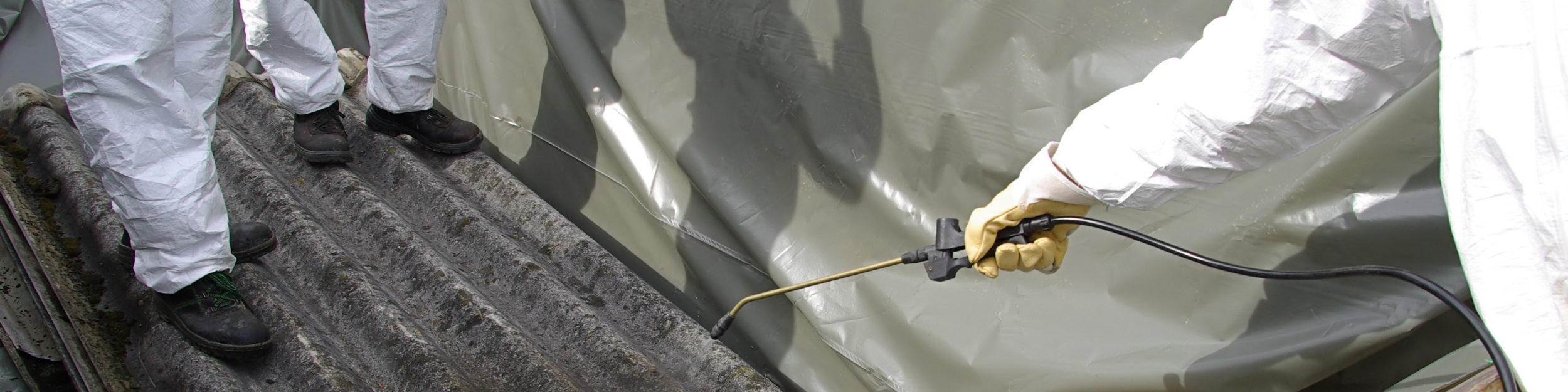
- Wet-method removal: materials are saturated with water and PVA suppressant, removed whole using hand tools (never power tools), and double-wrapped in 200-micron polyethylene.
- Continuous bagging and labelling: every bundle sealed, taped and labelled “CAUTION ASBESTOS.”
- Personnel decontamination before leaving the work area; PPE bagged as asbestos waste.
- H-class hazardous-dust vacuum sweep and visual final inspection.
For an inside view of the protective controls our teams operate under, see How Do Asbestos Removalists Protect Themselves on Site?.
Phase 4 — EPA-tracked transport and disposal
- Asbestos waste is transported by an authorised vehicle to an EPA-licensed landfill.
- The journey is logged on EPA Victoria’s Waste Tracker as an electronic manifest.
- You receive the manifest and landfill tip receipt as part of your documentation pack.
For the full journey of asbestos waste from your property to its final resting place, see What Happens to Asbestos After Removal in Melbourne?.
Phase 5 — Independent clearance certificate
- An independent competent person — not the removal contractor — inspects the area.
- A Regulation 297 clearance certificate is issued before re-occupation (or, on demolition sites, before mechanical demolition starts).
- Any contractor offering to “self-certify” their own clearance is offering you a piece of paper that will not survive scrutiny by a buyer’s solicitor, insurer or WorkSafe auditor.
Phase 6 — Documentation pack
You receive a complete compliance pack containing:
- A copy of the contractor’s WorkSafe Victoria licence and insurance.
- The ARCP and SWMS.
- The WorkSafe Victoria notification.
- The NATA-accredited sample results.
- The EPA Waste Tracker manifest and landfill tip receipt.
- The independent Regulation 297 clearance certificate.
- Before/during/after photographs.
- Updated Asbestos Register (where applicable).
Retain this pack indefinitely. It is the document your insurer, your council, your solicitor and any future buyer will ask for. Twenty years from now, when you sell the property, the buyer’s conveyancer will ask one question: “Has any asbestos work been done? Please provide licences, manifests and clearance certificates.” The compliance pack is the answer.
How Long Asbestos Removal Takes in Melbourne (Realistic Timeline)
The phase that drives the timeline isn’t the on-tools work — it’s the mandatory five-day WorkSafe notification window. Here’s a realistic end-to-end timeline for a typical Melbourne residential job:
| Day | Activity |
|---|---|
| Day 0 | Enquiry, free site inspection booked. |
| Day 1–3 | Site inspection. Samples taken if needed. |
| Day 3–8 | NATA lab results. Asbestos register issued. Fixed-price quote issued. |
| Day 8–10 | Quote accepted. ARCP and SWMS drafted. |
| Day 10 | WorkSafe Victoria notification lodged. |
| Day 11–15 | Five-day notification window. Builder schedules around clearance. |
| Day 16–18 | On-site licensed removal (typically 1–3 days). |
| Day 18 | EPA-tracked transport and disposal. |
| Day 19 | Independent clearance inspection. |
| Day 20–21 | Clearance certificate issued. Documentation pack delivered. |
Total enquiry-to-clearance: typically 2 to 3 weeks for a residential scope. Commercial and pre-demolition projects extend to 3 to 6 weeks depending on scale. Our detailed timeline article How Long Does Asbestos Removal Take in Melbourne? breaks each phase down.
A contractor who promises to start removal “tomorrow” is either not licensed, not notifying, or both. The five-day window is a legal minimum, not a negotiable target.
How Much Does Asbestos Removal Cost in Melbourne?
Pricing depends on the type and quantity of material, site access, and the disposal route. For most non-friable residential scopes in Melbourne, expect a fixed-price quote after a free on-site inspection. Indicative ranges for 2026 Melbourne work are:
- Asbestos fence (boundary panel replacement) — typically a few thousand dollars depending on length and access.
- Garage roof or wall sheeting — depends on roof area and height; pitched roofs with safe edge access run faster than flat metal-deck conversions.
- Eaves / soffit removal during a renovation — usually quoted with the broader builder package.
- Full house Super Six roof replacement — significantly more, with scaffolding, edge protection and replacement roofing included.
- Pre-demolition full site clearance — quoted per scope; see Asbestos and Demolition: The Full Site Clearance Process.
Cheap quotes are usually a sign the contractor is cutting corners — illegal dumping at a regular landfill, skipping the five-day notification, no ARCP, no independent clearance, no insurance. The maths of compliance is fixed: licensed labour, EPA-licensed disposal, NATA sampling, independent clearance and documentation cost what they cost. A quote materially below that floor is not cheaper — it is the cost of compliance deferred to you.
For a full pricing walk-through on the testing side, see How Much Does Asbestos Testing Cost in Melbourne and Victoria?.
Penalties — What Happens When the Rules Are Broken in Melbourne
Enforcement in Victoria is active and rising. The financial and legal exposure of unlicensed or non-compliant asbestos work is rarely capped and rarely insured.
- WorkSafe Victoria prosecutions under the OHS Act 2004 can attract penalties in the hundreds of thousands of dollars for businesses and significant fines for responsible individuals. Prosecutions are listed on the public WorkSafe register.
- EPA Victoria infringements for illegal dumping or unsafe transport routinely exceed $50,000, plus remediation costs — and EPA has direct powers under the Environment Protection Act 2017 to issue remediation notices to landowners, not just contractors.
- Insurance denial is a near-universal feature of policies covering pre-2004 properties when works are unlicensed. The financial exposure of an unlicensed contamination event is usually borne by the property owner.
- Council stop-work notices can halt the entire project — not just the asbestos scope — and trigger re-issue of the building permit.
The party most exposed is almost always the landowner, because the regulatory duty under both the OHS Act and the Environment Protection Act attaches to the person with management or control of the workplace or the property. Engaging a contractor does not transfer that duty — only properly executed and documented work does.
Special Cases by Property Type in Melbourne
The Melbourne regulatory pathway adapts slightly depending on what kind of property you’re dealing with.
Pre-1990 owner-occupied homes
The most common scenario in the inner and middle suburbs. Asbestos is typically found in eaves, fences, garage roofs, kitchen splashbacks, vinyl flooring, switchboards, and textured ceiling coatings. See Asbestos Removal in Older Homes Pre-1990 for Buyers in Melbourne for a buyer’s-eye view.
Rental properties
Landlords carry duties under the Residential Tenancies Act 2021 (Vic) and increasingly under WorkSafe expectations when the property is part of a rental portfolio (treated as a workplace for management). See Asbestos Removal in Rental Properties: Landlord Obligations in Melbourne.
Commercial buildings
Pre-2004 commercial premises require a current Asbestos Register and Asbestos Management Plan under the OHS Regulations 2017. Refurbishments and tenancy strip-outs are heavily prescribed. See Asbestos Removal for Commercial Buildings: Process and Compliance in Melbourne and What is an Asbestos Management Plan and Do You Need One?.
Schools and childcare centres
The most heavily regulated environment of all — simultaneously governed by WorkSafe Victoria, EPA Victoria and the Education and Care Services National Law and National Regulations. Term-break scheduling and parent communication are central. See Asbestos Removal for Schools and Childcare Centres in Melbourne.
Pre-2004 demolitions
A demolition triggers Regulation 273 — asbestos must be identified and removed before mechanical demolition starts. See Asbestos Removal During Demolition in Melbourne and Asbestos and Demolition: The Full Site Clearance Process.
What If You Accidentally Disturb Asbestos During a Renovation?
This happens more often than property owners realise — particularly in inner-suburban renovations where layers of post-war additions sit on top of original 1900s–1950s fabric. The right response is:
- Stop work immediately in the affected area.
- Do not vacuum, sweep, fan or ventilate the room.
- Isolate — close doors, switch off ducted heating/cooling, restrict foot traffic.
- Photograph everything in place.
- Call a licensed asbestos removalist for urgent site attendance.
The cost of a stop-work assessment is a fraction of the cost of continuing through unidentified material. See What to Do If You Disturb Asbestos During Renovation in Melbourne for the full emergency response.
How Asbestos Gone and Clean Handles Class B Asbestos Removal Across Melbourne
We are a WorkSafe Victoria licensed Class B (non-friable) asbestos removalist and demolition contractor based in Melbourne, servicing every metropolitan suburb and most of regional Victoria — from the inner-north (Brunswick, Northcote, Coburg, Preston, Reservoir, Thornbury, Fitzroy, Collingwood, Carlton) through the inner-east (Hawthorn, Kew, Camberwell, Balwyn, Canterbury, Surrey Hills, Box Hill), inner-west (Footscray, Yarraville, Sunshine, Maribyrnong, Williamstown, Newport, Spotswood), bayside (St Kilda, Brighton, Sandringham, Mentone, Mordialloc, Hampton, Black Rock), south-east (Glen Iris, Malvern, Caulfield, Bentleigh, Cheltenham, Carnegie, Murrumbeena, Oakleigh, Clayton, Springvale, Dandenong), north-east (Heidelberg, Ivanhoe, Greensborough, Eltham, Templestowe), and out through the growth corridors of Wyndham, Casey, Cardinia, Whittlesea, Hume, Melton and Mitchell to Geelong, Ballarat, Bendigo, Shepparton, Wodonga, Warrnambool, the Mornington Peninsula, the Yarra Valley, the Latrobe Valley and Gippsland.
Every job we take on follows the same disciplined compliance backbone:
- Free on-site inspection within 24–72 hours of enquiry across Greater Melbourne.
- NATA-accredited sampling under AS 5370:2024 where required.
- Site-specific Asbestos Removal Control Plan (ARCP) and Safe Work Method Statement (SWMS).
- WorkSafe Victoria notification lodged at least five days before works commence.
- Licensed Class B removal using wet methods, H-class vacuums, double-wrapped containment and full PPE protocols.
- EPA Waste Tracker disposal at an EPA-licensed landfill, with full manifests provided.
- Independent Regulation 297 clearance certificate before re-occupation.
- Complete digital and hard-copy documentation pack delivered on completion.
Because we run asbestos removal and demolition under one ABN, builders, developers and owner-builders don’t lose program time waiting for two contractors to align diaries — the most common cause of slippage on pre-2004 demolition sites in Melbourne.
If anything on site presents as friable, we tell you on day one — not on demolition day — and coordinate a Class A specialist for that portion of the work under one project manager.
Frequently Asked Questions
Do I need a licence to remove asbestos in Melbourne?
If you are removing more than 10m² of non-friable asbestos anywhere in Victoria, you are legally required to use a WorkSafe Victoria licensed Class B (or Class A) removalist. Even within the under-10m² exemption, WorkSafe Victoria strongly recommends licensed removal, and most Melbourne councils expect it as a permit condition.
How do I check if an asbestos removalist is licensed in Melbourne?
Search the WorkSafe Victoria public asbestos removal licence holder register by business name or licence number. Confirm the licence is current, the class matches the scope of your job (Class B for non-friable, Class A for friable), and the business name on the licence matches the business name on the quote. Verification is free and takes under five minutes.
What is the difference between Class A and Class B asbestos removal in Melbourne?
A Class B licence authorises removal of all non-friable (bonded) asbestos — the vast majority of residential and light commercial work in Melbourne. A Class A licence authorises removal of friable and non-friable asbestos and requires additional controls including enclosures, negative-air units, decontamination units and air monitoring. Class B holders are legally prohibited from performing Class A work.
How long does asbestos removal take in Melbourne from start to finish?
Typically 2 to 3 weeks end-to-end for a residential scope and 3 to 6 weeks for commercial or pre-demolition projects. The five-day WorkSafe Victoria notification window is non-negotiable. On-site removal itself is usually the shortest phase (often 1 to 3 days).
Do Melbourne councils require evidence of asbestos compliance for a building or demolition permit?
Many do, and the trend is increasing. Councils across Greater Melbourne — including the City of Melbourne, Yarra, Boroondara, Whitehorse, Knox, Casey, Wyndham, Hume, Glen Eira, Stonnington, Kingston, Maribyrnong, Moonee Valley, Darebin, Banyule, Manningham, Monash, Bayside, Port Phillip, Hobsons Bay, Melton and Brimbank — increasingly require an asbestos register, a licensed removalist’s licence number, and (post-removal) a clearance certificate.
Where does asbestos waste go after it’s removed from a Melbourne property?
To an EPA-licensed landfill authorised to accept asbestos, transported under an EPA Waste Tracker electronic manifest. Burning, burying or kerbside-dumping asbestos is illegal under the Environment Protection Act 2017 and attracts significant penalties.
Can I sell a house in Melbourne that contains asbestos?
Yes — there is no legal requirement to remove asbestos before sale. However, vendors must disclose known material facts under the Sale of Land Act 1962 (Vic), Section 32, which is generally read as including known asbestos. See Can You Sell a House with Asbestos in Australia? for the full picture.
What documents should I receive when my Melbourne removal job is finished?
A complete documentation pack: the contractor’s WorkSafe Victoria licence and insurance, ARCP, SWMS, WorkSafe notification, NATA-accredited sample results, EPA Waste Tracker manifest, landfill tip receipt, independent Regulation 297 clearance certificate, and updated asbestos register where applicable. Keep this pack indefinitely.
Is asbestos still legal in Australia in 2026?
No. The manufacture, supply, use and reuse of all forms of asbestos has been banned in Australia since 31 December 2003. The legal obligations now relate to managing, removing and disposing of legacy asbestos already in the built environment.
How do I choose between multiple licensed removalists in Melbourne?
Once you have verified that each contractor is genuinely licensed, insured and compliant, the differentiators come down to: experience with your building era and material type, the quality of the site inspection and communication, whether they hold an integrated demolition licence, references from comparable Melbourne jobs, and the completeness of the documentation pack offered on completion. Price is the last filter, not the first.
The Bottom Line on Asbestos Removal in Melbourne
Melbourne’s asbestos compliance environment is detailed, but it is also predictable, repeatable and entirely manageable when the project is run by a licensed team that knows the framework end-to-end.
The honest takeaways for any Melbourne property owner, builder, developer, landlord or facility manager in 2026 are simple:
- Assume any pre-2004 building in Melbourne contains asbestos until laboratory analysis proves otherwise.
- Removing more than 10m² of non-friable asbestos requires a WorkSafe Victoria licensed Class B (or Class A) removalist — no exceptions.
- The seven-item checklist — licence, insurance, ARCP/SWMS, NATA sampling, WorkSafe notification, EPA-tracked disposal, independent clearance — is the dividing line between a compliant team and a cheap-and-nasty operator.
- Local council permits increasingly bake asbestos compliance into building and demolition approvals across Greater Melbourne.
- The documentation pack is the asset. The removal is the means of producing it.
- The duty sits with the landowner. Engaging a contractor does not transfer the legal exposure — only properly executed and documented licensed work does.
The cheapest quote in Melbourne asbestos removal is almost always the most expensive decision. The correct comparison is “fixed-price compliant vs deferred liability with no documentation.”
Get a Fixed-Price Quote Anywhere in Melbourne or Victoria
If you are planning a renovation, strip-out, roof replacement, garage demolition, fence replacement, full pre-2004 demolition, or any project that may disturb asbestos anywhere in Melbourne or Victoria, Asbestos Gone and Clean can provide:
- A free on-site inspection to confirm the scope, the licence class required, and any borderline material that needs sampling.
- A fixed-price written quote — including survey, sampling, ARCP, SWMS, WorkSafe Victoria notification, licensed Class B removal, EPA-tracked transport, EPA-licensed landfill disposal, independent Regulation 297 clearance certificate and full documentation pack.
- A complete compliance pack delivered on completion for your insurer, your council, your solicitor and any future buyer due diligence.
- Integrated demolition under one ABN where required.
☎ Call us: 0475 143 106
✉ Email: asbestosgoneandclean@gmail.com
???? Contact Us: Asbestos Gone and Clean – Contact
We service all Melbourne metropolitan suburbs — inner-north, inner-east, inner-west, bayside, south-east, north-east, and the outer-growth corridors — and travel throughout regional Victoria for residential, commercial, industrial, rural and demolition projects.
Free site inspection. No-obligation fixed-price quote. Full WorkSafe Victoria and EPA Victoria compliance pack delivered on completion.
Related Reading
- Asbestos Regulations and Legal Requirements in Australia: The 2026 Compliance Guide for Melbourne & Victoria — the full Victorian regulatory framework, licensing, registers, penalties and disposal rules.
- How to Choose a Licensed Asbestos Removalist in Australia (2026 Melbourne & Victoria Guide) — the seven things every licensed removalist must prove and the 12 questions to ask before signing.
- Class A vs Class B Asbestos Licence: What’s the Difference? — the licensing distinction explained in plain English, with Melbourne examples.
- Friable vs Non-Friable Asbestos: Key Differences Explained (2026 Melbourne & Victoria Guide) — the classification that drives the Class A vs Class B split.
- DIY vs Professional Asbestos Removal: Risks, Laws & Costs (2026 Melbourne & Victoria Guide) — the honest breakdown of the 10m² rule and the real cost of doing it yourself.
- How Long Does Asbestos Removal Take in Melbourne? — the end-to-end timeline from enquiry to clearance certificate.
- How Much Does Asbestos Testing Cost in Melbourne and Victoria? — NATA-accredited sampling and survey pricing.
- Asbestos Removal During Demolition: What You Need to Know (2026 Melbourne & Victoria Guide) — the full pre-demolition-survey-to-clearance-certificate sequence.
- Asbestos and Demolition: The Full Site Clearance Process Explained — phase-by-phase from enquiry to slab handover.
- What Happens to Asbestos After Removal in Melbourne? — the full disposal chain from kerb to EPA-licensed landfill.
- How Do Asbestos Removalists Protect Themselves on Site? — inside the layered protection system.
- Asbestos Removal for Commercial Buildings: Process and Compliance in Melbourne — the full commercial compliance pathway.
- Asbestos Removal for Schools and Childcare Centres in Melbourne — the heavily regulated education-and-care setting.
- Asbestos Removal in Rental Properties: Landlord Obligations in Melbourne — the duty framework under the Residential Tenancies Act 2021 (Vic).
- What Is an Asbestos Management Plan and Do You Need One? — register vs management plan, and what each one actually contains.
- What to Do If You Disturb Asbestos During Renovation in Melbourne — emergency response and remediation steps.
- Signs Your Building May Contain Asbestos: Visual Checklist for Melbourne Properties — pre-inspection identification cues.
- Asbestos Removal in Older Homes Pre-1990 for Buyers in Melbourne — the buyer’s-eye view.
- Can You Sell a House with Asbestos in Australia? — vendor disclosure under the Sale of Land Act 1962 (Vic).
Sources and Further Reading
- WorkSafe Victoria — Asbestos: Safety Basics, Licensing and Compliance Codes
- WorkSafe Victoria — Compliance Code: Removing Asbestos in Workplaces
- WorkSafe Victoria — Compliance Code: Managing Asbestos in Workplaces
- WorkSafe Victoria — Public Asbestos Removal Licence Holder Register
- Occupational Health and Safety Act 2004 (Vic)
- Occupational Health and Safety Regulations 2017 (Vic), Part 4.4 (including Regulations 271, 273, 274, 297, 425, 429, 458, 460)
- EPA Victoria — Publication IWRG611.2: Asbestos Transport and Disposal
- EPA Victoria — Waste Tracker System
- Environment Protection Act 2017 (Vic) and Environment Protection Regulations 2021 (Vic)
- Building Act 1993 (Vic) and Building Regulations 2018
- Planning and Environment Act 1987 (Vic)
- Residential Tenancies Act 2021 (Vic)
- Sale of Land Act 1962 (Vic)
- Asbestos and Silica Safety and Eradication Agency (ASSEA) — Asbestos National Strategic Plan 2024–2030
- Standards Australia — AS 5370:2024 Air Quality — Bulk Materials
Disclaimer: This article is general information only and is current as at May 2026. It is not legal, health or financial advice. For advice on a specific project, contact WorkSafe Victoria, EPA Victoria, your local council, or speak directly with Asbestos Gone and Clean.