
Quick answer: If you own a home in Victoria that was built or last renovated before 31 December 2003, you should assume it contains asbestos somewhere on site until a competent inspection proves otherwise. Roughly 1 in 3 Australian homes built before 1990 contains asbestos-containing material (ACM). The good news for Melbourne homeowners is that the vast majority of residential asbestos is non-friable (bonded) — the cement-based fences, eaves, garage walls, roof sheeting, wet-area substrates and vinyl floor tiles that a WorkSafe Victoria licensed Class B asbestos removalist can remove safely under a fixed-price scope. The DIY exemption is narrow: non-friable only, under 10m², under one hour over any seven-day period, owner-occupied residential. Step outside any of those bounds and a Class B licence is legally required. Disposal must go through the EPA Victoria Waste Tracker system to an EPA-licensed landfill, and the area cannot be re-occupied until an independent Regulation 297 clearance certificate has been issued.
This guide is written for Victorian homeowners — first-home buyers, owner-occupiers, renovators, knock-down-rebuild owners, downsizers and inheritors — who want to understand asbestos removal in plain English without the marketing fog. It draws on the same WorkSafe Victoria framework, EPA Victoria disposal rules and on-tools experience that we apply on Class B jobs across Greater Melbourne and regional Victoria every week.
Why This Article Exists
Most homeowner questions about asbestos come from one of four moments:
- You’re about to buy a pre-1990 home and the building report mentions “materials consistent with asbestos cement.”
- You’re about to renovate and your builder has just told you the bathroom strip-out can’t start until the wet-area sheeting is tested.
- You’ve already disturbed something — drilled into a wall, snapped a fence sheet, lifted a vinyl tile — and you’re trying to work out whether you have a problem.
- You’ve inherited the house and the original owner left no records of what’s where.
Whichever of those describes you, the underlying question is the same: what am I legally required to do, what does it actually cost, and how do I make sure this is done properly?
This article is the homeowner-level overview that answers those questions in one place, and points you to the deeper guides in this series when you need the detail.
The Legacy Window: Why Pre-2004 Matters
Australia banned the manufacture, supply, use and reuse of all forms of asbestos on 31 December 2003. Every Victorian home, garage, shed, fence, factory or shopfront constructed or substantially renovated before that date sits inside the asbestos legacy window.
In Melbourne, the legacy window covers almost the entire pre-1990 streetscape — the post-war brick veneers of Reservoir, Coburg, Preston and Pascoe Vale; the mid-century triple-fronts of Box Hill, Glen Iris and Caulfield; the weatherboard cottages of Northcote, Brunswick and Yarraville; the 1960s–1980s growth-corridor stock of Werribee, Hoppers Crossing, Dandenong, Frankston, Cranbourne and Berwick; and almost every pre-1990 property in regional Victoria from Geelong and the Mornington Peninsula through to Ballarat, Bendigo and the Yarra Valley.
The Australian Government’s working estimate is 1 in 3 Australian homes built before 1990 contains asbestos. In Melbourne’s older suburbs the proportion runs higher because pre-1990 housing stock dominates the streetscape and the typical pre-1990 home contains asbestos in multiple locations — not one.
Working rule of thumb: Pre-2004 + Melbourne or Victoria = treat as containing asbestos until a NATA-accredited test proves otherwise.
Where Asbestos Actually Lives in a Melbourne Home
The single most useful skill for a Victorian homeowner is knowing where to look. The same materials show up in the same places across most pre-1990 builds.
The most common non-friable (Class B) locations
| Location | What you’re looking at |
|---|---|
| Boundary and side fences | Asbestos cement sheeting between timber posts, sometimes with capping. A standard suburban fence is 30–60m² once both sides are counted — well over the DIY exemption. |
| Eaves and soffits | Flat fibro panels under the roof overhang on most pre-1985 homes. |
| Garage walls and roof | Fibro walls and Super Six corrugated roofing on freestanding pre-1990 garages. |
| Roof sheeting | Corrugated asbestos cement (Super Six profile) on the main dwelling, garage, shed or veranda. |
| Wet-area sheeting | Behind the tiles in bathrooms, laundries and kitchens, typically 4.5–6mm fibro sheet from the 1950s into the late 1980s. |
| Vinyl floor tiles | 9-inch square tiles bedded into black bitumen adhesive in kitchens, laundries, hallways and sunrooms. |
| Switchboard backing panels | Dark Zelemite, Ausbestos, Lebah or Miscolite panels behind the breakers in pre-1985 boards. |
| Flues | Asbestos cement flue pipes on slow-combustion heaters, kitchen wood stoves and pre-1985 gas hot water units. |
| Sheds and outbuildings | Backyard sheds, dunnies, pump houses, lean-tos and workshops — almost universally fibro on pre-1985 properties. |
| Underground pipes | Asbestos cement stormwater and water pipes on older blocks. |
Less common but higher-risk (friable / Class A) locations
| Location | What you’re looking at |
|---|---|
| Textured (“popcorn”) ceilings | Soft, crumbly textured coatings on lounge and bedroom ceilings of some pre-1985 homes. Almost always friable. |
| Pipe lagging | Fibrous insulation on hot water and steam pipes in older homes, terraces and converted warehouses. |
| Loose-fill insulation | Rare in Victoria but possible in inherited rural properties. |
| Heater millboard and rope | Inside old wood heaters, behind fireplaces and around boiler doors. |
| Damaged ACM | Any of the non-friable materials above that has been broken, weathered, fire-damaged or water-damaged into a powdery state. |
The friable / non-friable classification is the single most important distinction in the entire system because it determines which licence class can legally remove the material. We cover this in detail in our friable vs non-friable guide.
For a full visual walkthrough of every spot to check, see our signs your building may contain asbestos visual checklist.
The 10m² Rule: When Homeowners Can DIY (and When They Can’t)
Victoria’s asbestos rules sit under the Occupational Health and Safety Act 2004 and the Occupational Health and Safety Regulations 2017 (Vic), with WorkSafe Victoria as the lead regulator and EPA Victoria as the disposal regulator.
For an owner-occupied residential property — not a workplace, not a rental, not a strata block — the legal DIY position is:
DIY is legally permitted only when ALL of the following are true:
| Condition | Threshold |
|---|---|
| Asbestos type | Non-friable (bonded) only |
| Total area | Less than 10m² |
| Time on tools | Less than 1 hour in any seven-day period |
| Property type | Owner-occupied residential (not a workplace) |
| Disposal | Must still go to an EPA-licensed landfill |
Breach any one of those thresholds and you have moved out of the DIY exemption and into territory that legally requires a WorkSafe Victoria Class B asbestos removal licence.
DIY is never permitted for:
- Friable asbestos — popcorn ceilings, pipe lagging, millboard, asbestos rope, fire/water-damaged cement sheeting. This is Class A licensed work only.
- Rental properties — even if you own them. A rental is a workplace for the agent, the tradesperson and any inspector that enters it, so the OHS Regulations apply in full.
- Workplaces — commercial premises, factories, warehouses, retail tenancies, schools, churches, halls.
- Common property in strata or owners-corporation buildings.
- Anything over 10m² — and 10m² is smaller than most Melburnians realise.
Reality check: A typical garden fence is 30–60m². A garage wall is over 10m². A bathroom of fibro sheeting is 8–15m². A roof is multiples of 10m². Once you genuinely measure the asbestos on a typical pre-2004 Melbourne property, almost every “DIY” job is actually a licensed Class B job in disguise.
Even within the under-10m² exemption, WorkSafe Victoria strongly recommends engaging a licensed removalist. Our deep-dive on the DIY vs professional decision breaks down what each option actually costs once PPE, polythene, double-wrapping, vehicle transport, tip fees and risk are honestly priced in.
What a Compliant Class B Removal Actually Looks Like
When you engage a WorkSafe Victoria licensed Class B asbestos removalist in Melbourne or Victoria, the process is far more structured than most homeowners expect. The on-tools removal is usually the shortest part of the project. The compliance backbone — survey, notification, controls, disposal, clearance, documentation — is what makes the difference between a job that’s “done” and a job that’s actually defensible at insurance, sale and audit.
Here’s how the end-to-end residential job runs.
Step 1 — Site inspection and identification (Days 1–7)
A licensed Class B contractor or licensed assessor inspects the property, identifies all suspect ACM, and takes NATA-accredited bulk samples under AS 5370:2024 where the material identity cannot be confirmed visually. The output is a written asbestos register and removal scope that classifies every material as friable or non-friable.
- On-site time: 1–3 hours for a standard residential property.
- Lab turnaround: 2–5 working days.
- Cost: $400–$900 for a standard pre-1990 home with 3–8 samples.
For the full pricing breakdown, see our asbestos testing cost guide.
Step 2 — Fixed-price quote, ARCP and SWMS (Days 7–10)
On acceptance of the quote, the contractor prepares:
- A site-specific Asbestos Removal Control Plan (ARCP)
- A site-specific Safe Work Method Statement (SWMS)
- A fixed-price written quote covering survey, sampling, ARCP, SWMS, WorkSafe Victoria notification, removal, transport, EPA-tracked disposal, independent clearance certificate and documentation pack — with no hidden tip fees.
Step 3 — WorkSafe Victoria notification (Days 10–15)
Under Regulation 460 of the OHS Regulations 2017, the licensed removalist lodges a written notification with WorkSafe Victoria at least five clear days before the work commences. The five-day clock is non-negotiable for licensed Class B work. A contractor offering “same-week” works on a licensed scope is either skipping notification or misrepresenting the timeline.
Step 4 — Pre-works site setup
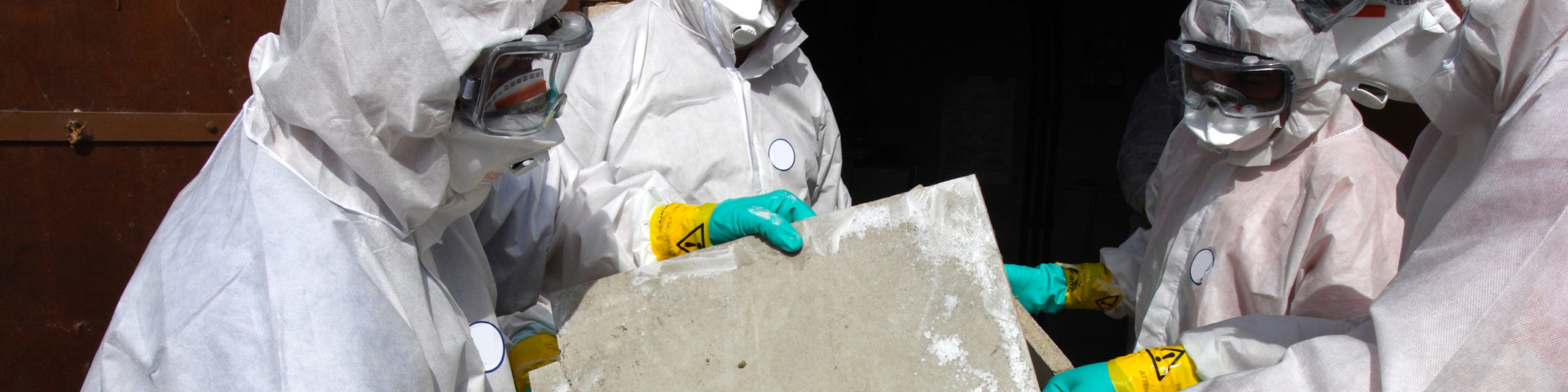
On removal day, the crew arrives in fully sign-written vehicles, conducts a pre-start safety brief, isolates the work zone with barriers and signage, lays polythene drop sheets, sets up the H-class HEPA vacuum, and dons full PPE — disposable Type 5 coveralls, P2 or P3 respirators (or PAPRs for friable scopes), gloves, boot covers and eye protection.
Our deep-dive on how asbestos removalists protect themselves covers the engineering, work-method and PPE controls in detail.
Step 5 — Removal under wet methods (Days 15–17)
Bonded asbestos is removed under wet methods — the material is misted with water and a wetting agent to suppress fibres at the point of disturbance. Fixings are unscrewed rather than cut where possible. Sheets are removed whole rather than broken. Power tools, dry sweeping, high-pressure water blasting and any other dust-generating method are prohibited.
A typical pre-1990 Melbourne residential scope — eaves, garage roof, fences, bathroom sheeting — runs one to three working days on site.
Step 6 — Double-wrapping and labelling
Every piece of removed asbestos is double-wrapped at source in 200-micron (minimum 0.2mm) polythene sheeting, sealed with duct tape, and labelled “CAUTION ASBESTOS” with the contractor’s details and the date. Smaller fragments go into heavy-duty double-bagged asbestos waste bags. The wrapped waste is staged inside the contained work zone until ready for transport.
Step 7 — Site decontamination
All polythene, used PPE, wipes, vacuum filters and contaminated tools are bagged as asbestos waste. The work zone is HEPA-vacuumed and wet-wiped. The crew passes through staged decontamination — coveralls bagged, respirators wiped, boots cleaned — before leaving site.
Step 8 — EPA-tracked disposal (Day 17)
The wrapped waste is classified as Reportable Priority Waste (RPW) under the Environment Protection Regulations 2021 (Vic), manifested in EPA Victoria’s Waste Tracker system before transport, moved in a covered secure vehicle by an EPA-permissioned operator, and buried in engineered, GPS-mapped cells at an EPA-licensed landfill authorised to receive asbestos. You receive the manifest and tip receipt as part of the documentation pack.
For the full disposal journey, see our guides on what happens to asbestos after removal and how asbestos is safely disposed of in Australia.
Step 9 — Independent Regulation 297 clearance certificate (Days 17–21)
Under Regulation 297 of the OHS Regulations 2017, the person who commissioned the removal must obtain a clearance certificate from an independent competent person before re-occupying the area. The clearance assessor cannot be the removal contractor — this separation is the safeguard against conflict of interest.
For non-friable residential scopes, this is typically a thorough visual clearance of the entire work zone. The clearance certificate is the regulatory permission to re-occupy.
Step 10 — Documentation pack handover (Days 19–21)
You receive a complete pack:
- Class B licence copy of the removal contractor
- Certificate of Currency for public liability and workers’ compensation
- Asbestos Register and Removal Scope
- Site-specific ARCP and SWMS
- WorkSafe Victoria notification confirmation
- NATA-accredited laboratory sample results
- EPA Waste Tracker manifests
- EPA-licensed landfill disposal receipts
- Independent Regulation 297 clearance certificate
- Before/during/after photographs
Retain this pack indefinitely. It is the document trail your insurer, your future buyer’s solicitor, the council and any future regulator will rely on.
Total residential project timeline: approximately 2 to 3 weeks from first call to final documentation. For larger scopes, friable material, or integrated demolition work, allow 3 to 6 weeks. See our realistic asbestos removal timeline guide for the day-by-day breakdown.
What It Costs in 2026: Melbourne and Victorian Homeowner Pricing
Pricing depends on the type and quantity of material, site access, and the disposal route. The figures below are indicative ranges for 2026 across Greater Melbourne and regional Victoria. A site-specific fixed-price quote will always be more accurate than any general table.
| Scope | Indicative range (2026) |
|---|---|
| Asbestos testing — single bulk sample (lab only) | $40 – $80 |
| Asbestos testing — standard pre-1990 home inspection (3–8 samples) | $400 – $900 |
| Asbestos cement fence (20–40m of fence line) | $2,500 – $6,000 |
| Asbestos eaves (standard 3-bedroom home) | $3,000 – $7,500 |
| Asbestos garage roof | $3,500 – $8,000 |
| Asbestos cement main roof (single residential) | $8,000 – $20,000 |
| Bathroom and laundry wet-area sheeting | $2,500 – $6,500 |
| Vinyl floor tiles (per room) | $1,800 – $4,500 |
| Switchboard backing panel removal (coordinated with electrician) | $600 – $1,500 |
| Textured ceiling — Class A scope (per room) | $4,500 – $12,000 |
| Combined pre-1990 home full strip (non-friable) | $12,000 – $35,000 |
| Pre-demolition full house strip | $15,000 – $50,000+ |
What a compliant fixed-price quote should always include: survey, sampling, ARCP, SWMS, WorkSafe Victoria notification, licensed removal, transport, EPA-tracked landfill disposal (with manifest), independent Regulation 297 clearance certificate, and the documentation pack.
What a cheap quote often quietly omits: NATA-accredited sampling, the five-day notification, EPA-licensed landfill disposal (replaced with general transfer station dumping — illegal), and the independent clearance certificate (sometimes “signed off” by the removal contractor themselves — also not legal).
If a quote is materially cheaper than the ranges above, the difference is almost never about skill. It is about which compliance items have been left out. The cheapest quote is usually the most expensive one once a stop-work notice, contamination clean-up or denied insurance claim turns up.
For the deeper breakdown of how cheap quotes get to their headline number, see our how to choose a licensed asbestos removalist guide.
Your Legal Duties as a Victorian Homeowner
In an owner-occupied residential setting where the asbestos is undisturbed and in good condition, you have no positive legal obligation to remove it. The framework is built around safe management and safe removal at the point of disturbance, not blanket eradication.
However, the moment any of the following occurs, your legal position changes:
1. You decide to renovate
Any renovation that disturbs walls, ceilings, eaves, flooring, roofing, fencing or wet areas in a pre-2004 building should be preceded by an asbestos inspection. See our pre-renovation inspection guide for when this is legally expected.
2. You let tradespeople onto the site
The moment any tradesperson — plumber, electrician, plasterer, painter, solar installer, NBN technician — works on the property, the residence becomes a workplace for the duration of their attendance. The OHS Regulations 2017 (Vic) workplace duties apply, which means:
- A current Asbestos Register should be available to the tradesperson before they start.
- Any disturbance of identified or assumed ACM must comply with the removal regulations.
- The tradesperson has the right to refuse to work in an environment where the asbestos status is unknown.
3. You rent the property out
The instant a residential rental tenancy commences, the property is unambiguously a workplace for the managing agent, every contractor, and every inspector that enters. A formal Asbestos Register and Asbestos Management Plan are required under Regulations 425 and 429. See our landlord obligations guide for the rental-specific compliance backbone.
4. You sell the property
Vendor disclosure under Section 32 of the Sale of Land Act does not currently require a positive asbestos declaration. But purchaser building and pest inspectors routinely look for asbestos on pre-2004 homes, and any evidence of past unlicensed work shows up — broken fragments in roof cavities, fresh patching in known ACM locations without a clearance certificate, mismatched eave panels, partial fence removals without disposal documentation.
When those flags surface, the typical outcomes are a re-price downwards by a five-figure sum, a fallen-over sale, or a vendor-funded remediation condition before settlement. Our deep-dive on selling a house with asbestos in Australia walks through the dynamics.
5. You demolish or knock down
Under Regulation 273, before any building or structure is demolished, the person with management or control must — so far as reasonably practicable — ensure that all identified or assumed ACM is removed first. This applies to both commercial and residential demolitions in Victoria. See our asbestos removal during demolition guide for the full pre-demolition pathway.
6. You disturb something accidentally
If you have already drilled, cut, sanded, snapped, lifted or otherwise disturbed something you now suspect contains asbestos — stop, isolate the area, and read our what to do if you disturb asbestos during renovation guide before doing anything else. The first hour after a disturbance is when the right actions matter most.
The Documentation Pack: The Single Most Valuable Outcome
The compliance documentation pack is the part of the project that homeowners undervalue most consistently — and that proves most valuable in the years after the job is done.
The pack should include, at a minimum:
- Licence copy of the removal contractor (Class B and/or Class A as applicable), with current expiry date.
- Certificate of Currency for public liability and asbestos-endorsed insurance.
- Asbestos Register and Removal Scope from the pre-works survey.
- NATA-accredited laboratory sample results under AS 5370:2024.
- Asbestos Removal Control Plan (ARCP) and Safe Work Method Statement (SWMS) for the site.
- WorkSafe Victoria notification confirmation showing the five-day notice was lodged.
- EPA Waste Tracker manifests for every load disposed of.
- EPA-licensed landfill disposal receipts showing where the material actually went.
- Independent Regulation 297 clearance certificate signed by an assessor independent of the removal contractor.
- Photographs of the site before, during and after.
This pack is what:
- Your home insurer wants to see if a future incident is traced back to the removal scope. Standard Australian home and contents policies overwhelmingly exclude losses arising from unlicensed asbestos work.
- Your future buyer’s solicitor will request when the pre-2004 property comes up in due diligence.
- Your council may ask for at building permit, demolition permit or occupancy certificate stage.
- WorkSafe Victoria or EPA Victoria will require if the site is ever audited.
The compliance pack is worth tens of thousands of dollars at resale. Keep it. Pass it to the next buyer with the property.
A Smart Sequence for Homeowners Across the Property Lifecycle
The right order of operations changes by life stage. Here’s how the same homeowner-level decisions fit together across a typical Melbourne property journey.
If you’re buying a pre-1990 home
- Before going unconditional, commission an asbestos inspection on top of the standard building and pest report.
- Get a written removal scope and indicative budget from a licensed Class B contractor.
- Adjust your offer or finance buffer to reflect the scope — typical pre-1990 inner-Melbourne homes carry $12,000–$35,000 of latent ACM removal scope.
- Store the inspection report with your property documents at settlement.
Our pre-1990 buyers’ guide covers this pathway in full.
If you’re about to renovate
- Pre-renovation inspection — asbestos register and removal scope before any trades enter.
- Removal first, renovation second — all ACM that will be disturbed by the planned works is removed under a Class B (or Class A where required) scope, clearance certificate issued, before any other trades start.
- Renovation proper — builder, plumber, electrician, tiler work in a documented asbestos-free zone.
- Documentation update — clearance certificate added to the property file; any remaining ACM flagged for future works.
This sequence avoids the single most common cause of Melbourne renovation blowouts: a trade cutting into an unidentified ACM mid-project, triggering a stop-work order, a contamination assessment, an unplanned licensed removal, and a resequencing of every other trade.
If you’re staying put and managing in place
- Get a written Asbestos Register that identifies and locates every ACM on site.
- Inspect annually — visual check for cracks, chalkiness, weather damage, biological growth, fixings working loose, and any new damage from storms, hail or accidental impacts.
- Address damage immediately under a licensed scope. Don’t paint over, don’t patch, don’t let it weather further.
- Plan removal when the time is right — before the next renovation, before sale, or when a high-risk material (switchboard panel, deteriorating fence, weathering roof) starts to show condition decline.
See our is asbestos dangerous if undisturbed guide for the honest leave-or-remove framework.
If you’re preparing to sell
- Commission a pre-sale inspection so you understand what your buyer’s inspector will find.
- Get a written removal scope and indicative budget so you can decide whether to remove pre-sale, price the property accordingly, or disclose and negotiate.
- If removing pre-sale, make sure you receive and keep the full documentation pack — it goes to the buyer as part of the value of the sale.
If you’re demolishing or rebuilding
- Pre-demolition asbestos survey — sometimes called a Type 3 destructive survey, this is the regulatory baseline before any demolition permit is exercised.
- Licensed Class B (and Class A where required) removal of all identified ACM before demolition starts.
- Independent Regulation 297 clearance certificate before the structure comes down.
- EPA-tracked disposal of all asbestos waste, separate from the general demolition spoil.
- Documentation pack handed to the builder, developer or owner-builder for inclusion in the project file.
Our full site clearance guide walks through this in detail.
Choosing a Licensed Class B Removalist in Victoria
Not all asbestos contractors are equal. The minimum due-diligence checks for any Victorian homeowner are short, fast and free.
The non-negotiable checks
- WorkSafe Victoria Class B asbestos removal licence — ask for the licence number and verify it on the WorkSafe Victoria Public Asbestos Removal Licence Holder Register. Confirm the licence is current, the class matches the work (Class B for non-friable, Class A for friable), and the business name on the licence matches the business name on the quote.
- Certificate of Currency for public liability and workers’ compensation, with the asbestos endorsement explicitly confirmed.
- Fixed-price written quote itemising survey, sampling, ARCP, SWMS, WorkSafe notification, removal, transport, EPA-tracked landfill disposal, and the independent Regulation 297 clearance certificate.
- Named EPA-licensed landfill for disposal — vague “we take it to the tip” answers are a red flag.
- Independent Regulation 297 clearance — separate from the removal contractor. A contractor offering to “sign their own clearance” is offering something that is not legal in Victoria.
Red flags
- Same-week removal with no apparent room for the five-day WorkSafe notification.
- No mention of NATA-accredited sampling.
- Vague or unnamed disposal route.
- Quote without ARCP and SWMS line items.
- Contractor proposing power tools or dry sweeping on ACM.
- Insurance certificate that does not explicitly include asbestos endorsement.
- Headline price more than 30% below the indicative ranges in this article — usually a sign of omitted compliance items, not superior efficiency.
Our how to choose a licensed asbestos removalist guide covers the seven things every licensed removalist must prove and the 12 questions to ask before signing.
Frequently Asked Questions
Do I need to remove asbestos from my Melbourne home if it’s in good condition?
No, not as a homeowner of an owner-occupied residential property where the asbestos is undisturbed and in good condition. The Victorian framework is built around safe management plus safe removal at the point of disturbance — not blanket eradication. The right approach for stable, intact, undamaged ACM in a home you intend to keep is usually a written Asbestos Register, an annual visual inspection, and planned licensed removal before any disturbance event (renovation, demolition, sale, or condition decline).
Is it legal to remove asbestos myself in Victoria?
Only if all of these are true: the asbestos is non-friable, the total area is under 10m², the work takes under one hour in any seven-day period, the property is owner-occupied residential (not a workplace, not a rental, not common property), and the waste is taken to an EPA-licensed landfill. Step outside any of those bounds and a WorkSafe Victoria Class B licence is legally required.
Do I need a licence to remove an asbestos fence or shed in Melbourne?
If the total area of asbestos cement sheeting exceeds 10m², yes — a Class B asbestos removal licence is required. Most suburban Melbourne fences exceed this threshold by some margin once both sides are counted (typically 30–60m² for a standard suburban fence line). Most fibro garages and outbuildings are 40m² and up. The DIY exemption is narrower than it looks on paper.
How much does asbestos removal cost in Melbourne for a typical homeowner?
A single asbestos cement fence runs $2,500–$6,000. Eaves on a standard 3-bedroom home run $3,000–$7,500. A garage roof runs $3,500–$8,000. Bathroom and laundry wet-area sheeting runs $2,500–$6,500. A combined non-friable strip of a pre-1990 home runs $12,000–$35,000. Friable scopes (textured ceilings, pipe lagging) sit higher because they require Class A controls.
How long does asbestos removal take in Melbourne?
A typical pre-1990 Melbourne residential job runs 2 to 3 weeks end-to-end from first call to final documentation. The on-tools removal itself is usually 1 to 3 working days. The five-day WorkSafe Victoria notification window is non-negotiable for any licensed scope.
What’s the difference between Class A and Class B asbestos removal?
A Class B licence authorises removal of non-friable (bonded) asbestos — the cement-based materials that make up the vast majority of residential asbestos in Melbourne. A Class A licence authorises removal of friable asbestos (anything that crumbles to powder under hand pressure when dry) plus non-friable. Class B holders are legally prohibited from undertaking Class A work under any circumstances.
What is a Regulation 297 clearance certificate and do I need one?
Under Regulation 297 of the OHS Regulations 2017, the person who commissioned Class A or Class B asbestos removal must obtain a clearance certificate from an independent competent person before re-occupying the area. The clearance assessor cannot be the removal contractor — the separation prevents conflict of interest. The clearance certificate is the regulatory permission for re-occupation and the single most valuable document in your post-removal documentation pack.
Where does asbestos waste actually go after it’s removed from my home?
It goes to an EPA Victoria-licensed landfill authorised to receive asbestos. The waste is classified as Reportable Priority Waste, logged in EPA Victoria’s Waste Tracker system, transported in a covered vehicle by an EPA-permissioned operator, and buried in engineered, GPS-mapped cells that are immediately covered with clean fill. Disposal at general transfer stations, household tips, recycling centres or on private land is illegal and carries fines exceeding $50,000 plus remediation.
What happens if I accidentally disturb asbestos in my home?
Stop work immediately, leave the area, close doors and windows to isolate the room, do not vacuum or sweep, do not let pets or children near the area, and call a licensed Class B removalist before doing anything else. The first hour after a disturbance is when the right actions matter most — including bagging contaminated clothing, wet-wiping accessible surfaces and arranging a licensed clean-up and clearance.
Will my home insurance cover an asbestos incident?
Standard Australian home and contents and home building insurance policies overwhelmingly exclude losses arising from unlicensed asbestos work. The compliance documentation pack from a licensed removal — licence, ARCP, SWMS, WorkSafe notification, EPA manifest, landfill receipt, Regulation 297 clearance — is what protects you on insurance for the life of the property.
Can I sell a Melbourne home that contains asbestos?
Yes. Asbestos does not prevent sale, and Victorian Section 32 disclosure does not currently require a positive asbestos declaration. However, buyers’ building and pest inspectors routinely look for asbestos on pre-2004 homes, and the presence of unlicensed past work — broken fragments, mismatched eave panels, fresh patching without a clearance — commonly causes re-pricing, falls-over and vendor-funded remediation conditions. A clean compliance documentation pack from licensed past works is the single most valuable thing you can attach to a pre-2004 sale.
Do I need an asbestos register for my own home?
Not legally for an owner-occupied residence with no workplace overlay. But a written register is genuinely useful — it tells future tradespeople, builders, real-estate agents and buyers exactly what’s where, and it makes every subsequent disturbance event cheaper, safer and faster. The moment the property becomes rental, commercial or under any kind of workplace overlay, an Asbestos Register and Asbestos Management Plan are mandatory under Regulations 425 and 429.
Can a Class B removalist also handle the demolition?
Yes — and ideally, yes. If your asbestos removal and demolition run under one contractor and one ABN, you avoid the single biggest cause of program slippage on pre-2004 demolition sites in Melbourne: the gap between “asbestos removalist finishes” and “demolition contractor starts.” Integrated soft strip and demolition services under one project manager consistently deliver a cleaner program, a cleaner site and a cleaner documentation pack.
Get a Compliant Class B Asbestos Removal Quote for Your Victorian Home
If you are buying, renovating, selling, demolishing or simply managing a pre-2004 home anywhere in Melbourne or Victoria — and you want it done under a current WorkSafe Victoria Class B licence, with proper notification, EPA-tracked disposal and a clean independent clearance certificate at the end — that is exactly what we do every day.
Asbestos Gone and Clean is a Melbourne-based licensed Class B (non-friable) asbestos removalist and demolition contractor servicing all of Greater Melbourne and regional Victoria — from the inner-north, inner-east, inner-west, bayside and south-east suburbs through the outer growth corridors and out to Geelong, Ballarat, Bendigo, the Mornington Peninsula, the Yarra Valley, Shepparton, Warrnambool and the Latrobe Valley.
Every job we take on includes:
- A free, no-obligation site inspection and fixed-price written quote.
- A copy of our current WorkSafe Victoria Class B asbestos removal licence.
- A Certificate of Currency for public liability and asbestos-specific insurance.
- A site-specific Asbestos Removal Control Plan (ARCP) and Safe Work Method Statement (SWMS).
- NATA-accredited sampling under AS 5370:2024 where required.
- Five-day WorkSafe Victoria notification lodged on your behalf.
- EPA Waste Tracker disposal at an EPA-licensed landfill, with manifest and tip receipt provided.
- Independent Regulation 297 clearance certificate before re-occupation.
- A complete digital and hard-copy documentation pack delivered on project close-out.
If your job is non-friable, we complete it end-to-end. If any portion of the material is friable, we tell you on day one — not on demolition day — and coordinate a Class A specialist for that scope under one project manager. And because we run asbestos removal and demolition under one ABN, you don’t lose program time waiting for two contractors to align diaries.
☎ Call us: 0475 143 106
✉ Email: asbestosgoneandclean@gmail.com
???? Contact Us: Asbestos Gone and Clean – Contact
Related Reading
- Asbestos Regulations and Legal Requirements in Australia: The 2026 Compliance Guide for Melbourne & Victoria — the deep-dive on the Victorian regulatory framework, licensing, registers and penalties.
- DIY vs Professional Asbestos Removal: Risks, Laws & Costs (2026 Melbourne & Victoria Guide) — the honest, no-spin breakdown of the 10m² rule and the real cost of doing it yourself.
- Friable vs Non-Friable Asbestos: Key Differences Explained (2026 Melbourne & Victoria Guide) — the underlying classification that drives the Class A vs Class B split.
- Class A vs Class B Asbestos Licence: What’s the Difference? (2026 Melbourne & Victoria Guide) — which licence is needed for which job.
- How to Choose a Licensed Asbestos Removalist in Australia (2026 Melbourne & Victoria Guide) — the seven things every licensed removalist must prove and the 12 questions to ask before signing.
- Signs Your Building May Contain Asbestos: A Visual Checklist (2026 Melbourne & Victoria Guide) — the room-by-room visual walk-through for pre-2004 properties.
- Asbestos Removal in Older Homes: What Pre-1990 Buyers Need to Know — the buyers’ deep-dive on the pre-1990 housing stock across Melbourne and Victoria.
- Do I Need an Asbestos Inspection Before Renovating? (2026 Melbourne & Victoria Guide) — when an inspection is legally expected and what it actually involves.
- How Much Does Asbestos Testing Cost in Melbourne and Victoria? (2026 Pricing Guide) — the transparent breakdown of NATA-accredited testing fees.
- How Long Does Asbestos Removal Take? A Realistic Timeline (2026 Melbourne & Victoria Guide) — the day-by-day end-to-end timeline.
- What Happens to Asbestos After It’s Removed From a Property? (2026 Melbourne & Victoria Guide) — the post-removal disposal journey.
- How Asbestos Is Safely Disposed of in Australia: The 2026 Melbourne & Victoria Safety Guide — the six safety controls that make safe disposal mean what it says.
- What to Do If You Disturb Asbestos During a Renovation (2026 Melbourne & Victoria Guide) — the first-hour playbook after an accidental disturbance.
- Is Asbestos Dangerous If Undisturbed and in Good Condition? (2026 Melbourne & Victoria Guide) — the leave-or-remove framework for stable ACM.
- Can You Sell a House with Asbestos in Australia? (2026 Melbourne & Victoria Guide) — the resale dynamics for pre-2004 property.
- Asbestos and Demolition: The Full Site Clearance Process Explained (2026 Melbourne & Victoria Guide) — the pre-demolition-survey-to-slab-handover sequence.
Sources and Further Reading
- WorkSafe Victoria — Asbestos: Safety Basics, Licensing and Compliance Codes
- WorkSafe Victoria — Compliance Code: Removing Asbestos in Workplaces
- WorkSafe Victoria — Compliance Code: Managing Asbestos in Workplaces
- Occupational Health and Safety Act 2004 (Vic)
- Occupational Health and Safety Regulations 2017 (Vic), Part 4.4 (including Regulations 273, 297, 425, 429, 460)
- EPA Victoria — Publication IWRG611.2: Asbestos Transport and Disposal
- Environment Protection Act 2017 (Vic) and Environment Protection Regulations 2021 (Vic)
- Asbestos and Silica Safety and Eradication Agency (ASSEA) — Asbestos National Strategic Plan 2024–2030
- Standards Australia — AS 5370:2024 Air Quality — Bulk Materials
- Safe Work Australia — Code of Practice: How to Safely Remove Asbestos
- Sale of Land Act 1962 (Vic), Section 32
Disclaimer: This article is general information only and is current as at May 2026. It is not legal, health or financial advice. For advice on a specific project, contact WorkSafe Victoria, EPA Victoria, your local council, or speak directly with Asbestos Gone and Clean.