
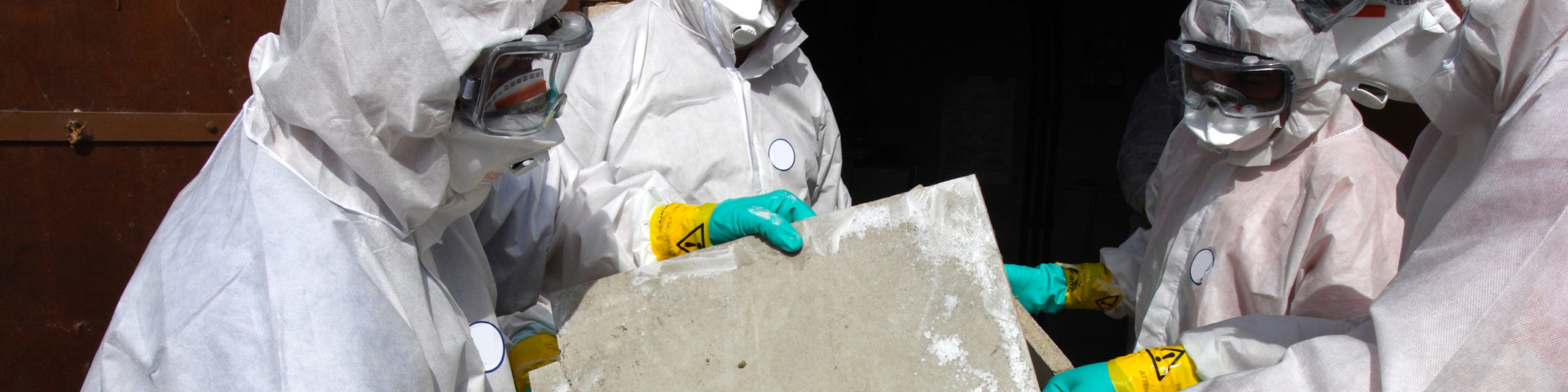
Quick answer: If you own, manage, lease or are about to refurbish, strip out or demolish a commercial building in Melbourne or Victoria that was constructed before 31 December 2003, asbestos removal sits at the centre of your compliance obligations. Under Part 4.4 of the Occupational Health and Safety Regulations 2017 (Vic), a workplace with identified or assumed asbestos must hold a current Asbestos Register and a documented Asbestos Management Plan. Removal of any non-friable asbestos beyond a strict residential DIY exemption — which does not apply to commercial workplaces at all — must be carried out by a WorkSafe Victoria licensed Class B asbestos removalist (or Class A for friable material), notified to WorkSafe at least five days in advance, conducted under a site-specific Asbestos Removal Control Plan (ARCP) and Safe Work Method Statement (SWMS), signed off by an independent clearance certificate under Regulation 297, and disposed of at an EPA-licensed landfill under EPA Victoria’s Waste Tracker system. Skip any of these steps and you’ve put your tenants, your contractors, your insurance, your sale and your directors personally on the wrong side of Victorian law. This guide walks through the entire compliance pathway from first site walk-through to final documentation pack — written by a Melbourne-based Class B (non-friable) licensed asbestos removalist servicing all of Greater Melbourne and Victoria.
TL;DR — The Commercial Asbestos Removal Compliance Pathway
| Step | What Happens | Who Is Responsible | Regulatory Anchor |
|---|---|---|---|
| 1. Identification | Asbestos Register prepared / reviewed; pre-works survey if scope is invasive | Licensed asbestos assessor (NATA sampling under AS 5370:2024) | OHS Regs 2017 (Vic) Part 4.4, Div 5 |
| 2. Management Plan | Documented Asbestos Management Plan in place and accessible | Building owner / PCBU with management or control | OHS Regs 2017 (Vic) Reg 429 |
| 3. Scope & Quote | Fixed-price written quote, ARCP and SWMS drafted | Licensed Class B (or Class A) removalist | OHS Regs 2017 (Vic) Reg 458 |
| 4. WorkSafe notification | Five-day written notification lodged | Removalist | OHS Regs 2017 (Vic) Reg 460 |
| 5. Tenant / building coordination | Access, hours, isolation, HVAC, neighbouring tenancies | Owner + PCBU + removalist | OHS Act 2004 (Vic) s.21 |
| 6. Containment & removal | Wet methods, hand tools, sealed enclosures, P2/P3 RPE | Licensed removalist | WorkSafe Compliance Code — Removing Asbestos in Workplaces |
| 7. Decontamination | Three-stage where required, H-class HEPA, PPE bagged | Licensed removalist | WorkSafe Compliance Code |
| 8. Independent clearance | Visual (Class B) or air-monitoring (Class A) clearance | Independent licensed assessor | OHS Regs 2017 (Vic) Reg 297 |
| 9. Disposal | EPA Waste Tracker manifest, EPA-licensed landfill | Licensed transporter | Environment Protection Regulations 2021 (Vic) |
| 10. Documentation pack | Licences, ARCP, SWMS, clearance, manifests, photos retained | Owner (retains); removalist (provides) | OHS Act 2004 (Vic); EPA Act 2017 (Vic) |
If any one of those rows is missing on your project, you have a non-compliant job — regardless of how clean the site looks at the end.
Why Commercial Asbestos Removal Is a Different Animal to Residential
A fibro fence in a back yard in Reservoir and a 1980s commercial tenancy in the Melbourne CBD are not the same job, even if both contain non-friable asbestos cement sheeting. Commercial removal is materially more complex than residential, for five reasons that show up on every project we run.
1. The building is a workplace from day one. A commercial property is a workplace under the Occupational Health and Safety Act 2004 (Vic) from the moment anyone is engaged to perform work on it — long before fit-out, long before tenants. That triggers the full suite of duties under Part 4.4 of the OHS Regulations 2017 (Vic), including the mandatory Asbestos Register, the Asbestos Management Plan, and the duty to consult workers and HSRs about the work. None of these are optional. The 10m² / 1-hour DIY exemption that applies to owner-occupier residential properties does not apply to commercial workplaces at any quantity — every commercial removal needs a licensed contractor.
2. There are multiple PCBUs in scope. A commercial removal job typically involves the building owner, the body corporate or property manager, the principal contractor, the tenant being displaced, sometimes the adjoining tenants, the asbestos assessor, the licensed removalist, the demolisher and the new fit-out builder. Every one of those parties is a Person Conducting a Business or Undertaking (PCBU) with overlapping duties to consult, cooperate and coordinate. Get the consultation wrong and the project stops — regardless of what’s actually been removed.
3. The building keeps operating around the work. Most commercial removals happen with at least part of the building still trading — neighbouring tenancies open, lifts running, HVAC live, deliveries still arriving. That changes everything about how the work zone is isolated, how the air handling is controlled, how the program is staged and when the work is allowed to happen. After-hours weekend and overnight work is the rule, not the exception, on commercial removals in the Melbourne CBD and inner suburbs.
4. The materials list is broader and weirder than residential. A commercial building from the 1960s, 70s or 80s can contain everything a residence contains plus pipe lagging in plant rooms, sprayed structural steel coatings, vinyl flooring with bitumen mastic across thousands of square metres, switchboard panels and meter boards with Zelemite or Ausbestos backing, fire doors with asbestos rope and millboard, riser-shaft sheeting, ceiling tiles, lift-shaft linings, and asbestos cement on roof plant rooms and screen walls. The probability of friable material appearing on a commercial pre-2004 site is materially higher than residential, and the trigger for Class A involvement is correspondingly more common.
5. The documentation burden is heavier — for very good reasons. A residential job hands back a small compliance pack. A commercial job hands back a pack sized for the building’s lifecycle: future fit-outs, future strip-outs, sale, refinance, insurance, council change-of-use approvals and any future enforcement audit. The Asbestos Register and Management Plan, once established, become living documents that travel with the property indefinitely.
The takeaway: a commercial removal is not just “a bigger residential job.” It is a regulated workplace project that needs to be programmed, documented and coordinated as such.
The Legal Framework: Five Instruments You Need to Know
Commercial asbestos removal in Victoria sits inside a layered legal framework. You don’t need to read all five instruments end-to-end, but you do need to know they exist and where the obligations come from — because every one of them surfaces on a commercial project at some point.
1. Occupational Health and Safety Act 2004 (Vic)
The parent statute. Section 21 imposes the primary duty on employers and PCBUs to provide a safe workplace, “so far as is reasonably practicable.” Asbestos is the textbook example of a hazard that triggers this duty in commercial settings.
2. Occupational Health and Safety Regulations 2017 (Vic) — Part 4.4
The operational rulebook for asbestos in Victorian workplaces. Part 4.4 covers identification, registers, management plans, training, removal licences, notifications, control measures, and clearance. Every commercial removal in Victoria is governed end-to-end by Part 4.4.
3. WorkSafe Victoria Compliance Codes
Two compliance codes carry significant practical weight:
- Compliance Code: Managing Asbestos in Workplaces — for owners, managers and PCBUs of pre-2004 commercial buildings.
- Compliance Code: Removing Asbestos in Workplaces — for licensed removalists and the principal contractors who engage them.
Compliance codes are not Acts, but a court will accept compliance with them as evidence of compliance with the underlying duty, and departure from them as a serious flag.
4. Environment Protection Act 2017 (Vic) and Environment Protection Regulations 2021 (Vic)
Removal is regulated by WorkSafe. Disposal is regulated by EPA Victoria. Asbestos waste is classified as Reportable Priority Waste, must be tracked through the Waste Tracker electronic manifest system, and must be transported by a permissioned operator to an EPA-licensed landfill. The two regulatory layers run in parallel — both have to be satisfied.
5. Asbestos National Strategic Plan 2024–2030
The current national policy framework, administered by the Asbestos and Silica Safety and Eradication Agency (ASSEA). It has formalised the shift toward proactive identification and prioritised removal in commercial buildings, and is the policy backdrop driving more rigorous enforcement of registers and management plans across Victorian commercial stock in 2026.
The Asbestos Register: The Single Document Every Commercial Building Must Have
Under Regulation 425 of the OHS Regulations 2017 (Vic), a person with management or control of a workplace must ensure that an Asbestos Register is prepared for the workplace if the building was constructed before 31 December 2003, or if asbestos has been identified at the workplace.
What the Register Must Contain
- A record of any identified asbestos or ACM.
- A record of any inaccessible areas that are likely to contain asbestos (treated as assumed ACM until proven otherwise).
- The location, type and condition of each item.
- The date the item was last inspected and the date of the next inspection.
- A statement if no asbestos is identified or assumed.
How Often It Must Be Reviewed
The Register must be reviewed at least every five years, and immediately whenever:
- ACM is removed, sealed or enclosed.
- Further ACM is identified.
- The condition of an existing ACM changes.
- A renovation, refurbishment or maintenance activity is planned that may disturb ACM.
In practice, that means the Register for a busy Melbourne commercial building gets touched several times a year, not once every five.
Where It Must Be Accessible
The Register must be readily accessible to workers, HSRs, contractors and emergency services. On Melbourne commercial sites, that typically means a hard copy in the building manager’s office and a digital copy on the building’s contractor induction portal.
Why It’s the Document Every Trade Asks For First
Every electrician, plumber, HVAC technician, NBN installer and shopfitter who walks onto a pre-2004 commercial site in Victoria is legally entitled to see the Register before starting work. A missing or out-of-date Register doesn’t just expose the owner — it stops every trade visit until it’s fixed.
The Asbestos Management Plan: The Document That Tells You What To Do About It
Where the Register identifies what asbestos is present, the Asbestos Management Plan (AMP) documents what is being done about it. Under Regulation 429, an AMP is mandatory for any workplace where asbestos is identified or assumed.
A compliant Management Plan covers:
- The identification of asbestos / ACM (cross-referenced to the Register).
- Decisions and reasons (for example, encapsulate this material, remove this material in the next refurbishment cycle, remove this material immediately).
- Procedures for managing incidents, exposures and emergencies involving asbestos.
- Procedures for workers, contractors and others to access the Register.
- Information, instruction, training and supervision of workers.
- Air monitoring requirements, if applicable.
- Health surveillance requirements, if applicable.
- Roles, responsibilities and timeframes for review.
The AMP is the document a court will ask to see if a worker, contractor or visitor is later diagnosed with an asbestos-related disease. Its presence — or absence — is the single biggest determinant of whether the owner or PCBU is found to have met their duty under section 21 of the OHS Act.
The Commercial Asbestos Removal Process — Step by Step
Once the Register flags ACM that needs to come out — typically ahead of a strip-out, fit-out, refurbishment, change of use, sale, or demolition — the licensed removal process follows a tightly defined sequence. Here is exactly how it runs on a typical Melbourne or Victorian commercial job.
Step 1 — Pre-works asbestos survey
Before any quote is finalised, a licensed asbestos assessor conducts a pre-works survey. For a commercial fit-out or strip-out, this is more invasive than the management survey behind the existing Register — the assessor will lift ceiling tiles, open riser shafts, inspect behind wall linings, sample suspended ceiling void contents, sample switchboard backings, sample vinyl flooring and its adhesive, and document every ACM that will be disturbed by the proposed scope.
Sampling is conducted to AS 5370:2024 (Air Quality — Bulk Materials) and analysed at a NATA-accredited laboratory. Sample counts on commercial tenancies typically run 10–25, and on heavy industrial pre-demolition surveys, 25–100+.
The deliverable is an updated Register, a project-specific schedule of ACM to be removed, and a clear classification of each item as friable (Class A) or non-friable (Class B).
Step 2 — Fixed-price written quote, ARCP and SWMS
Once the scope is locked, the licensed removalist provides:
- A fixed-price written quote covering survey integration, removal, decontamination, transport, EPA-licensed landfill disposal, manifests, and the independent Regulation 297 clearance certificate.
- A site-specific Asbestos Removal Control Plan (ARCP) documenting the scope, methodology, isolation, control measures, decontamination, waste pathway and emergency procedures.
- A Safe Work Method Statement (SWMS) covering each task in the removal.
The ARCP and SWMS are not boilerplate. They are written for this building, this tenancy, this HVAC arrangement, this riser shaft, this program. If a contractor hands you a generic document with another address scrubbed off the cover page, that is the sign to find a different contractor.
Step 3 — WorkSafe Victoria five-day notification
The removalist lodges the mandatory five-day written notification with WorkSafe Victoria, including the ARCP, SWMS, licence details, site address, start date and supervisor. The five-day clock is a legal minimum and is not compressible for ordinary program convenience. On commercial projects, the five-day window is usually the longest fixed element in the program — it pays to lock the quote and start the clock early.
Step 4 — Building, tenant and contractor coordination
This is the step that doesn’t exist on residential jobs and is the most consistently underestimated on commercial ones. Before any work starts on site, the removalist coordinates:
- Building management — induction, after-hours access, lift access, dock access, security, signage.
- Affected tenants — formal notification of the works, the dates, the controls and the air handling arrangements. In multi-tenanted buildings, this is a legal consultation obligation under OHS Act s.35.
- Adjoining tenancies — isolation of shared HVAC, sealing of shared service penetrations, dust-control coordination at the boundary.
- The principal contractor — sequencing with demolition, soft strip, structural, services and fit-out trades.
- Body corporate and owners corporation — where the building is strata-titled or multi-owner.
A well-run commercial removal is 30% physical work and 70% coordination. The coordination starts the day the quote is accepted, not the morning of the works.
Step 5 — Site setup and isolation
On the first scheduled day on site:
- The work area is isolated with 200-micron polyethylene critical-barrier sheeting and asbestos warning signage (“CAUTION ASBESTOS REMOVAL IN PROGRESS — UNAUTHORISED ENTRY PROHIBITED”).
- For larger, complex or friable scopes, a sealed enclosure with negative-pressure HEPA-filtered extraction is constructed.
- All HVAC penetrations into the work area are sealed and, where the building HVAC cannot be isolated mechanically, the supply and return are dampered or shut down on the affected zones.
- A three-stage decontamination unit (dirty room, shower, clean room) is installed at the entry, with PPE and waste receivers ready.
- Floor and lift-lobby pathways out to the loading dock are protected with disposable matting.
- Air monitoring background samples are collected before work begins, where required by the ARCP.
Step 6 — Wet removal under controlled methods
Removal proceeds under the controls that define every compliant Class B job in Victoria:
- Materials are continuously misted with water and a PVA wetting agent to suppress fibres at source.
- Hand tools only — no power tools, no angle grinders, no high-pressure washers, no dry methods.
- Sheets are unscrewed and lifted off whole, not broken to fit a bin.
- Removed material is placed directly into labelled 200-micron polyethylene asbestos waste bags or wrapped whole, double-wrapped and sealed.
- All horizontal and vertical surfaces in the work zone are wet-wiped and H-class HEPA-vacuumed continuously.
- Air monitoring is conducted progressively where the ARCP requires it (mandatory for Class A; situational for Class B in occupied buildings).
Step 7 — Decontamination of personnel, tools and waste
- Disposable PPE (P2/P3 respirators, Type 5/6 disposable coveralls, gloves, boot covers) is removed at the decontamination unit and bagged as asbestos waste.
- Reusable tools and equipment are wet-wiped and HEPA-vacuumed before exit.
- Workers shower through the three-stage unit before re-entering the public side of the building.
- Respirators are removed last, outside the work zone boundary.
Step 8 — Independent clearance under Regulation 297
A licensed asbestos assessor independent of the removal contractor conducts the formal clearance under Regulation 297 of the OHS Regulations 2017 (Vic).
- For non-friable scopes, this is typically a visual clearance of every surface in the work zone, plus a check that all waste has been bagged and removed.
- For friable scopes or for Class B removals in sensitive occupied buildings, air monitoring clearance is included — air samples are analysed at a NATA-accredited laboratory and must return below the regulatory clearance threshold before the area can be re-occupied.
The clearance assessor cannot be the removal contractor. This separation is a legal requirement that prevents conflicts of interest, and the document carries no weight if it is signed by anyone in the removalist’s chain. Any commercial removal that produces a clearance certificate from a related party is non-compliant.
Step 9 — EPA-tracked transport and disposal
- Asbestos waste is classified as Reportable Priority Waste under the Environment Protection Regulations 2021 (Vic).
- Every load is tracked through EPA Victoria’s Waste Tracker electronic manifest system from collection to landfill.
- Transport must be by a permissioned operator in a covered, secure vehicle.
- Disposal is at an EPA-licensed landfill authorised to receive asbestos. Around Greater Melbourne, this is a short and well-known list of receiving sites.
- The landfill tip receipt is retained and provided to the owner as part of the documentation pack.
If a contractor offers to “take care of disposal” without producing a Waste Tracker manifest and a landfill tip receipt, the waste is not going where it should be going — and the legal exposure for illegal dumping flows back to the property owner, not just the contractor.
Step 10 — Documentation pack handover
Every commercial removal we complete is handed back with a full compliance pack containing:
- Removalist’s Class B (or Class A) licence copy and currency.
- NATA-accredited laboratory results under AS 5370:2024.
- The site-specific ARCP and SWMS.
- The WorkSafe Victoria five-day notification receipt.
- Air monitoring results where conducted.
- The independent clearance certificate under Regulation 297.
- EPA Waste Tracker manifests for every load.
- Landfill tip receipts for every load.
- Photographs of the work zone before, during and after.
- An updated entry for the building’s Asbestos Register and a corresponding update to the Management Plan.
This pack is the evidence trail your insurer, your council, your future purchaser, your incoming tenant and (if it ever comes to it) WorkSafe Victoria will want to see. Retain it indefinitely, digitally and in hard copy.
Common Commercial Asbestos Hotspots Across Melbourne and Victoria
Decades of running commercial removals across Greater Melbourne and Victoria, certain locations and materials show up again and again. Different commercial typologies throw up different hotspots — and recognising them at the survey stage saves serious time and money during the works.
Pre-1990 Melbourne CBD office stock
The Melbourne CBD has significant pre-1990 commercial stock that has cycled through multiple fit-outs without comprehensive ACM removal. Typical encounters:
- Suspended ceiling tiles with asbestos paper backing.
- Floor vinyl and underlying bitumen mastic across thousands of square metres of office floor plate.
- Fire-rated wall linings containing asbestos millboard, particularly around stair cores and lift shafts.
- Riser-shaft sheeting in services risers and mechanical shafts.
- Switchboard backing panels (Zelemite, Ausbestos, Lebah) in main and sub-distribution boards.
- Lagged pipework in basement plant rooms and service voids (Class A scope).
- Sprayed structural fireproofing on steel beams and columns in some 1960s–1970s towers (Class A scope).
- Asbestos rope, gaskets and millboard around boilers, ducting and rooftop plant.
Inner-suburban retail strips and small commercial
Across Brunswick, Fitzroy, Collingwood, Richmond, South Yarra, Carlton, North Melbourne, St Kilda, Prahran, South Melbourne, Footscray, Yarraville and Sunshine, the typical retail / small-commercial profile includes:
- Eaves and shopfront soffits in asbestos cement.
- Bathroom and back-of-house wet area sheeting behind tiles.
- Vinyl floor tiles with black bitumen adhesive.
- Switchboard backing panels.
- Asbestos cement roofing on rear additions and outbuildings.
- Fibro internal walls in mezzanine and storage areas.
Western and northern industrial belt — factories and warehouses
Sunshine, Tottenham, Brooklyn, Footscray West, Coburg North, Preston, Campbellfield, Broadmeadows, Thomastown, Dandenong South, Braeside, Moorabbin, Keilor East and surrounding industrial suburbs are home to the majority of Melbourne’s mid-century light industrial stock. The pattern is consistent:
- Corrugated asbestos cement roofing and wall cladding — sometimes hectares of it.
- Office areas with vinyl floor tiles and bitumen adhesive.
- Switchboard panels in main and sub-distribution boards.
- Pipe lagging on process, steam, chilled water and hot water lines in plant rooms (Class A).
- Fire doors and rope seals on boilers, ovens, kilns and roller doors.
- Sprayed limpet insulation on steel structure in some older sheds (Class A).
- Cement flues on rooftop process exhausts.
Hospitality, retail and motel stock — regional Victoria
Geelong, Ballarat, Bendigo, Shepparton, Wodonga, Warrnambool, the Mornington Peninsula, the Yarra Valley and the Latrobe Valley all contain extensive pre-1985 commercial stock. The pattern in regional commercial is typically:
- Sprayed and textured ceiling coatings in motel rooms, dining rooms and function spaces (often friable — Class A).
- Eaves, soffits and gable ends in asbestos cement.
- Corrugated asbestos cement roofing on rear additions, back-of-house wings and stables.
- Wet area sheeting in bathrooms, kitchens and back-of-house.
- Switchboard panels.
- Pipe lagging in older boiler rooms (Class A).
Institutional buildings — schools, hospitals, community centres
Pre-1985 Victorian state schools, hospitals, libraries, town halls, churches and community halls have consistent ACM patterns: cement-sheet ceilings and walls, vinyl flooring with bitumen, asbestos rope and millboard around heating systems, lagged pipework in plant rooms, fire-rated doors, and switchboard panels. Institutional removal work in occupied buildings adds a further layer of complexity around displacement, sensitive populations, after-hours scheduling and air monitoring.
The single most common commercial discovery
The most common situation we encounter on commercial sites is hidden ACM exposed mid-fit-out. A ceiling tile is lifted, a wall lining comes off, a switchboard is opened, a riser shaft is accessed — and what was supposed to be a straightforward fit-out scope suddenly includes ACM that wasn’t on any register. At that point the fit-out must stop until a licensed removalist closes out the scope, the Register is updated, and a clearance certificate is issued.
That single failure mode is why a comprehensive pre-works survey is the cheapest and most valuable line item in any commercial project budget.
Class B vs Class A on Commercial Projects: What You Need to Know
We are a WorkSafe Victoria licensed Class B (non-friable) asbestos removalist. On commercial projects, the Class B / Class A question is more nuanced than residential, because the probability of friable material appearing in a pre-2004 commercial building is materially higher.
What a Class B licence covers on a commercial site
A Class B licence authorises removal of any quantity of non-friable (bonded) asbestos — there is no upper area limit. On commercial sites that covers the bulk of the work: cement sheeting, corrugated roofing, eaves, soffits, vinyl floor tiles, switchboard panels, asbestos cement pipes, intact wall linings, fibro infill panels and roof flashings.
What requires a Class A licence on a commercial site
Class A is required for friable material and for any non-friable material that has been degraded by fire, water, weathering or aggressive impact to the point that the fibres are no longer locked in the matrix. On commercial pre-2004 buildings, that commonly includes:
- Sprayed limpet insulation on structural steel.
- Pipe and boiler lagging in plant rooms, risers and ceiling voids.
- Asbestos millboard behind ovens, boilers, fire-rated doors and fireplaces.
- Asbestos rope and gaskets around boilers, ovens, ducting and industrial plant.
- Sprayed textured ceiling coatings (popcorn / acoustic) in 1960s–1980s commercial fit-outs and motels.
- Fire-damaged commercial ACM of any original classification.
How we run a commercial scope that combines both
A typical commercial pre-2004 strip-out or refurbishment will often combine Class B and Class A scopes — for example, a CBD office fit-out where the non-friable sheeting, vinyl flooring and switchboard panels are Class B, but the plant room lagging and a section of sprayed steel fireproofing are Class A.
We run these as a single integrated project: we deliver the Class B scope in-house under our own licence, and we coordinate the Class A scope through a vetted Class A subcontractor under our project management. The owner gets one accountable contact, one project plan, one fixed-price quote, and one consolidated documentation pack — instead of trying to coordinate two separate licensed contractors with two separate ARCPs and two separate clearance certificates.
For a deeper breakdown of the licence distinction, see our companion guide on Class A vs Class B Asbestos Licence.
Timelines: How Long a Commercial Asbestos Removal Actually Takes
Commercial removals do not run on residential timelines. The five-day WorkSafe notification window is the same, but everything around it tends to stretch.
Small commercial — retail strip or small office (under 200m²)
| Phase | Duration |
|---|---|
| Pre-works survey | 1–3 days on site, 3–7 days for lab |
| Quote, ARCP, SWMS | 2–5 days |
| WorkSafe five-day notification | 5 calendar days |
| Tenant and building coordination | Concurrent with notification |
| On-site removal | 1–3 days |
| Clearance and documentation | 1–3 days |
Total: approximately 3 to 4 weeks end-to-end.
Medium commercial — full-floor office fit-out strip (200–1,000m²)
Total: approximately 4 to 6 weeks end-to-end. On-site removal is typically 3–7 working days, often staged after-hours and weekends to keep adjoining tenancies open.
Light industrial — warehouse or factory roof and cladding replacement
Asbestos removal alone is typically 1 to 3 weeks on site, with the wider project (engineering, scaffold, edge protection, new building envelope) running 5 to 8 weeks end-to-end.
Pre-demolition commercial / industrial site
The phase where program planning matters most. Mechanical demolition cannot start until the independent clearance certificate is issued under Regulation 297. Realistic timelines:
- Pre-demolition (destructive / Type 3) survey: 3 days to 2 weeks on site, plus lab.
- Survey report, quote, ARCP, SWMS, WorkSafe notification: 2 weeks.
- Licensed asbestos removal: 1–4 weeks (sometimes more on heavy industrial).
- EPA-tracked transport and disposal: concurrent.
- Independent clearance: 1–3 days.
- Mechanical demolition: separate program — 2–8 weeks for commercial / industrial.
Total commercial pre-demolition asbestos timeline: 6 to 12 weeks, with mechanical demolition added on top.
For a deeper look at how asbestos slots into a commercial demolition program, see our companion guide on Asbestos Removal During Demolition.
Costs: What Commercial Asbestos Removal Costs in Melbourne in 2026
Cost varies more on commercial than residential, because the work zone, the access constraints, the after-hours premium and the engineering controls dominate the budget rather than the raw quantity of material. But indicative ranges in Melbourne in 2026:
| Project type | Indicative cost range (incl. survey, removal, EPA disposal, clearance, documentation) |
|---|---|
| Small retail tenancy strip-out (under 100m²) | Mid four-figure to low five-figure range |
| Office fit-out strip — single floor (300–800m²) | Mid five-figure range |
| Whole-tenancy or whole-floor strip with multiple ACM types | High five-figure to low six-figure range |
| Warehouse / factory roof and cladding replacement | Five-figure to mid six-figure depending on area and height |
| Pre-demolition commercial / industrial site | Five-figure to seven-figure depending on building, ACM inventory and access |
| Friable scope (Class A) within a commercial project | Materially higher per m² than non-friable, driven by enclosure, negative air, air monitoring and decontamination |
These ranges include the survey, sampling, ARCP, SWMS, WorkSafe notification, removal, decontamination, double-wrap disposal as Reportable Priority Waste, EPA Waste Tracker manifests, EPA-licensed landfill disposal, independent Regulation 297 clearance certificate, and the documentation pack — not the lowest-headline-figure-and-extras-on-top model. Cheap quotes on commercial removals are almost always a sign that the contractor is cutting corners on disposal, on independent clearance, on the Class A scope, or on the documentation. The downstream cost of any of those compromises far exceeds the saving on the quote.
For an honest breakdown of commercial survey costs specifically, see our companion guide on How Much Does Asbestos Testing Cost in Melbourne?
What Goes Wrong on Non-Compliant Commercial Removals (And Why the Owner Carries It)
Across the Melbourne and Victorian commercial market, the same handful of compliance failures cause the same handful of expensive problems on commercial sites. None of these are theoretical.
The “we’ll take care of it” demolition contractor
A general demolition contractor without a Class B licence offers to “include the asbestos” in the demolition quote. They strip the building with asbestos still in place. Mechanical demolition pulverises the ACM into the spoil. The entire demolition pile becomes contaminated waste. Disposal cost multiplies by 5–10x. WorkSafe issues a prohibition notice. EPA issues an environmental remediation order. The project stops for months. The owner — not just the contractor — is named on every notice.
The missing Register
A pre-2004 commercial building is sold or leased without an Asbestos Register, or with a Register that hasn’t been reviewed for 12+ years. The first trade onto the site flags the gap. Every fit-out and maintenance trade is now refusing to proceed without a current Register. The new tenant’s program is delayed by 3–6 weeks. The original due-diligence failure flows back to the seller or landlord under the contract of sale.
The conflicted clearance certificate
The removal contractor signs their own clearance certificate, or arranges a “clearance” through a related entity. The certificate carries no legal weight under Regulation 297. The contamination is discovered six months later by an incoming tenant. The owner is left holding the remediation cost, the breach of lease exposure, and the cleanup cost — with no enforceable clearance to point to.
The unlicensed Class A scope
A Class B contractor takes on a friable scope — sprayed insulation, pipe lagging, fire-damaged sheeting — without the Class A licence required to do so legally. Even if the physical removal “looks fine,” the work is non-compliant on its face. Insurance excludes the entire loss. WorkSafe prosecutes both the contractor and the PCBU who engaged them. Class B licensees who undertake Class A work are also prosecuted regardless of whether anyone was harmed.
The dumped disposal
The waste leaves site without a Waste Tracker manifest. The contractor disposes of it informally — sometimes at an unauthorised tip, sometimes in mixed C&D waste, sometimes worse. When the EPA traces the waste back, the property owner is on the Section 31A notice for illegal dumping. The financial exposure is uncapped and largely uninsurable.
The common thread: on a commercial project, the building owner and PCBU carry the legal duty regardless of who they hired. “I gave the job to a contractor” is not a defence under the OHS Act 2004 or the Environment Protection Act 2017. Every step of the compliance pathway has to be in place — and visible in the documentation pack — for the owner’s position to be safe.
How Asbestos Gone and Clean Handles Commercial Asbestos Removal in Melbourne and Victoria
We are a WorkSafe Victoria licensed Class B (non-friable) asbestos removalist and demolition contractor based in Melbourne, servicing commercial clients across all of Greater Melbourne and regional Victoria — from the CBD and inner-suburb commercial strips through the western and northern industrial belt, the eastern and bayside office corridors, the south-east industrial precincts, and out to Geelong, Ballarat, Bendigo, Shepparton, the Mornington Peninsula, the Yarra Valley and the Latrobe Valley.
Every commercial job we take on follows the same backbone:
- Free site inspection within 24–72 hours across Greater Melbourne, with NATA-accredited sampling where required under AS 5370:2024.
- Honest classification of friable vs non-friable scope before the program is locked in — no surprises mid-project.
- Fixed-price written quote covering survey integration, ARCP, SWMS, WorkSafe notification, removal, decontamination, transport, EPA-licensed landfill disposal, independent Regulation 297 clearance certificate, and the complete documentation pack.
- Coordinated Class A subcontracting for any friable scope, under our project management — one accountable contact, one quote, one consolidated documentation pack.
- Site-specific ARCP and SWMS — never boilerplate.
- WorkSafe Victoria five-day notification lodged on your behalf, with a copy in your pack.
- After-hours, weekend and overnight scheduling for occupied commercial buildings — we work around your tenants, not through them.
- Wet methods, hand tools, H-class HEPA vacuums, P2/P3 respiratory protection, three-stage decontamination units as standard on every job.
- Air monitoring where required by the ARCP — analysed at NATA-accredited laboratories.
- Independent licensed assessor clearance under Regulation 297 — never signed by us, never signed by a related party.
- EPA Waste Tracker manifests for every load, with landfill tip receipts retained.
- Full documentation pack delivered on completion — for your insurer, your council, your tenants, your future purchasers, and any future audit.
Because we run asbestos removal and demolition under one ABN, commercial clients in Melbourne and Victoria can use us for the integrated scope — pre-demolition survey, licensed removal, EPA-tracked disposal, independent clearance, and soft-strip or mechanical demolition — under a single project management structure. That single-contractor structure is the most reliable defence against the program-slippage and compliance-gap risks that show up when separate trades try to coordinate the asbestos-to-demo handover.
Frequently Asked Questions
Do I need an Asbestos Register for my commercial property in Victoria?
Yes — if the building was constructed before 31 December 2003, an Asbestos Register is mandatory under Regulation 425 of the OHS Regulations 2017 (Vic). It must be reviewed at least every five years, and immediately whenever ACM is removed, identified or changed in condition. The Register must be readily accessible to workers and contractors.
Does the residential 10m² / 1-hour DIY exemption apply to my commercial premises?
No. The DIY exemption in Victoria applies only to owner-occupier residential properties. Every commercial asbestos removal — at any quantity — requires a licensed contractor. There is no “small commercial job” carve-out.
Can my fit-out builder remove the asbestos as part of the strip-out?
Only if they hold a current Class B asbestos removal licence (for non-friable) or Class A licence (for friable). Most general fit-out builders are not licensed for asbestos removal and must engage a licensed removalist as a separate trade. We hold a Class B licence and integrate the removal scope with the strip-out so the program doesn’t slip.
What’s the difference between an Asbestos Register and an Asbestos Management Plan?
The Register documents what ACM is present and where. The Management Plan documents what is being done about it — encapsulation, removal scheduling, training, incident response, and roles and responsibilities. Both are mandatory in Victorian workplaces where ACM is identified or assumed.
Do I have to remove asbestos before refurbishing a commercial tenancy?
If the refurbishment will disturb identified or assumed ACM, yes. Under Regulation 458 and the Compliance Code, the ACM must be removed by a licensed contractor before the refurbishment work proceeds. Disturbing ACM during fit-out without licensed removal is one of the most commonly prosecuted offences in commercial settings.
Can my removal contractor sign their own clearance certificate?
No. Under Regulation 297, the clearance assessor must be independent of the removal contractor. A clearance signed by the removalist themselves, or by a related entity, has no legal weight. We arrange clearance through truly independent licensed assessors on every job.
How long does WorkSafe Victoria notification take?
The notification is a written submission lodged at least five calendar days before the work commences. The five-day clock cannot be compressed for ordinary program convenience — but it is concurrent with the building and tenant coordination, so it rarely sits on the critical path if the quote is accepted promptly.
Who carries the legal responsibility if something goes wrong?
The PCBU with management or control of the workplace — typically the building owner or, in some leasing structures, the tenant — carries the primary duty under the OHS Act 2004 (Vic). The duty is not transferred by engaging a contractor. That’s why the documentation pack matters: it’s the evidence that the owner discharged the duty correctly.
Is asbestos still legal in Australia in 2026?
No. The manufacture, supply, use and reuse of all forms of asbestos has been banned in Australia since 31 December 2003. The legal obligations now relate to managing, removing and disposing of legacy asbestos already in the built environment.
Can a commercial removal be done while the rest of the building is operating?
Yes, and that’s the typical pattern in Melbourne CBD, multi-tenanted office buildings and busy commercial strips. It requires after-hours and weekend scheduling, careful HVAC isolation, sealed enclosures, air monitoring where appropriate, and formal consultation with affected tenants. We program every commercial removal around the building’s operational reality.
What documentation do I get at the end?
A full compliance pack: licences, NATA lab results, ARCP, SWMS, WorkSafe notification, air monitoring (where conducted), independent Regulation 297 clearance certificate, EPA Waste Tracker manifests, landfill tip receipts, before/during/after photographs, and an updated Asbestos Register entry. This pack is retained indefinitely — it’s your evidence trail for insurance, sale, refinance, change of use and any future audit.
Do you service regional Victoria as well as Melbourne?
Yes. We service all of Greater Melbourne and travel throughout Victoria for larger commercial, industrial and demolition projects — Geelong, Ballarat, Bendigo, Shepparton, Wodonga, Warrnambool, the Mornington Peninsula, the Yarra Valley, the Latrobe Valley and beyond. The Occupational Health and Safety Regulations 2017, the Environment Protection Regulations 2021 and the WorkSafe Compliance Codes apply state-wide.
The Bottom Line on Commercial Asbestos Removal in Melbourne and Victoria
Commercial asbestos removal in Victoria is not a hidden corner of the regulations. It is the most heavily prescribed, most heavily inspected and most heavily prosecuted area of the workplace safety framework — for reasons that 4,000 asbestos-related Australian deaths per year make obvious. The compliance pathway is detailed, but it is also predictable, repeatable and entirely manageable when the project is run by a licensed contractor who knows the framework end-to-end.
For commercial owners, building managers, principal contractors, developers and tenants in Melbourne and Victoria, the practical takeaways are simple:
- Assume any pre-2004 commercial building contains asbestos until proven otherwise. The probability is far higher than the residential baseline.
- Maintain a current Asbestos Register and Asbestos Management Plan for every pre-2004 workplace. These are living documents, not one-off filings.
- Use a licensed Class B (or coordinated Class B + Class A) removalist for every commercial scope — there is no DIY threshold.
- Insist on an independent clearance certificate under Regulation 297. Never accept clearance signed by the removalist or a related party.
- Insist on EPA-tracked disposal with Waste Tracker manifests and landfill receipts. The owner carries the dumping exposure if the chain breaks.
- Keep the full documentation pack indefinitely. It is your shield for insurance, sale, refinance, audit and future works.
- Engage a licensed contractor who understands the commercial environment — not just the physical removal, but the tenant coordination, the after-hours scheduling, the HVAC isolation, and the integration with fit-out, demolition and refurbishment programs.
Get those seven things right, and a commercial asbestos removal becomes a programmed milestone in your project rather than a compliance crisis waiting to happen.
Get a Compliant, Fixed-Price Quote for Your Commercial Project
If you own, manage, lease or are about to refurbish, strip out or demolish a commercial property anywhere in Melbourne or Victoria, Asbestos Gone and Clean can provide:
- A free on-site inspection within 24 to 72 hours across Greater Melbourne, with NATA-accredited sampling where required under AS 5370:2024.
- An honest classification of Class B (non-friable) vs Class A (friable) scope before the program is locked in.
- A fixed-price written quote — including survey, sampling, ARCP, SWMS, WorkSafe Victoria notification, removal, decontamination, transport, EPA-licensed landfill disposal, independent Regulation 297 clearance certificate and the full documentation pack.
- Coordinated Class A subcontracting for any friable scope under our project management — one accountable contact, one quote, one consolidated documentation pack.
- In-house Class B removal of all non-friable scope, plus integrated soft strip and demolition under the same ABN.
- Updated Asbestos Register and Management Plan entries on completion.
- A complete compliance pack delivered on completion for your insurer, your council, your incoming tenants, your body corporate and any future buyer due diligence.
☎ Call us: 0475 143 106
✉ Email: asbestosgoneandclean@gmail.com
???? Contact Us: Asbestos Gone and Clean – Contact
We service all Melbourne metropolitan suburbs and travel throughout Victoria for larger commercial, industrial and demolition projects.
Sources and Further Reading
- WorkSafe Victoria — Compliance Code: Managing Asbestos in Workplaces
- WorkSafe Victoria — Compliance Code: Removing Asbestos in Workplaces
- Occupational Health and Safety Act 2004 (Vic), s.21, s.35
- Occupational Health and Safety Regulations 2017 (Vic), Part 4.4 (including Regs 273, 297, 425, 429, 458, 460)
- EPA Victoria — Publication IWRG611.2: Asbestos Transport and Disposal
- Environment Protection Act 2017 (Vic)
- Environment Protection Regulations 2021 (Vic) — Reportable Priority Waste; Waste Tracker
- Asbestos and Silica Safety and Eradication Agency (ASSEA) — Asbestos National Strategic Plan 2024–2030
- Standards Australia — AS 5370:2024 Air Quality — Bulk Materials
Disclaimer: This article is general information only and is current as at May 2026. It is not legal advice. For advice on a specific commercial project, contact WorkSafe Victoria, EPA Victoria, or speak directly with Asbestos Gone and Clean.