
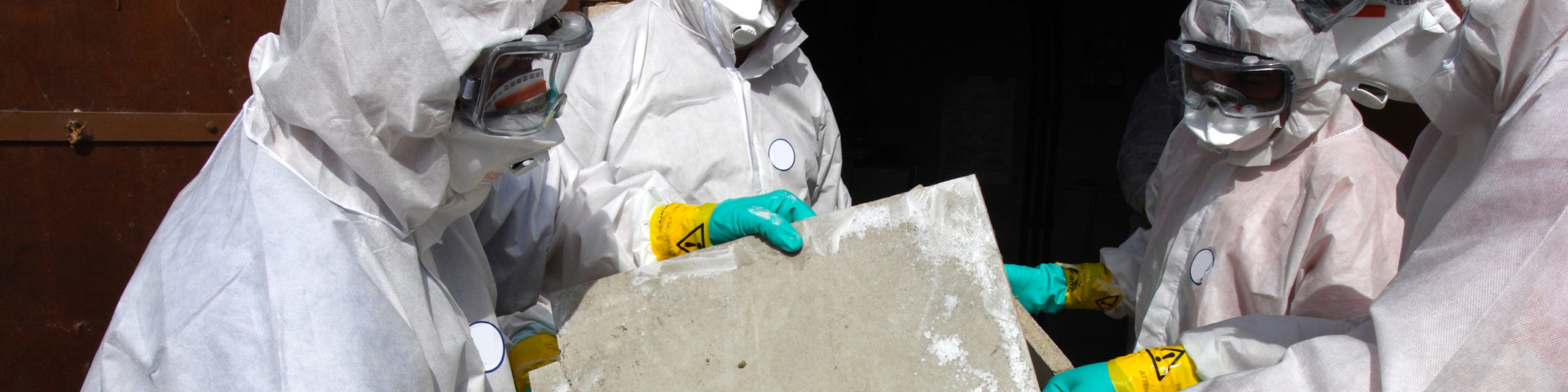
When a homeowner, builder or property manager engages a licensed asbestos removalist in Melbourne, one of the most common — and most reasonable — questions asked is some version of this: if asbestos is so dangerous that I’m not allowed to remove it myself, how on earth does your team do this safely every day?
It is a fair question, and the answer is not “we hold our breath and hope.” The answer is a layered system of legal controls, engineering controls, work-method controls, personal protective equipment, decontamination protocols, training, medical surveillance and documented procedures — every one of them prescribed under the Occupational Health and Safety Regulations 2017 (Vic), the WorkSafe Victoria Compliance Code: Removing Asbestos in Workplaces, and the underlying Occupational Health and Safety Act 2004 (Vic).
In other words, a licensed Class B asbestos removalist working in Greater Melbourne or regional Victoria is operating inside one of the most heavily regulated occupational safety frameworks in the country, and the protections used on site are the cumulative result of more than four decades of medical evidence, coronial findings, WorkSafe inspections and lessons learned the hard way.
This article explains, in practical detail, exactly how asbestos removalists protect themselves on the job — what equipment they wear, what engineering controls they use, what they do before, during and after a removal, and how the system is designed so that the fibres released by the work do not end up in their lungs, on their clothing, or in the surrounding environment.
It is written from the perspective of a WorkSafe Victoria licensed Class B (non-friable) asbestos removalist servicing all of Melbourne and Victoria. Class A (friable) work involves additional controls, which we cover where relevant.
The Core Principle: There Is No Safe Level of Exposure
Before unpacking the equipment list, it is essential to understand the principle that drives every protection decision on an asbestos removal site.
The World Health Organization, the International Agency for Research on Cancer (IARC), Safe Work Australia, the Asbestos and Silica Safety and Eradication Agency (ASSEA) and WorkSafe Victoria all formally adopt the position that there is no safe level of exposure to asbestos. Every form of asbestos — chrysotile (white), amosite (brown) and crocidolite (blue) — is classified as a Group 1 human carcinogen.
The diseases caused by asbestos — mesothelioma, lung cancer, asbestosis, pleural disease — have latency periods of 20 to 50 years. There is no medical test that can detect a problematic exposure on the day it happens, and there is no medical intervention that can undo a fibre once it is lodged in lung tissue. Approximately 4,000 Australians die every year from asbestos-related diseases as at 2026 — more than the national road toll.
This shapes the entire approach to worker protection. We do not aim to keep exposure “below a safe threshold,” because no such threshold exists. We aim to drive exposure as close to zero as is practically achievable, on every job, every time. That is why the protection system is layered — if any single control fails, the next layer behind it is still doing its job.
The Hierarchy of Controls — Why PPE Is the Last Line of Defence
A common misconception is that asbestos worker safety is primarily about the mask. It isn’t. PPE is the final layer of protection in a system that is built around eliminating or controlling the hazard at source.
The Hierarchy of Controls — codified under the OHS Act 2004 (Vic), the OHS Regulations 2017, and Safe Work Australia’s Model Code of Practice: How to Manage and Control Asbestos in the Workplace — ranks risk controls in descending order of effectiveness:
- Elimination — remove the hazard entirely.
- Substitution — replace the hazard with a lower-risk alternative.
- Engineering controls — physical changes to the workplace that isolate workers from the hazard.
- Administrative controls — procedures, training, signage, shift patterns.
- Personal Protective Equipment (PPE) — equipment worn by the worker.
On an asbestos removal job, elimination and substitution are not available — the asbestos is already in the building. So the entire protective system rests on layers 3, 4 and 5 working together. The masks are real, the suits are real, the respirators are real — but they sit behind the wet methods, the H-class vacuums, the polyethylene enclosures, the decontamination units, and the work-method controls. Take any one layer out and the system loses integrity.
This is exactly why DIY asbestos removal in a home garage is so dangerous even when a homeowner wears a P2 mask. The mask is the last line of defence — and on its own, with no engineering controls behind it, it is being asked to do work it was never designed to do.
Layer 1: Engineering Controls — Isolating the Hazard at Source
On a licensed Class B removal site, the first line of defence is the set of physical, engineered measures that keep fibres from becoming airborne — or, if they do, keep them from leaving the work zone.
Wet methods (fibre suppression at source)
Every licensed removalist on a Melbourne or Victorian site removes asbestos using wet methods wherever it is safe to do so (and where electrical or mechanical hazards do not preclude water).
- Materials are sprayed continuously with water and a wetting agent (commonly PVA-based) before and during disturbance.
- The water binds dust to the substrate so that fibres remain locked in the wet matrix instead of becoming airborne.
- Wet methods are non-negotiable on bonded sheeting, fibro, eaves, roofing, vinyl tiles and asbestos cement products.
The single biggest reason wet methods exist is that they are vastly more effective at protecting the worker than a respirator alone. Suppressing the fibre at source means the respirator never has to filter it out of the air.
Hand tools only — never power tools
Under Regulation 280 of the OHS Regulations 2017 (Vic) and the WorkSafe Victoria Compliance Code, power tools must not be used on asbestos-containing materials. That includes:
- Angle grinders.
- Circular saws and reciprocating saws.
- High-pressure water blasters.
- Sanders and grinders of any kind.
- Compressed-air tools.
Power tools generate enormous quantities of respirable fibre in seconds — orders of magnitude more than hand tools. The rule against them is one of the single most protective controls on any asbestos site.
Whole-piece removal
Where the design and condition of the material allows, removalists detach asbestos sheets, panels and tiles whole — unscrewing fasteners, working fixings free, lifting in one piece rather than breaking down. A sheet removed intact releases almost no fibre. A sheet that is broken, levered or snapped releases millions.
Critical-barrier polyethylene sheeting
For removals inside an occupied building or where adjacent surfaces need to be protected, the work zone is isolated with 200-micron critical-barrier polyethylene sheeting, sealed with duct tape, with HVAC penetrations sealed. The barrier prevents fibres from migrating into adjoining rooms, voids and air paths.
H-class hazardous-dust vacuum cleaners
Standard vacuum cleaners — including most commercial trade vacuums — exhaust the finest fibres straight back into the air, because their filtration is not rated for sub-micron particulates. The only vacuum cleaner authorised for asbestos work is an H-class hazardous-dust vacuum with HEPA filtration.
H-class vacuums are used to:
- Clean horizontal and vertical surfaces in the work zone.
- Decontaminate reusable tools and equipment.
- Pick up any visible debris during and after removal.
- Decontaminate PPE before its removal at the decontamination unit.
A general-purpose shop vac on an asbestos site is one of the clearest indicators that the contractor is not operating to licence.
Negative-pressure enclosures (Class A and high-risk Class B)
For higher-risk work — typically Class A friable removal, but occasionally for sensitive Class B work in occupied buildings — a full enclosure with HEPA-filtered negative pressure is constructed. The enclosure is held at negative 5 to 10 pascals relative to the surrounding atmosphere, so that any fibre release inside the enclosure is drawn into HEPA filtration rather than leaking out. A continuous manometer monitors the pressure differential.
For routine non-friable Class B work, full enclosures are not standard — wet methods, whole-piece removal and critical-barrier sheeting provide the required fibre control.
HVAC isolation
Before any disturbance begins, all heating, ventilation and air-conditioning vents in or near the work zone are sealed. HVAC systems are extremely effective at moving fibres around a building, and an open vent next to a removal area can deposit measurable fibre concentrations several floors away within hours.
Layer 2: Administrative Controls — Documented Procedures and Training
The second protective layer is administrative — the procedures, plans and competency requirements that govern how the work is done, by whom, and under what supervision.
The Asbestos Removal Control Plan (ARCP)
Before any licensed removal begins, a site-specific Asbestos Removal Control Plan (ARCP) is prepared. The ARCP documents:
- The type, location, quantity and condition of the asbestos.
- The removal methodology.
- The engineering controls in use.
- The PPE and RPE selected for the job.
- The decontamination procedures.
- The waste handling and disposal pathway.
- The emergency response procedures.
The ARCP is not a generic template with the address swapped in — it is prepared for the specific site, by a competent supervisor, and reviewed before work begins.
The Safe Work Method Statement (SWMS)
A Safe Work Method Statement (SWMS) sits alongside the ARCP and covers each task in the removal — how it will be done, what hazards are associated, what controls are in place, who is responsible. SWMS are mandatory under the OHS Regulations 2017 for any high-risk construction work, and asbestos removal qualifies.
Training and competency
Every removalist on a licensed Class B job in Victoria must hold the nationally recognised unit of competency CPCCDE3014 — Remove non-friable asbestos. This is a Vocational Education and Training (VET) qualification delivered by Registered Training Organisations and includes:
- Identification of asbestos-containing materials.
- Risk assessment and control hierarchy.
- Safe work procedures for non-friable removal.
- PPE selection, fit and use.
- Decontamination procedures.
- Waste handling and disposal.
- Emergency response.
The site supervisor must additionally hold CPCCBC4051A — Supervise asbestos removal (or equivalent earlier code).
Class A removalists hold both CPCCDE3014 and CPCCDE3015 — Remove friable asbestos, with additional supervisory and OHS management requirements.
Medical fit-for-work certificates
Every removalist on a Victorian Class B or Class A job must hold a current medical fit-for-work certificate, renewed every two years. The medical assessment confirms the worker has adequate respiratory function and is fit to wear respiratory protection — a worker with compromised lung capacity cannot safely use a P3 respirator for an eight-hour shift.
Respirator fit testing
Respirators only work if they form a proper face seal. Every Class B removalist undergoes respirator fit testing to AS/NZS 1715:2009 before being issued with a respirator for use on site, and re-tested at defined intervals. Beards, stubble, facial scarring or jewellery that breaks the seal disqualify the worker from wearing a tight-fitting respirator until the issue is resolved.
Supervision and signage
The site is signed at every entry point: “CAUTION ASBESTOS REMOVAL IN PROGRESS — UNAUTHORISED PERSONS PROHIBITED.” Access is restricted to trained, fit-tested, properly equipped personnel only. The nominated supervisor controls entry and egress, monitors compliance with the ARCP, and is the documented point of accountability for the safety of every worker on the site.
WorkSafe Victoria notification
For all licensed removal work, the licensed contractor lodges a written notification with WorkSafe Victoria at least five days before removal begins. The notification includes the site address, ACM type and quantity, control measures, and supervisor details. WorkSafe inspectors may attend any notified site at any time during the works — and they do, regularly.
Layer 3: Personal Protective Equipment (PPE) — The Last Line of Defence
With the engineering and administrative controls established, the worker is then equipped with PPE. The PPE is selected based on the risk profile of the specific job — non-friable bonded sheeting in good condition requires less aggressive RPE than damaged or weathered material; friable lagging in a plant room requires the highest level available.
Respiratory Protective Equipment (RPE)
This is the equipment most people picture when they think of asbestos worker safety, and it is where the protection levels step up most clearly.
P2 respirators
A P2 respirator is the minimum acceptable level of respiratory protection for low-risk, short-duration non-friable removal — for example, removing a small intact panel of bonded sheeting in good condition with full wet methods. A P2 is disposable, forms a seal around the nose and mouth, and is rated for the filtration of fine particulates. A paper dust mask is not a P2 and is not acceptable for any asbestos work.
P3 respirators (half-face)
A P3 half-face respirator is the standard for most Class B non-friable work in Melbourne. P3 is the highest filtration class for particulate respirators, with replaceable cartridges and a more robust face seal than a P2. P3 half-face respirators are typically used for routine bonded sheeting removal — fibro, roofing, eaves, fences.
P3 full-face respirators
A P3 full-face respirator adds eye protection to the respiratory protection. It is the standard for higher-risk non-friable work — for example, removing larger volumes of sheeting, weathered material, working overhead, or work in confined spaces where dust may concentrate.
Powered Air-Purifying Respirators (PAPRs)
A PAPR uses a battery-powered fan to draw air through a HEPA filter and deliver clean air under positive pressure to the worker’s hood or facepiece. PAPRs:
- Reduce breathing resistance for long shifts.
- Provide positive pressure that resists inward leakage even if the seal is briefly compromised.
- Are commonly used for Class A friable removal and for higher-end Class B work in hot conditions or confined spaces.
Air-fed (supplied-air) respirators
For the highest-risk work — Class A friable removal inside a sealed enclosure — workers may use air-fed respirators, which deliver breathing air from a clean compressor located outside the contaminated zone via an umbilical line. This is the highest level of respiratory protection routinely used in the industry.
Disposable coveralls (Type 5/6)
Removalists wear disposable coveralls that are rated Type 5/6 to AS/NZS 1716 — Type 5 protects against airborne solid particulates, Type 6 against limited liquid splash. Key features:
- Hooded, covering the head from the back of the neck up.
- Taped seams to prevent fibre penetration through stitching.
- Elasticated wrists and ankles, taped over for full closure with the gloves and boots.
- No internal pockets, so fibres cannot accumulate against skin.
- Single-use — disposed of as asbestos waste at the end of the shift, never laundered.
Some workers wear a layered system — a base layer of clothing they leave at site, with a coverall over the top — but the coverall itself is always disposable.
Disposable gloves and boot covers
- Gloves are disposable nitrile or similar, long-cuffed, taped to the coverall sleeve.
- Boots are typically dedicated rubber boots that remain on site and are wet-wiped and HEPA-vacuumed before exit, or disposable boot covers that go in the asbestos waste at the end of the shift.
Eye protection
For half-face respirator users, safety glasses or sealed goggles are worn. Full-face respirators incorporate their own integrated eye protection.
Headwear and high-visibility clothing
A hard hat, high-visibility coverall (where required by the principal contractor) and any specialist gear (working-at-height harnesses, hearing protection for adjacent works) are worn over or alongside the asbestos PPE — the asbestos PPE is the inner protective layer.
Layer 4: Decontamination — Getting Off Site Without Taking Fibres With You
PPE is only protective if it is removed in a way that does not contaminate the worker, their clothing, their vehicle, their home or their family. The decontamination protocols are the bridge between “in the contaminated zone” and “safe to leave.”
The decontamination unit
For routine Class B non-friable removal, a purpose-set decontamination zone is established at the edge of the work area:
- Drop sheets isolate a clean area.
- An H-class vacuum, water and wet wipes are positioned at the boundary.
- Asbestos waste bags are pre-positioned.
- Clean replacement clothing is staged outside the zone.
For Class A friable removal, a three-stage decontamination unit (DCU) is constructed at the enclosure entry:
- Dirty room — workers remove their outer coveralls, boot covers, gloves and respirator filters, double-bagging them as asbestos waste.
- Shower room — workers shower fully, including hair, with the respirator still on. The respirator is removed and washed last.
- Clean room — workers dry off, dress in clean clothing, and exit the enclosure.
Water from the DCU is captured, filtered through HEPA-equivalent water filtration, and the filters disposed of as asbestos waste.
The decontamination sequence (non-friable Class B)
The standard sequence for exiting a Class B work zone is:
- HEPA-vacuum the coverall while still wearing it — head to toe, including the hood, sleeves, legs and boots.
- Wet-wipe any visible debris from the coverall and boots.
- Carefully roll down the coverall from the inside, so the contaminated outer surface is rolled inward and away from the body.
- Step out of the coverall onto the clean side of the boundary.
- Remove gloves last, bagging them inside the rolled coverall.
- Bag the coverall, gloves and boot covers as asbestos waste — double-wrapped in 200-micron polyethylene, sealed, labelled “CAUTION ASBESTOS.”
- Wet-wipe exposed skin (face, hands, forearms, neck) with disposable wipes, bagged as asbestos waste.
- Remove the respirator last — and only on the clean side of the boundary.
- Wash hands and face thoroughly with water before leaving the site.
A worker who has been in a contaminated zone never walks back into a clean office, vehicle or home in their work clothing. The clothing is on the site, in the decontamination zone — and either staying there for laundering off-site by an approved process, or being bagged as waste.
Vehicle and tool decontamination
- Reusable tools are wet-wiped and H-class HEPA-vacuumed before leaving the site.
- Equipment — scaffolding, ladders, ropes — is wet-wiped at the boundary.
- Vehicles that carry asbestos waste are lined before loading, and the lining is disposed of as asbestos waste at the destination.
- The vehicle interior is wet-wiped between jobs.
This is one of the under-discussed reasons it pays to use a properly equipped removalist: a contractor who treats the back of his ute as both a tool truck and an asbestos transport is contaminating every job he attends.
Layer 5: Health Surveillance and Ongoing Medical Monitoring
The protective system extends beyond the work site and into long-term worker health monitoring.
Initial and periodic health assessment
Class B and Class A asbestos removalists in Victoria undergo:
- An initial health assessment before being authorised to perform asbestos work, including respiratory function testing and a baseline chest examination.
- Periodic health surveillance at intervals defined by their occupational physician — typically every two years for routine workers, more frequent for higher-exposure roles.
- Exit health assessment when leaving the industry, providing a documented baseline against which any future disease can be referenced.
Exposure record-keeping
Under the OHS Regulations 2017 (Vic), employers must keep records of each worker’s asbestos exposure history — the sites worked, the materials handled, the controls in use, the duration of exposure. These records are retained for at least 40 years after the worker leaves the industry, recognising the long latency of asbestos disease.
Why this matters to the client
The medical surveillance and record-keeping regime is not just an internal industry matter — it is a meaningful indicator of contractor seriousness. A removalist who is documenting his team’s exposure history correctly is a removalist who is taking the fibre control seriously on site. The two go together.
What This Looks Like on a Typical Melbourne Class B Job
To make the protection system concrete, here is how it plays out on a routine Class B non-friable removal in Melbourne — say, the removal of an asbestos cement fence and a small garage roof in a 1970s home in the eastern suburbs.
| Phase | Worker Protection in Action |
|---|---|
| Site set-up | Hi-vis worn over standard work clothing. Signage installed. Drop sheets laid. Decontamination boundary marked. H-class vacuum, water sprayer and waste bags positioned. |
| PPE-up | Workers change into disposable Type 5/6 coveralls, taped at wrists and ankles. Boot covers fitted. P3 half-face respirators fit-checked. Gloves taped to coverall sleeves. |
| Wet-down | Materials misted continuously with water + PVA wetting agent throughout the removal. |
| Removal | Hand tools only. Sheets removed whole, lowered carefully, never broken. Each sheet immediately double-wrapped in 200-micron polyethylene, sealed, labelled. |
| Continuous monitoring | Supervisor present at all times. Workers do not eat, drink or smoke on site. Respirators stay on inside the work zone. |
| Decontamination | Coveralls H-class vacuumed while worn. Wet-wiped. Rolled down from inside-out. Bagged as waste. Respirator removed last, outside the boundary. |
| Tool clean-down | Tools wet-wiped, HEPA-vacuumed, stored for re-use. Vehicle lining inspected and replaced if needed. |
| Waste loaded | Double-wrapped, labelled bags loaded into the lined transport vehicle. Manifest prepared in EPA Waste Tracker. |
| Clearance | Independent competent person under Regulation 297 attends, performs visual clearance, issues clearance certificate. |
| Documentation | Owner receives the full documentation pack: licence, ARCP, SWMS, WorkSafe notification, EPA manifest, disposal receipt, clearance certificate. |
This is what a job looks like done correctly. None of it is dramatic; all of it is methodical.
How Class B Worker Protection Differs from Class A
For non-friable Class B work — which represents the great majority of residential and light commercial removal in Melbourne — the protection system described above is appropriate and adequate. Wet methods, whole-piece removal, P2/P3 respirators, Type 5/6 coveralls, H-class vacuums and a structured decontamination boundary are the controls relied on every day, every job.
For Class A friable removal, the controls step up significantly:
- Full sealed enclosures with critical-barrier polythene.
- HEPA-filtered negative pressure at -5 to -10 pascals continuously monitored.
- Three-stage decontamination units with showers.
- Air-fed respirators or PAPRs with positive pressure.
- Continuous air monitoring before, during and after the works, with NATA-accredited sample analysis.
- Smoke testing / enclosure integrity checks before any disturbance begins.
- Mandatory full-time on-site supervision by a Class A licensed supervisor.
- Clearance air monitoring as part of the Regulation 297 clearance, not just visual.
The reason the two licence classes exist is precisely because the protective system has to be calibrated to the risk. A Class B contractor relying on Class B controls to perform Class A work is operating outside the protective envelope his system was designed for — which is why the legal separation between the two is absolute and not negotiable.
What This Means for You as a Melbourne Property Owner, Builder or Project Manager
The worker protection system on a licensed asbestos removal site is also, by design, the client protection system. Every control that keeps the removalist’s lungs clean is also the control that keeps fibres out of your house, your office, your tenancy, your demolition site, your neighbour’s backyard, your future buyer’s roof cavity. The two cannot be separated.
When you are evaluating asbestos removalists in Melbourne or Victoria, the questions to ask are not just “what does it cost?” and “when can you start?” They are:
- “Can I see your current WorkSafe Victoria Class B (or Class A) licence?”
- “Can I see your Certificate of Currency for public liability and asbestos-specific insurance?”
- “Can I see your ARCP and SWMS for this job?”
- “What PPE and RPE will your team be using, and have they been fit-tested?”
- “Do you have CPCCDE3014 records for your removalists and CPCCBC4051A for your supervisor?”
- “Are your team holding current medical fit-for-work certificates?”
- “What H-class vacuum and decontamination set-up will be on site?”
- “Will the work be notified to WorkSafe Victoria at least five days in advance?”
- “Who is the independent clearance assessor under Regulation 297?”
- “How is the waste being tracked through EPA Victoria’s Waste Tracker and disposed of?”
A licensed removalist will have all of these answers ready, in writing, before you sign anything. A contractor who hedges on any of them is a contractor whose worker protection system is incomplete — and a worker protection system that is incomplete is a client protection system that is also incomplete.
How Asbestos Gone and Clean Protects Its Team on Every Melbourne and Victorian Job
We are a WorkSafe Victoria licensed Class B (non-friable) asbestos removalist and demolition contractor based in Melbourne, servicing all of Greater Melbourne and regional Victoria — from the inner suburbs out to Geelong, Ballarat, Bendigo, the Mornington Peninsula, the Yarra Valley, the Latrobe Valley and beyond.
Every job we run is built on the protection system set out in this article. In practical terms, that means:
- Wet methods on every removal — water and PVA-based wetting agents suppress fibre at source on every job, every time.
- Hand tools only — no power tools, no high-pressure water, no shortcuts.
- Whole-piece removal wherever practical, with immediate double-wrap in 200-micron polyethylene.
- H-class hazardous-dust vacuum cleaners with HEPA filtration on every site.
- P2, P3 half-face, P3 full-face and PAPR respiratory protection matched to the job, with all operators fit-tested to AS/NZS 1715:2009.
- Type 5/6 disposable coveralls taped at wrists and ankles, single-use, bagged as waste at shift end.
- Documented decontamination procedures at every site boundary, with H-class vacuum and wet-wipe protocols.
- CPCCDE3014-qualified removalists and CPCCBC4051A-qualified supervisors on every job.
- Current medical fit-for-work certificates for every worker, renewed two-yearly.
- Site-specific ARCP and SWMS prepared and reviewed before every job.
- Five-day WorkSafe Victoria notification lodged in advance.
- EPA Waste Tracker manifests and disposal at EPA-licensed asbestos landfills — never transfer stations, never private land.
- Independent Regulation 297 clearance certificates on every job.
- Full documentation pack delivered to every client — licences, insurances, ARCP, SWMS, WorkSafe notification, EPA manifest, disposal receipt, clearance certificate.
If you have a non-friable asbestos removal or asbestos-affected demolition job anywhere in Melbourne or Victoria — a fence, a garage, a roof, eaves, fibro sheeting, vinyl tiles, a switchboard, or a whole-of-house pre-demolition strip — we can scope, quote, notify, remove, dispose and certify the job from start to finish, with documented compliance and a team that goes home safely every night.
Contact us today for a fixed-price written quote, prepared with the same standard of worker and client protection described above.
Frequently Asked Questions: How Asbestos Removalists Protect Themselves
What PPE do asbestos removalists wear in Melbourne?
Licensed Class B asbestos removalists in Melbourne wear, at minimum: a P2 or P3 respirator (with P3 being standard for most jobs), Type 5/6 disposable coveralls with hood and taped seams, disposable gloves taped to the coverall sleeves, dedicated boots or disposable boot covers, and safety glasses or sealed goggles (or a full-face respirator with integrated eye protection). For higher-risk work, a PAPR or air-fed respirator may be used. PPE is the last line of defence — engineering and administrative controls do most of the protective work.
What is the difference between a P2 and a P3 respirator for asbestos work?
A P2 respirator is the minimum acceptable level for low-risk, short-duration non-friable removal. A P3 respirator offers significantly higher filtration efficiency and a more robust face seal, and is the standard for most Class B non-friable work in Melbourne. P3 is available as half-face (with separate eye protection) or full-face (with integrated eye protection). Paper dust masks are not equivalent to either and are not acceptable for any asbestos work.
Do asbestos removalists need a special vacuum cleaner?
Yes. Only an H-class hazardous-dust vacuum cleaner with HEPA filtration is permitted on an asbestos site. A standard household, shop or trade vacuum will exhaust the finest fibres straight back into the air. An H-class vacuum is rated to filter sub-micron particulates and is used to clean surfaces, decontaminate tools, and decontaminate PPE.
Why aren’t power tools allowed on asbestos?
Power tools — angle grinders, circular saws, sanders, high-pressure water blasters — release enormous quantities of respirable asbestos fibre in seconds, often orders of magnitude more than hand tools. Under the OHS Regulations 2017 (Vic) and the WorkSafe Victoria Compliance Code, power tools are prohibited on asbestos-containing materials. The rule is one of the single most protective controls on any asbestos site.
What training does an asbestos removalist need in Australia?
In Victoria, every Class B removalist must hold the nationally recognised unit CPCCDE3014 — Remove non-friable asbestos. The site supervisor must hold CPCCBC4051A — Supervise asbestos removal. Class A removalists must hold CPCCDE3015 — Remove friable asbestos in addition to CPCCDE3014. Workers must also be respirator fit-tested to AS/NZS 1715:2009 and hold current medical fit-for-work certificates renewed every two years.
How do asbestos removalists decontaminate themselves at the end of a shift?
The standard sequence is: H-class vacuum the coverall while still wearing it; wet-wipe any visible debris; roll the coverall down from inside-out; step out onto the clean side of the boundary; remove gloves last and bag them in the coverall; double-wrap and bag all PPE as asbestos waste; wet-wipe exposed skin; remove the respirator last, only on the clean side. For friable Class A work, a three-stage decontamination unit with a full shower is required.
Can a beard interfere with asbestos respiratory protection?
Yes — and significantly. Tight-fitting respirators (P2, P3 half-face, P3 full-face) require a continuous skin-to-mask seal. Beards, stubble, sideburns crossing the seal line, facial scarring, or jewellery breaking the seal will defeat the protection. Workers cannot wear a tight-fitting respirator on an asbestos site if they have facial hair in the seal zone. PAPRs with loose-fitting hoods are sometimes used as an alternative where facial hair cannot be removed.
How often are asbestos removalists health-checked?
In Victoria, asbestos removalists undergo an initial health assessment before authorisation to perform asbestos work, periodic health surveillance typically every two years, and an exit health assessment when leaving the industry. Exposure records are retained for at least 40 years after the worker leaves the industry, recognising the long latency of asbestos disease.
Are PPE and engineering controls enough to make asbestos removal completely safe?
The honest answer is that no occupational health system can guarantee zero risk on any task that involves a Group 1 carcinogen with no safe exposure threshold. What the layered protection system does is drive exposure as close to zero as is practically achievable on every job, through engineering controls, administrative controls and PPE working together. Approximately 4,000 Australians die every year from asbestos-related disease — almost all of them from exposures decades ago, before the modern protection system was in place. The current system exists precisely so that today’s removalists are not the mesothelioma cohort of 2050.
What should I look for when comparing asbestos removalist quotes in Melbourne?
Beyond the price, check that the quote includes: WorkSafe Victoria Class B (or Class A) licence number and Certificate of Currency; public liability insurance with asbestos endorsement; a site-specific ARCP and SWMS; the PPE and RPE specification for the job; CPCCDE3014 and CPCCBC4051A records; five-day WorkSafe Victoria notification; EPA Waste Tracker manifest; disposal at an EPA-licensed landfill; and an independent Regulation 297 clearance certificate. A cheaper quote that omits any of these is not actually cheaper — it has just shifted the cost (and the liability) onto the client.
Does Asbestos Gone and Clean service all of Melbourne and Victoria?
Yes. We service all of Greater Melbourne — the CBD, inner suburbs, eastern, western, northern and southern suburbs — and all of regional Victoria, including Geelong, Ballarat, Bendigo, the Mornington Peninsula, the Yarra Valley, the Latrobe Valley, Gippsland and beyond. Whether you have a single fence panel in a Brunswick terrace or a full pre-demolition strip on a Dandenong commercial site, our team operates the same layered protection system on every job.
Final Word — Worker Protection Is Client Protection
If there is one principle worth taking away from this article, it is that the worker protection system on a licensed Class B asbestos removal site is the same system that protects the client, the neighbours, the future occupants of the property, and the wider Melbourne and Victorian community.
When a removalist cuts corners on his own PPE, his decontamination, his wet methods or his H-class vacuum, he is not only risking his own lungs — he is risking yours, and your children’s, and the lungs of every future buyer and tradesperson who walks into your property after he leaves.
That is why the system is layered. That is why it is documented. That is why it is regulated to the level it is. And that is why, when you engage a licensed Class B asbestos removalist in Melbourne or Victoria, the question “how do you protect yourselves on the job?” is the right question to ask — because the answer reveals everything you need to know about whether the contractor is also protecting you.
Need a licensed Class B non-friable asbestos removalist in Melbourne or Victoria?
Contact Asbestos Gone and Clean for a fixed-price written quote, a site-specific ARCP, full WorkSafe Victoria compliance, EPA-tracked disposal and an independent Regulation 297 clearance certificate on every job. Servicing all of Greater Melbourne and regional Victoria.
☎ Call us: 0475 143 106
✉ Email: asbestosgoneandclean@gmail.com
???? Contact Us: Asbestos Gone and Clean – Contact